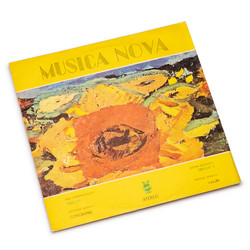
Aurel Stroe
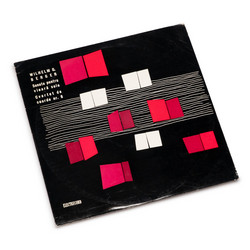
Concert Pentru Clarinet Și Orchestră / Canto II Pentru 12 Formatii Instrumentale / Muzică De Concert Pentru Pian, Alămuri Și Percuție (LP)
condition (record/cover): NM / VG+ (sticker removal residue and light stamp on back)
Aurel Stroe (1932-2008) is one of the figures who defines the specific character of Romanian new music in the period between the cultural opening of the mid-1960s and the tightening of the Ceaușescu years. He studied at the Bucharest Conservatory, attended the Darmstadt Summer Courses between 1966 and 1969 where he worked with György Ligeti, Karlheinz Stockhausen, and Mauricio Kagel, and returned to teach at the Conservatory until 1985 - teaching, among others, Horațiu Rădulescu, who would go on to develop spectral technique in Paris in directions that owe something to Stroe's early thinking about sound and structure. Stroe himself later developed what he called "morphogenetic music," a compositional system integrating mathematical theories of catastrophe, chaos, and thermodynamics - but the works on this LP predate that system and belong to a more direct, if still rigorous, engagement with the European post-war avant-garde.
The centerpiece is the Concert pentru clarinet și orchestră (Clarinet Concerto, 1974-75), dedicated to clarinetist Aurelian-Octav Popa, who performs it here. It is among Stroe's most sustained and concentrated works: the soloist in a position not of lyric display but of structural argument with the orchestra, the language pushing toward the timbral complexity of his Darmstadt formation without abandoning dramatic shape. Canto II (1968) for twelve instrumental groups shows the spatial imagination that would later become central to his aesthetic; Muzică de concert (1964) for piano, brass, and percussion is an earlier but no less rigorous statement. Three works, three moments in a trajectory that led eventually to Germany, where Stroe settled in 1986 and taught until his death. Original Electrecord pressing.