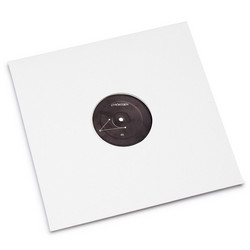
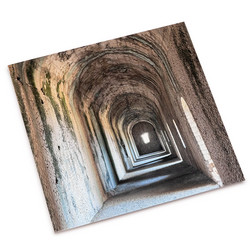
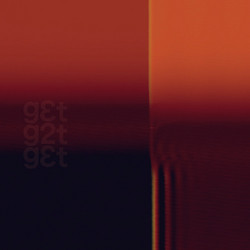
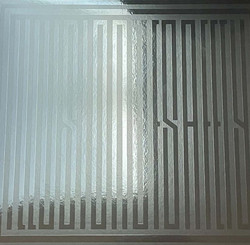
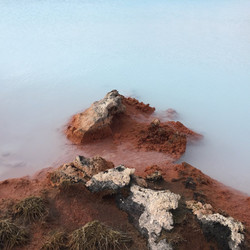
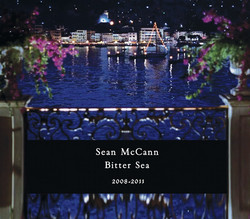
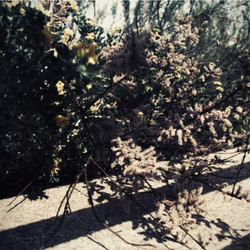
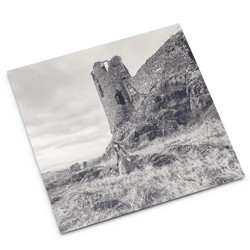
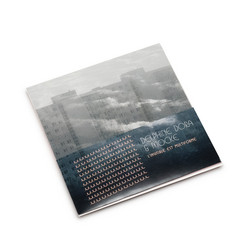
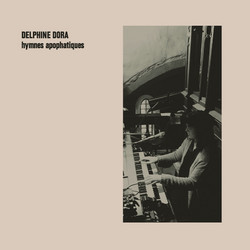
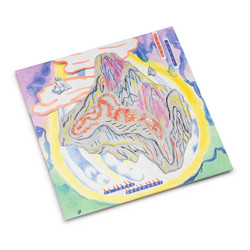
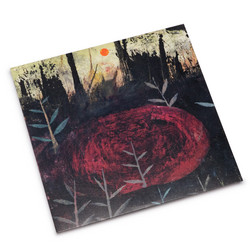
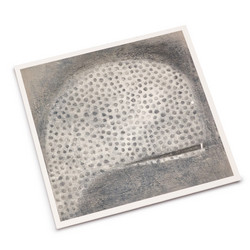
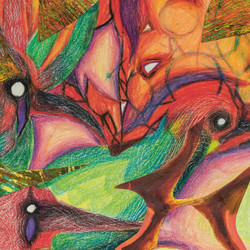
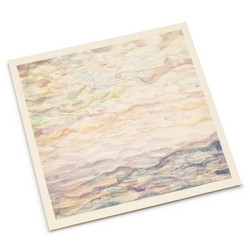
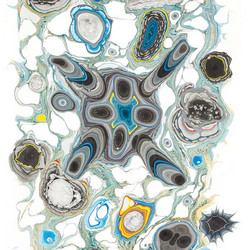
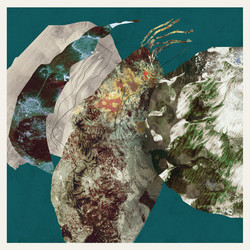
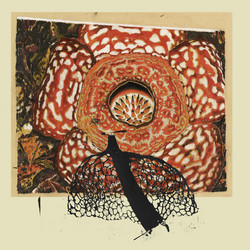
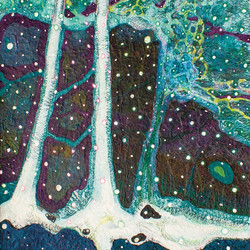
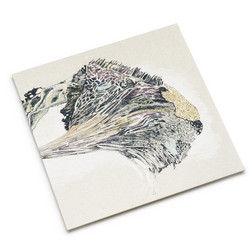
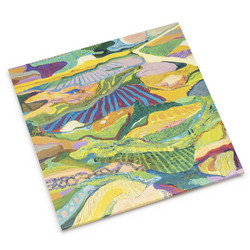
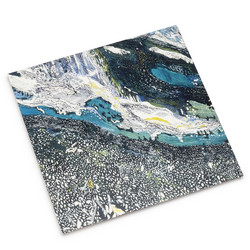
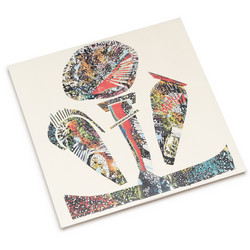
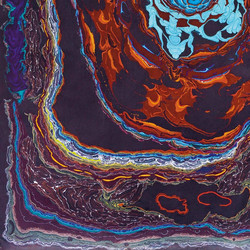
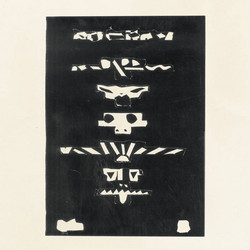
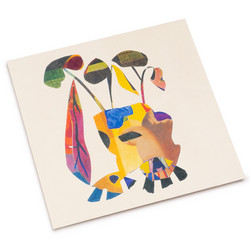
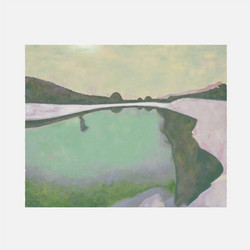
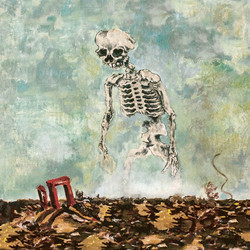
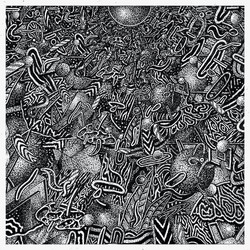
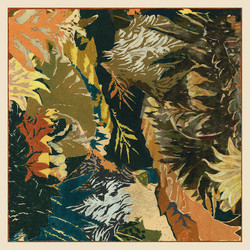
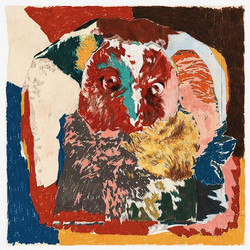
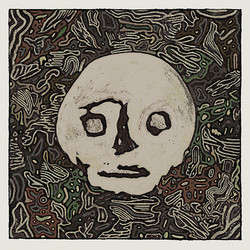
It's surprising that, until now, we haven't had the opportunity to take a deep dive into the wonderful world of Delphine Dora. For more than two decades, the French composer, vocalist. improviser, and multi-instrumentalist has carved out a singular proximity within the musical landscape, consistently dissolving the boundaries between notions of poetic, song, and experimental composition — not to mention numerous discreet idioms of each — through a prolific body of work issued by noteworthy labels like Early Music, An'archives, Modern Love, Recital, Morc, Feeding Tube, and Three:four, among numerous others, including her own widely celebrated Wild Silence imprint. Now, Dora joins the Marionette family — a label that regularly captured our attention with killer releases by a consolation of artists, including Roxane Métayer, Andrea Belfi & Jules Reidy, Soundwalk Collective, Pierre Bastien, Francesco Cavaliere & Tomoko Sauvage, and Razen (with Will Guthrie) — for her latest outing 'L'ineluctable pulsation du temps'. Comprising a suite of ten keyboard led, largely instrumental pieces, it's an absolutely captivating body of work, plumbing new dimensions of Dora's endlessly ambitious, shape-shifting explorations as one of the most unique artists working in Europe today. Issued by Marionette in a lovingly produced, vinyl edition, housed in reverse-board sleeve with artwork by Jon Joanis — the beauty of which is only matched by the sounds within — it's arrived just in time to balm our spirits and souls against these endlessly strange times.
First emerging onto the French scene during the early 2000s, for the entirety of her career Delphine Dora has remained an artist who is impossible to fully pin down, cultivating a body of work that spans avant-folk, poetry, minimalism, free improvisation, and electroacoustic music, while flirting at the boundaries of many more and resting easily in none. In many ways, as an artist, musician, and composer, she belongs to a legacy that includes visionaries and peers like Arthur Russell, Laurie Anderson, Meredith Monk, Richard Youngs, Annelies Monseré, Roxane Métayer, and Lise Barkas, all of whom similarly blur the boundaries between experimental music and numerous creative traditions through reimagining of notions song. In addition to her extensive body of solo work, Dora has formed collaborative relationships with artists like Sophie Cooper, Marina Gusina, Andrew Chalk, Josephine Foster, Keiji Haino and Valentina Magaletti, among numerous others, "Dora often becomes the voice of a place, at once embodied and ghostly, intimate and experimental. Her ecstatic litanies explore the subconscious of folk in forms of bliss both abstract and real, timeless ceremonies woven from voice and piano, bird chirps and rural sounds, electronic intuitions and barely perceptible drones."
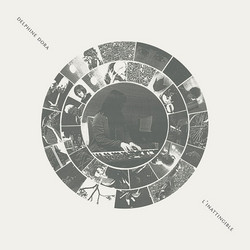
Dora's latest full-length and first with Marionette, 'L'ineluctable pulsation du temps', emerges as one of her most stunning to date to embody this highly refined means of reflecting the relationship between a sense of time and the self. Composed in 2018, in parallel with 'L'Inattingible' (issued jointly by Meakusma and Three:four in 2020), an album regarded by many as Dora's most ambitious, this newly revealed companion stands in sharp contrast to the aforementioned's vocal led pieces, comprising ten almost entirely instrumental efforts. 'L’Inattingible' was a collection of songs that was both deeply intimate and personal, entirely in French, while remaining open to external arrangements and to the participation of musicians from around the world (Lau Nau, Sylvia Hallett, Aby Vulliamy, Le Fruit Vert…). 'L’Inéluctable', equally rich, is on the other hand entirely instrumental: a record made in solitude, yet open to the outside world, its contemporary rhythms, alienation, and acceleration, drawing inspiration from an essay of Hartmut Rosa.
Noted for the ease with which she traverses the keyboard — from piano to synthesizers and pipe organs —'L'ineluctable pulsation du temps' finds Dora sculpting and navigating a sonic and instrumental territory where she arguably best shines. Stemming from a period during which she was immersed in the exploration of the the Nord Electro synthesizer — renowned for its ability to create rich polyphonies — the album's ten pieces range from paired down solo piano works, to compositions comprising elaborate layerings of numerous keyboard sounds, harnessing the specific qualities of their timbres, tonalities, and texture. Like nearly everything Dora does, 'L'ineluctable pulsation du temps' defies easy categorization. At times its rippling tones dance with the poetic impressionism of Satie, Ravel, and Debussy, while its repetitive phrasing of melodies, arpeggios, and long-tones nod toward Minimalism, and the complex combinations within its sound palette reveal a deep relationship with the richest territories of experimental electroacoustic music, early music, and folk. Being entirely a thing unto its own, perhaps the easiest ways to describe 'L'ineluctable pulsation du temps' is by stepping away from explicitly musical terms. It is profoundly beautiful, poetic, and ambitious: the realization of a transcendental form of experimental music that draws countless histories into its radically forward-thinking forms.
Encountering Dora at her most colorful, dynamic, and rhythmical, not to mention most compositionally brilliant and direct, 'L'ineluctable pulsation du temps' may just be our favorite release by Delphine Dora to date (and we've love it all, along the way). It's one of those rare records that captivates you from the first needle drop, pull you in further, and reveals new dimensions with every return. We know it's early in the year, but this one is down to be one of 2026's best. Issued by Marionette in a lovingly produced, vinyl edition, housed in reverse-board sleeve with artwork by Jon Joanis, once the word gets out it's going to fly so don't sleep. 'L'ineluctable pulsation du temps' is potent reminder of the power of music and crucial place it can occupy in our lives.