Força Maior is the meeting point between two complementary obsessions. On one side, Pedro Alves Sousa (aka Má Estrela), a saxophonist who treats his horn as raw voltage, feeding it through pedalboards and amplifiers until it becomes vapor, grain and halo rather than mere notes. On the other, Pedro Tavares (aka Funcionário), an artist who folds sound and video into reflective environments where memory and imagination braid together. Under the shared name Força Maior, they build music that feels like a slow‑motion collision of these sensibilities: tactile breath and reed work, infinitely subdivided and re‑cast as texture, set inside electronic spaces that invite drifting, but never quite let you forget the body at their core.
Morte Lilás was born in a place that already vibrates with history. Over a week in June 2023, the two Pedros set up camp at Alves Sousa’s family farm in Ferreirim, near Lamego: a partly abandoned, 400‑year‑old granite property once owned by one of the “40 conspirators” who helped secure Portugal’s independence from Spain in the 17th century. The farm became everything at once – residency, studio, instrument and ghost. Each day was a recording day: Sousa with sax and electronics, Tavares with sampler and processing. Apart from a few sine‑tone punctuations and the incidental presence of the environment (most clearly the birds on “Quinta à Tarde”), every sound begins in the saxophone before being bent, filtered, stretched and layered by both musicians. The result is a saxophonic tapestry that breathes with quiet intensity, an ambient music whose softness is underpinned by a fierce, sustained attention.
The opening piece, “Quinta à Tarde” – its title a playful nod to Eno’s Thursday Afternoon – acts as an unhurried portal into this world. Sousa’s breathy entrance arrives like a foghorn heard from a distance, cushioned by a delicately shifting electronic backdrop. Nothing hurries; time dilates. Instead of peaks and drops, there is slow evolution: pensive layers drifting in and out of focus, small emphasis changes that gradually tilt the listener’s sense of balance. As the piece unfolds, the centre of gravity moves almost imperceptibly from sax to processing, a long‑form fade in which Tavares’ texture work quietly takes over the frame without erasing its source.
“Cubos” keeps the haze but lets a pulse emerge. Rhythmic clicks and microscopic pings sketch a swung grid, a kind of skeletal beat that the sax can weave through with short melodic phrases. Those lines are immediately caught, fed back and bent, cascading through delays that blur cause and effect. It’s Força Maior in distilled form: acoustic gesture and electronic echo dovetailing so tightly that they become a single, flickering pattern. Where “Quinta à Tarde” stretches time, “Cubos” gently toys with it, nudging the music toward motion without sacrificing its gauzy edge.
The title track, “Morte Lilás”, is the set’s sprawling centre of gravity. Here the duo lean into reverberation and continuity, letting sustained tones and long decays dissolve the distinction between foreground and background. The piece hovers somewhere between hypnotic trance and articulate reverie: enough detail to keep the ear engaged, enough sameness of texture to induce a kind of waking dream. At a certain point, the flow pulls back – not as a jolt, but like a tide receding to reveal the shape of the seabed. In that partial stillness, you become aware of the underlying structures the reverb had been smearing: subtle cycles, harmonic pivots, the way a particular timbre reappears in altered form. When the music returns to the album’s more relaxed architecture – understated pulses, softened edges, generous space – it feels less like a new section and more like an exhale after a long held breath.
“Menta” works as a miniature, a short‑form sketch of Força Maior’s contours. Here the focus is on “loops of air pressure gradients” – tiny shifts in attack and dynamics that carry unexpected emotional weight. There’s a sense of fragility: motifs that might disintegrate if repeated once too often, lines that seem to arrive already half‑remembered. It’s the closest the record comes to song form, but the song is ghosted, more implied than declared.
Closing piece “Cascata do Inferno” suggests violence in name while whispering in sound. Instead of a torrent, you get an atmospheric cascade, built from breaths, gentle multiphonics and shimmering electronic chords that arrive in slow, deliberate waves. Short melodic cycles unfurl and overlap, like eddies in a river; processing adds a subtle shine, enough to make the tones feel slightly unreal without severing them from their physical origin. It’s a track that rewards patience: the longer you stay with it, the more you hear in the supposed calm – micro‑tensions in pitch, faint distortions, the way the stereo field slowly tilts. By the time it fades, the listener has been led downstream, eyes closed, into a serene turbulence that feels both carefully shaped and fundamentally unpredictable.
Throughout Morte Lilás, Força Maior move with calm precision. There’s no grandstanding, no sudden stylistic left turns, just an ongoing commitment to see how far a single instrument, a particular space and two sets of ears can be pushed toward each other. The farm in Ferreirim, with its centuries of human history and current semi‑abandonment, hangs over the record as an invisible third collaborator: a reminder that every breath of sound is also air that has carried other voices, other conspiracies, other silences.
Recorded & edited by Pedro Alves Sousa & Pedro Tavares
Mixed by Pedro Alves Sousa
Mastered by Lendl Barcelos
Cut by Frédéric Alstadt
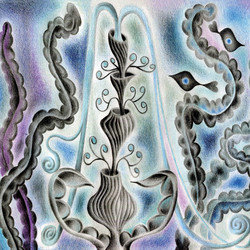
Images by Nuno Vieira