“In Curtis’ deft hands, the piece emerges as a meditation on tension, each of the two renderings bringing out decidedly different aspects of its potentialities.”
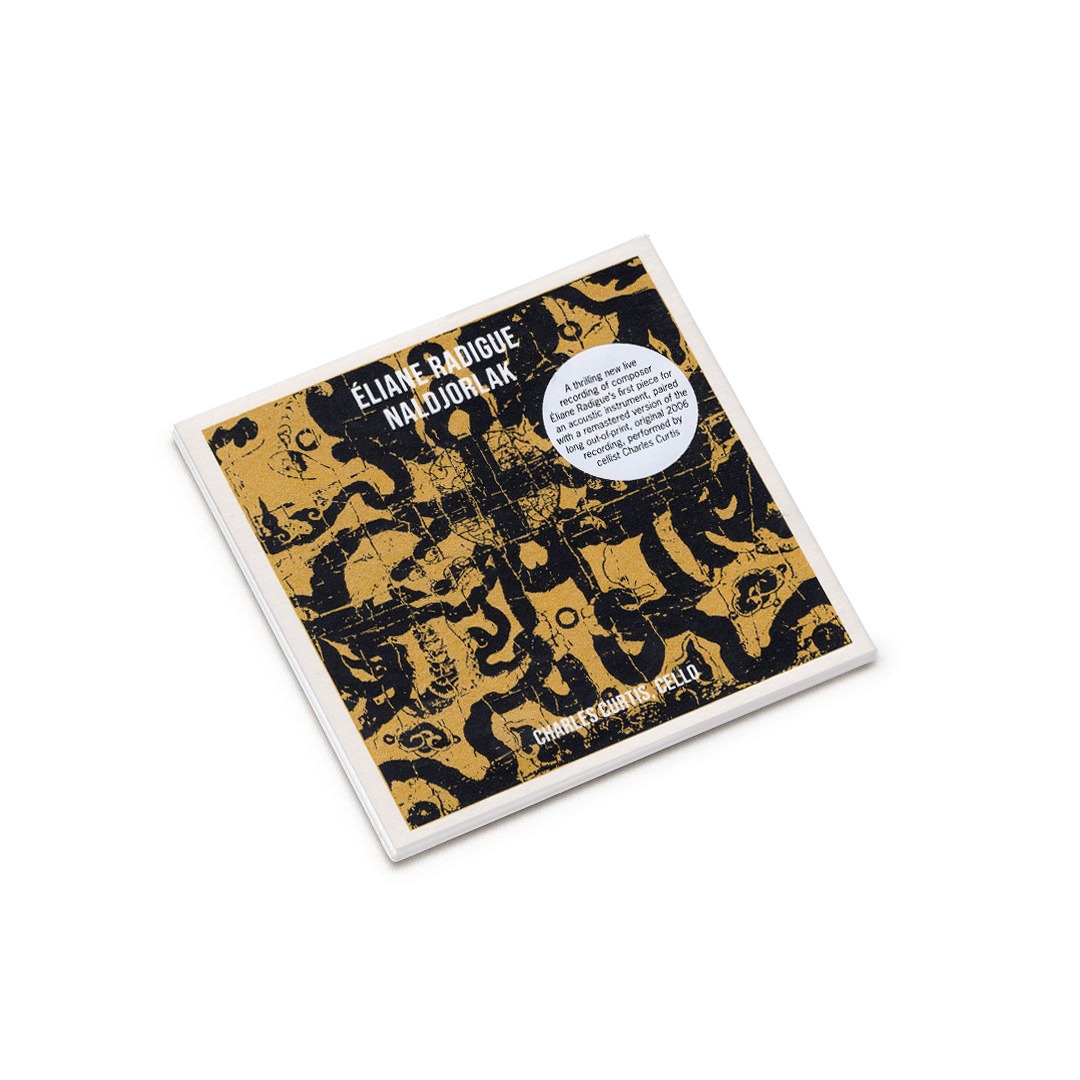
Belonging to their long standing dedication to the work of the experimental cellist, Charles Curtis, that’s already delivered the triple CD survey, “Performances & Recordings 1998-2018” and Terry Jennings' "Piece for Cello and Saxophone”, Tashi Wada’s Saltern imprint returns with Éliane Radigue’s “Naldjorlak”, a singular work of Minimalism, originally created by the composer in 2005 in close collaboration with Curtis. The work that marked the beginning of Radigue’s work with acoustic instruments, this beautifully produced double CD, housed in a silkscreened sleeve with liner notes by Gascia Ouzounian, features two highly distinct renderings of this remarkable work, and stands high among our favorite releases of the year so far.
The worlds of avant-garde and experimental musics have always fostered deep collaboration and diverse forms of creative interplay. Among these processes, deserving far more recognition, are those rare musicians who dedicate their lives and towering talents, often working closely with the composers themselves, to executing the demanding works within this field - those like David Tudor, Charlotte Moorman, Joseph Celli, Paul Zukofsky, and numerous others. Within the contemporary landscape, there is arguably no more important of these figures than the American cellist, Charles Curtis. For decades he has been a shining light, rendering his remarkable, singular mastery of his instrument to the works of Pauline Oliveros, La Monte Young, Alvin Lucier, Terry Jennings, Morton Feldman, Anton Webern, Olivier Messiaen, Alison Knowles, Richard Maxfield, and numerous others. Back in 2020, we were able to catch the clearest vision of this with Saltern’s fantastic 3 CD survey, “Charles Curtis: Performances & Recordings 1998-2018”. Now, the label returns with “Naldjorlak”, an astounding double CD capturing some of his groundbreaking work with Éliane Radigue. Engrossing on creative terms, and of huge historical importance, it’s thrilling and revelatory at every turn.
The French composer, Éliane Radigue, is among the most remarkable creative figures working today - a visionary mind who has quietly blazed trails for more than half a century, leaving an unparalleled body of work in her wake. She has endlessly rewritten how we understand music and the materiality of sound. Quiet, radical, and rebellious, her works are infused with mesmerizing intellectual and creative optimism, culminating as sonic mediations which join life and art as a single force.
Born in 1932, Radigue began her musical endeavors in Paris during the late 1950s and early 60’s, working under Pierre Schaeffer and Pierre Henry, before quickly outstepping the limits of her mentors. First working predominantly in tape, during the early 1970s she made the radical switch to modular synthesis. Over the next three decades, drawing on her practice as a Buddhist, she dedicated herself to an intimate relationship with her ARP 2500, exploring it - pushing not only her own notions of musicality endlessly forward, but with it the entire landscape of experimental sound.
Following a brief retirement, during the early 2000s, Radigue made the unexpected shift toward composing for acoustic instruments, reinvigorating her career and cultivating a new level of renown, most notably via the sprawling, constantly evolving work, Occam Ocean. This unexpected shift by one of the great electronic composers of her generation was the result of a chance encounter between herself and the cellist Charles Curtis and a suggestion by a mutual friend that they work together. The result, composed in 2005 in close collaboration with Curtis, was “Naldjorlak”.
Born in Laguna Beach, California, in 1960, Charles Curtis studied at Juilliard, before spending a decade as the Principal Cellist of the NDR Symphony Orchestra in Hamburg, as well as working extensively with numerous other orchestras and chamber music ensembles. Always ambitious and forward thinking, during the 1980s he studied with La Monte Young, subsequently working closely with the composer, executing Four Dreams of China, Composition 1960 #7, Poem for Chairs, Tables and Benches Etc., and Trio for Strings, as well as having Just Charles and Cello in the Romantic Chord composed for him, the only solo work ever created by Young for a performer other than himself. In many ways, this single effort laid the groundwork for the kind of intimate, collaborative relationship which he has gone on to foster with many of the greatest figures of our moment, most notably, in this case, Éliane Radigue, with “Naldjorlak”.
Composed in 2005, Saltern’s edition of “Naldjorlak” brings together two complete performances by Curtis, recorded nearly 15 years apart, the first in Paris in 2006 - originally released by Shiiin in 2008 and out of print ever since - and the second a never before released rendering created in Los Angeles in 2020. The joint billing allows for a clear perception of the work’s evolution over those years, as well as its inherent mutability.
Compared to the slow evolution of iconic works in Radigue’s output like “Trilogie De La Mort” and “Adnos”, there is a surprising amount of closely centred modulation of tone within “Naldjorlak”, the composer’s first foray into working with acoustic instruments. The piece is constructed around re-tuning of the entire cello to the wolf tone, a uniquely unstable frequency, creating a haunting, almost feedback-like resonance within the instrument itself. As Gascia Ouzounian writes in the liner notes: “Even as it expands conceptions of what sound is, and thus what music can be, to understand Naldjorlak only as music would be to limit its scope. It is music, but it is also physics and philosophy. Naldjorlak is a detailed investigation of the physical properties of resonating bodies and dynamic systems; it is a meditation on the condition of instability; it is a metaphysics of chaos and uncertainty.”
In Curtis’ deft hands, the piece emerges as a meditation on tension, each of the two renderings bringing out decidedly different aspects of its potentialities. The first, from 2005, is considerably more raw and tactile, with the cellist’s bow dragging across the strings with emotive provocations that lean toward an earlier, darker end of the spectrum that draw out subtle harmonics and textures within a spacious sense of restraint. The second, recorded in 2020, feels almost angelic by comparison, with Curtis’ bow work and shifting tones often feeling more exacting and razor sharp in dancing interplays, as they collectively unfold within one of the most striking and singular works of minimalism and drone that can be called to mind.
A truly engrossing listen of such quality and subtle complexity that each listen over the course of an entire lifetime would inevitably reveal an endless number of new interpretations and dimensions, “Naldjorlak” is unquestionably one of the greatest works created in Éliane Radigue’s long and illustrious career. Truly revelatory and moving, it’s yet another masterstroke from both the composer and Curtis.
Originally published by Soundohm.