“Raw and direct, like a direct tap to a beating, creative heart, Dekula’s “Congo Guitar” is the sonic equivalent to basking in glorious sunlight.”
The venerable Brighton, UK, based imprint, Hive Mind - already renowned for their remarkable musical journeys into unexpected corners of the globe - return with two of their most stunning releases to date; Ustad Noor Bakhsh’s “Jingul” and Vumbi Dekula’s “Congo Guitar” (co-released with Stockholm's Sing-A-Song Fighter). While the first draws the ear into the astounding rural traditions of the Balochistan region of Pakistan, via the sounds of Bakhsh's eclectic benju, the latter represents a mesmerizing immersion into contemporary Congolese guitar playing. Each is hypnotic and intoxicating in their own distinct ways, and represents some of the most captivating gestures in music making we’ve encountered this year.
Since they first caught our attention back in 2017 with their release of “Colours of the Night”, the final studio recordings of deep, hypnotic Gnawa songs from the late, great Maalem Mahmoud Gania, the UK based imprint, Hive Mind, has slowly emerged as one of the most diverse and striking catalogs of contemporary music from various corners of the globe. So far, they’ve dropped incredible albums by Moulay Ahmed El Hassani, Idjah Hadidjah & Jugala Jaipongan, Hassan Wargui, Yara Asmar, Gustavo Yashimura, Ricardo Dias Gomes, and a great many more, each taking us to places that we couldn’t have possibly expected. Their latest pair of LPs - Ustad Noor Bakhsh’s “Jingul” and Vumbi Dekula’s “Congo Guitar” - are two of their greatest to date.
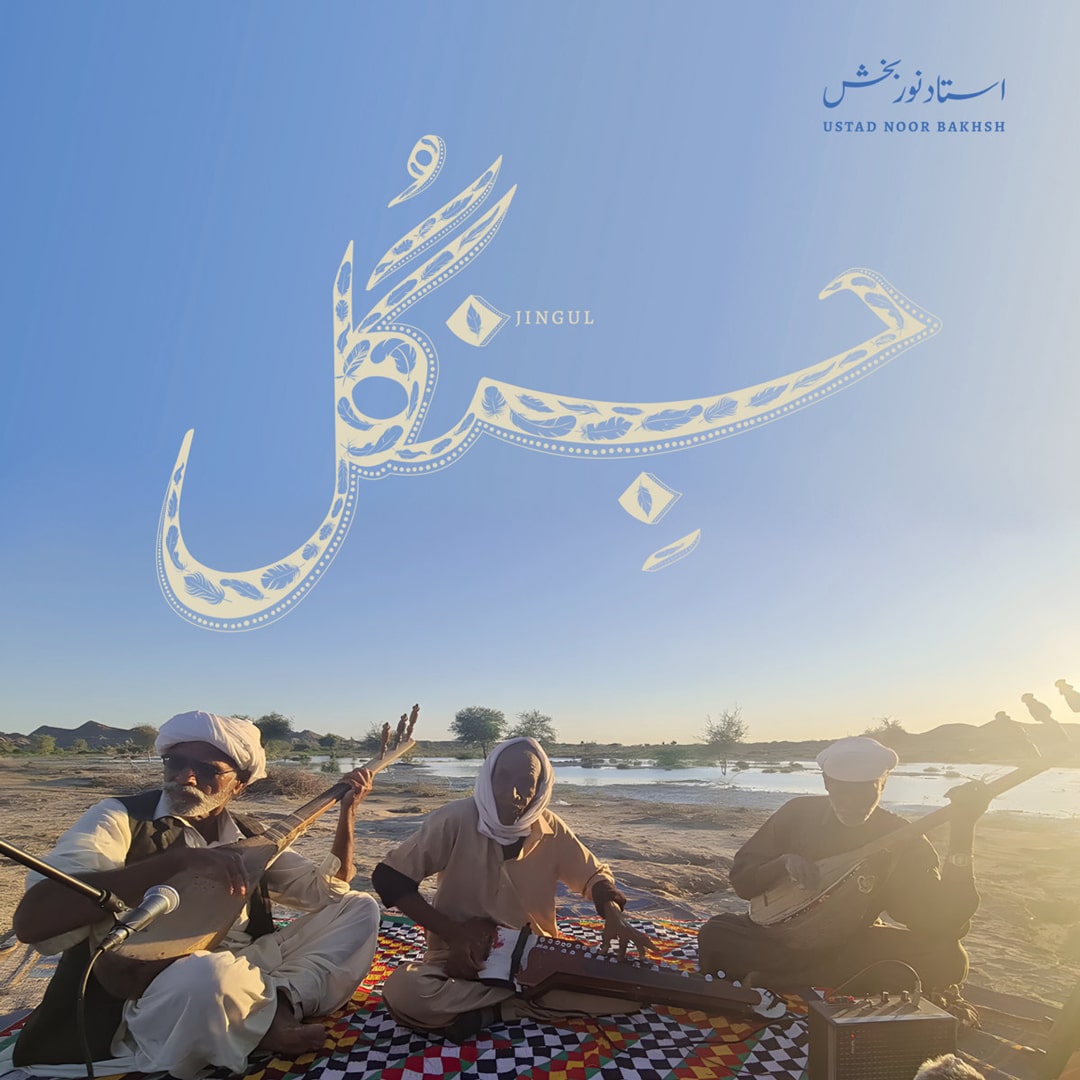
Ustad Noor Bakhsh hails from a small village in the Balochistan region of Pakistan. A master of a form that belongs to a remarkably rich heritage and living musical culture, he began playing the Balochi benju - a zither fretted by keys (in a manner similar to a hurdy-gurdy) that is related to the Indian bulbul tarang and shahi baaja - at a young age. Unique to the Balochistan region - said to be a modified version of a Japanese children's toy called the Taishōgoto - in a recent interview Bakhsh explained: “Normally the benju has six strings, but mine is electric. In the middle I have only one string, so five strings in total. The middle string is called zubaan (tongue), this is the one that speaks. Then there are these two other zubaans as well. They are all tuned to Sa [the root]. And the other two strings, called the bam, which are the drones, are tuned like this, to Pa [the fifth].” The sound it produces is truly intoxicating and unlike little else, somehow channeling countless centuries of tradition within a strikingly contemporary expanse of tone.
Being that the music he makes is incredibly regional, Bakhsh never entertained the possibility of an international audience or renown. He has spent the majority of his career playing weddings and other small gatherings. Fascinatingly, a series of viral YouTube videos and a subsequent invitation to perform on the first Boiler Room in Karachi last year, sparked a 10-country European tour and the release of his first LP, “Jingul”, via Hivemind.
Comprising five compositions across its two sides, “Jingul” was recorded live during sunset on the Shadi Kaur creek, close to Bakhsh's village, near Pasni, in Balochistan, Pakistan, and takes its name from a bird that frequents Noor's house, the songs of which inspired the album’s last track. Like the geographical region from which it stems - effectively straddling the space between modern day Pakistan, Afghanistan, and Iran - the music of Balochistan, and particularly that of Ustad Noor Bakhsh, incorporates melodies from the Arab Peninsula, Iran, various ragas from Pakistan and India, becoming an inward and wandering multicultural music.
Profoundly hypnotic and meditative, “Jingul” features Bakhsh’s intoxicating electric benju melodies unfurling against the backing of dual dambooras - a stringed instrument, similar to a lute - played by Jamadar Gohram and Doshambay, dancing together within sheets of ecstatic melancholy that perfectly reflect the joining of nature and the low light at the end of a day. Truly mesmerizing in the virtuosity of its playing as well as the emotive and imagistic qualities possessed by the delivery of rhythm and tone, this is unquestionably one of the most striking and engaging records to be released anywhere this year.
The second album in Hive Mind’s latest batch - Vumbi Dekula’s “Congo Guitar” - is co-released with our longtime favorites, the Stockholm, Sweden, based Sing-A-Song Fighter. A true marvel of solo guitar wizardry from the legendary, Sweden based Congolese guitarist Kahanga Dekula aka ”Vumbi”. His first solo album after years of leading the acclaimed ‘Dekula Band’, in addition to work in numerous other bands, it’s an absolute revelatory stunner, riding high on a joyous tapestry of expressive sound.
Vumbi Dekula was born in Kivu province in the Democratic Republic of Congo. Raised in a Swedish missionary home, due to having been born with polio, he started playing guitar at the age of 16, listening to the radio and teaching himself the melodies and rhythms of Rumba and Soukous, via the sounds of giants of the Congolese guitar sound like Dr Nico and Franco. During the early 1980s, Dekula moved to Tanzania where he played with the legendary group Orchestra Maquis, touring extensively, and within which he earned the nickname “Vumbi” because of his stellar solos. Following his move to Sweden during the early 90s, Dekula played in numerous bands including the Makonde Band and Ahmadu Jarr's Highlife Orchestra, before, in 2008, putting together his own group, The Dekula Band, which became beloved in Stockholm and across Europe for its infectious and hypnotic sound, drawing on rumba and Soukous. This led to Sing-A-Song Fighter’s release of The Dekula Band’s debut album ”Opika” in 2019, but the label’s founder Karl-Jonas Winqvist, was left with a longing desire to hear Vumbi play on his own, stating: “Because, in a way, Vumbi’s guitar playing is like an orchestra on its own. And the idea of just concentrating on all the amazing riffs and beautiful, uplifting melodies was just so appealing”. One thing led to another, and Dekula entered the studio for two days during lockdown, laying down the entirety of what became “Congo Guitar”.
Comprising seven stunningly beautiful compositions of rare artistry, over the course of the album’s length Dekula embarks upon solo guitar works, as well as pieces that incorporate the occasional harmonies and melodies of a second guitar, and the use of an old rhythm box machine. The palette was further expanded on “Maamajacy”, where the wordless backing vocals from Karl-Jonas Winqvist and Emma Nordenstam appear, whereas bass melodica features on “Weekend”, played by Winqvist, as well as space piano, played by Nordenstam on “Zuku”. For the final track, ”UN Forces Get Out of the DR of Congo”, he even went as far as introducing a banjo into the world of ”Congo guitar” to startling effect.
Raw and direct, like a direct tap to a beating, creative heart, Dekula’s “Congo Guitar” is the sonic equivalent to basking in glorious sunlight. Across each track, melodies shimmer and dance, provoking the body and mind to do the same and culminating as an immersion into one of the deepest traditions of African guitar music, shifting and evolving in real time at the hands of one of its great masters.
Originally published by Soundohm.