“nothing quite sounds like Dorothy Carter’s brilliant “Troubadour”: a wondrous immersion into a state of being by an artist who trod her path until her untimely passing in 2003”
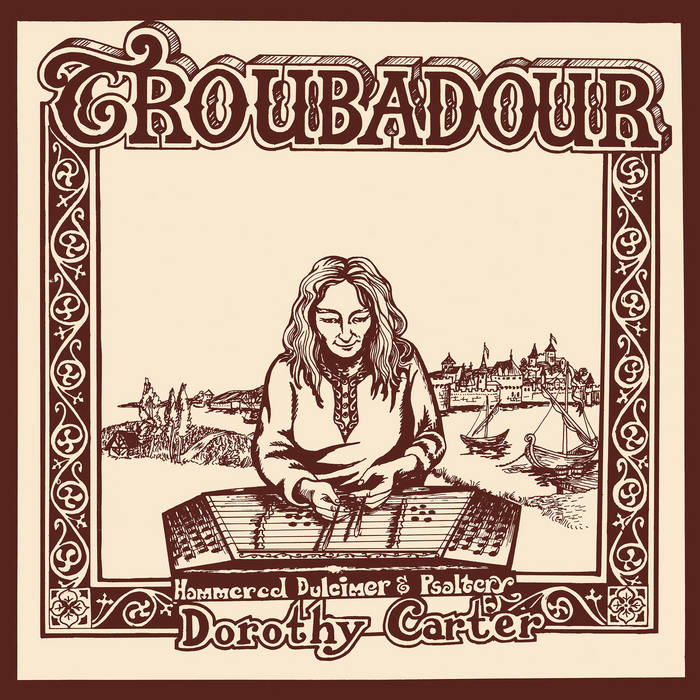
Blurring the lines between experimentalism and folk, the venerable Drag City returns with the first ever vinyl reissue of Dorothy Carter's cult debut, Troubadour, recorded with none other than Robert Rutman, and Sally Hilmer, in tow, and originally privately released in 1976. A heady hybrid of acoustic minimalism and folk, nodding toward traditional Persian and European folk music as much as the kinds of tonal ambience produced by artists like Charlemagne Palestine and Lubomyr Melnyk, it's a singular body of work that has captivated those in the know for decades, coming back into the world at long last!
There’s nothing more interesting than an artist who doesn’t fit in: visionaries who tread their own path and produce work that refuses expectation or to sit neatly within terms and categories. Historically speaking, few could be seen to better fit this description than Dorothy Carter. Entirely singular in her approach and practice, traversing the worlds of avant-garde and folk music via a vast palette of acoustic instrumentation - hammered dulcimer, zither, psaltery, hurdy-gurdy, etc. - Carter produced two privately-pressed, long out of print LPs - “Troubadour” and “Waillee Waillee” - during the 1970s that have been heralded and chased by adventurous listeners over the last 20 or so years. In 2023, Palto Flats graced us with a reissue of “Waillee Waillee”, and now Drag City is offering the same treatment to “Troubadour”.
The life and times of Dorothy Carter open a window into the breadth and duration of the American creative counterculture that slightly defies the standard narratives. Born in 1935, she began to study classical piano at age six, before attending Bard College in New York, the London Royal Academy, and Guildhall School of Music in France. Resistant to the strict structures of classical music, Carter became captivated by numerous folk traditions from across the world and began to travel and perform as a street musician, learning and exploring as she went.
Unlike most other members of her generation who joined the folk revival emerging during the 1950s and 60s - harkening back to what they perceived to be a more elemental and pure form of music - Carter had a radical and forward thinking streak that directed both her work and entire life, living in a commune, co-founding an avant-garde art gallery in New York, and most fascinatingly helping to found and working within the radically experimental collective called the Central Maine Power Company with David and Constance Demby, as well as with the avant-garde pioneer Robert Rutman.
It is this remarkable sensibility that rests at the undercurrent of “Troubadour”, Carter’s debut LP, originally issued in 1976, recorded during her early 40s in a small studio in Cambridge, Massachusetts, with Robert Rutman, Constance Demby, and fellow Central Maine Power Company member, Sally Hilmer, in tow. Featuring Demby on guqin - a seven-string Chinese instrument in the zither family, Hilmer on tambura, and Carter playing hammered dulcimer, psaltery, vocals, and flute, the album is a stunning bridge between numerous ancient approaches to music and the more radical elements that underscored her work with Central Maine Power Company and Robert Rutman.
Largely comprising instrumental pieces, “Troubadour” presents a fascinating, hybridic vision of acoustic minimalism that places Carter’s dulcimer at centre stage, hammering out sheets of rhythmic harmonics. Perhaps among the most interesting and tense are those that feature her voice, which occupy a similar space to Robbie Basho’s unconventional approach to the human voice, riding a razor’s edge between emotive beauty and something more aggressively avant-garde, that subsequently repositions folk music as a constantly evolving idiom that is vital and alive.
Nearly half a century on from its original release, nothing quite sounds like Dorothy Carter’s brilliant “Troubadour”: a wondrous immersion into a state of being by an artist who trod her path until her untimely passing in 2003.
Originally published by Soundohm.