“Multiple Musics” is an absolutely incredible piece of work and unquestionably one of the most engaging and important archival releases we’re likely to encounter this year”
From the always fantastic Metaphon comes two of the most beautiful and engrossing records we've heard this year: “Multiple Musics”, comprising an astounding, never before released body of recordings made in 1987 by Michael Ranta and Takehisa Kosugi; and “Wege / Ways”, a much-needed dive into the work of the neglected Polish, American electronic and computer music composer Rolf Gehlhaar. Both historical revelations of the highest order that fall in line with their recent, killer collections dedicated to the work of Robert Fesler, Nicole Lachartre, and others, these two, highly sympathetic bodies of work can't help but melt brains!
Working at a slow, meticulous pace, for a decade and a half, Metaphon - the Brussels based imprint run by Timo Van Luijk, Greg Jacobs and Marc Wroblewski - has continuously illuminated fascinating trajectories within a number of historically neglected contexts of experimental music and sound art. With their own criteria of personal taste guiding them, they have issued incredible releases by Jan Bruyndonckx, Jacques Bekaert, Arthur Petronio, Nicole Lachartre, Johannes Fritsch, Robert Fesler, and numerous others, each consistently shifting our perspectives on the past in their endeavour to support radically forward thinking music and those who make it. While primarily focused on artists from Belgium, Metaphon does occasionally cast its focus further afield.
One of Metaphon’s central focuses over the years has been the recorded output of the American composer Michael Ranta. Born in 1942 in Duluth, Minnesota, following studies in percussion and composition, Michael Ranta began his career working in the ensemble of his teacher Harry Partch during the mid 1960s, before moving to Cologne in 1967, where he joined Karlheinz Stockhausen’s group and worked with Mauricio Kagel, Helmut Lachenmann, and Josef Anton Riedl, among others, as well as founding Wired with Karl-Heinz Böttner and Mike Lewis, one of the three bands that is represented on Deutsche Grammophon’s highly sought after Free Improvisation triple LP box set, released in 1973. While these years laid the groundwork for a life in Germany, where he would permanently relocate in 1979, Ranta spent the majority of the 1970s living and working in South-East Asia, first working in the electronic studio of the Japanese radio, before moving to Taiwan, where he lived between 1973 and 1979. It was during this period that he also began working extensively with Japanese composers and musicians, eventually leading to his meeting with Toshi Ichiyanagi and Takehisa Kosugi, two of the most important and forward thinking voices of their generation. This trio’s one recorded document, “Improvisation Sep. 1975” (reissued by Metaphon in 2022), is a legendary release in the history of experimental music. What has remained elusive, is the fact that Kosugi and Ranta continued to work together and collaborate over the following years.
For most people well versed in experimental music, Takehisa Kosugi is a household name. He was unquestionably among the most important and visionary artists in 20th Century experimental music. First emerging onto Japan’s avant-garde music scene during the 1960s as a member of the country’s first improvisational music collective, Group Ongaku, as well as being an important contributor to the Fluxus movement, in 1969 Kosugi founded the seminal outfit, The Taj Mahal Travellers - leaving his mark on the wilder avenues of psychedelia forever - before, in 1975, embarking on his first solo album, Catch Wave, easily among the most important and influential statements in the entire canon of experimental music. While Kosugi is largely regarded for his work as a solo artist, particularly for his efforts on violin and electronics, he collaborated widely over the course of his career with artists as diverse as Nam June Paik, Charlotte Moorman, Akio Suzuki, Steve Lacy, Yuji Takahashi, and numerous others. For the first time, Metaphon’s “Multiple Musics” illuminates his enduring efforts as a duo with Michael Ranta.
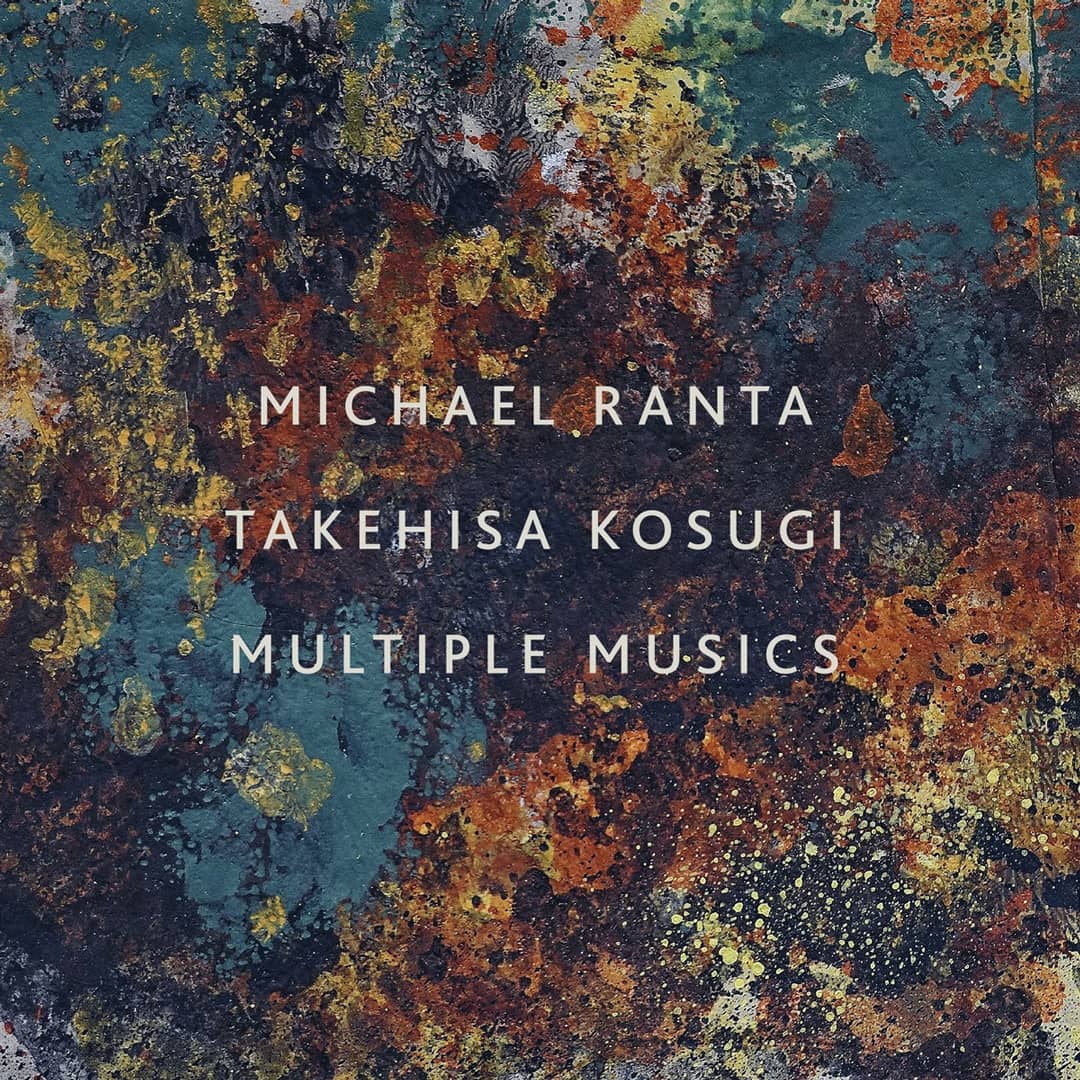
Following their collaboration on “Improvisation Sep. 1975”, Ranta and Kosugi performed together as a duo numerous times across the 1970’s and 1980’s. “Multiple Musics” captures just one of these instances: a never before released body of recordings made at the Japanese Culture Institute in Cologne in 1987. Featuring Ranta on percussion, mechanical sound sculpture, voice, strings, and effects; and Kosugi on vocals, violin, electronics, and effects, this outstanding performance features the application of an advanced multi delay system, independently utilized by both players, as a central, guiding component in the resulting, real-time composition: “The smartly treated cyclic tapestry of the delay system (modulated, transformed, harmonized) injects additional dimensions to the highly coordinated improvisation with voice, percussion, violin and electronics, creating interactive ‘composition-like’ textures being ‘Multiple Musics’.”
A single long-form piece that stretches across the album’s two sides, “Multiple Musics” unfolds like a microscopic exploration of a primordial swamp: rattling percussive textures, scraping, clangs, and vocalisations dancing and intertwining into a tense and shimmering tapestry of sonority across the first part. A clear evolution - like plants coming to bloom in the light of the sun - takes hold at the beginning of the second side as Kosugi lets loose brilliant timbral and tonal elements on violin, played against muted, arpeggiating plucked notes, before the clouds roll in and the piece evolves into a broody dark rumble of thumping percussion, electronics, and guttural howls, culminating as one of the most engrossing and emotionally rich expressions that can be experienced in either Ranta or Kosugi’s respective outputs.
A long unavailable window into Takehisa Kosugi and Michael Ranta’s enduring creative partnership working as a duo, unlocking a crucial, clearer vision of both of these seminal artists’ respective practices, “Multiple Musics” is an absolutely incredible piece of work and unquestionably one of the most engaging and important archival releases we’re likely to encounter this year.
ROLF GEHLHAAR - Wege / Ways
Rolf Gehlhaar (1943-2019) is one of those fascinating figures in the history of experimental and electronic music. While fairly obscure beyond a small circle of devoted fans, when peeling the skin of the onion, it turns out that he was at the eye of numerous creative storms. Regarded as a pioneer of computer controlled interactive music, as well as composing within various fields of instrumental and electronic music, Gehlhaar was born in Poland during the Second World War, before migrating to the United States where he grew up. Following his studies of philosophy and musical composition at Yale University, in 1967 he moved to Germany, where he became Karlheinz Stockhausen’s personal assistant and joined the composer’s performing ensemble. Two years later, with fellow Stockhausen collaborators, the composers Johannes Fritsch and David Johnson, he founded the legendary Feedback Studios in Cologne, a new-music performance center and publishing house, and then, eventually, following his move to England during the 1970s, a founding member of the Electro-Acoustic Music Association. While sinfully underrepresented as commercially available releases, over the course of his long career Gehlhaar produced a sprawling body of symphonies, instrumental works, experimental and electronic music, interactive computer controlled music and nearly everything between.
Metaphon’s “Wege / Ways” is the first release to ever be entirely dedicated to Gehlhaar’s work, and features three previously unreleased tracks that have been curated in the hope to show a glimpse of the versatility of the composer’s adventurous and innovative musical ideas. Comprising three works - “Wege / Ways”, “Harmonics”, and “Beckenstück” - even at first listen there’s a clear, sympathetic connection between Gehlhaar’s work and that of Takehisa Kosugi and Michael Ranta, offering some insight into Metaphon’s choice to issue the LP in the company they have. The first piece, “Wege / Ways” is composed for two electronically amplified strings, and features repetitive timbral bowing that threads incredible textures into a stunning sequence of pulsing tones cast within a gauzy haze of ambience and reverberance, which easily calls to mind the elegant simplicity and tension balanced by Tony Conrad across the length of his career. The second piece, “Harmonics”, was composed for "Sound = Space", a unique electronic instrument that is played by moving around a specific space, resonating deeply with similar ideas and approaches harnessed by Alvin Lucier for his piece “Vespers”. The final piece, nearly 2 minutes in length and taking up the entire second side, “Beckenstück” is a highly considered and sophisticated work for percussion and objects, predominantly deploying them for their resonant and timbral possibilities, which unfolds a writhing, while structured, sea of sonority and culminates as one of the more thrilling gestures for solo percussion we can call to mind.
Similar to their collections dedicated to the work of Robert Fesler, Nicole Lachartre, Johannes Fritsch, and Jan Bruyndonckx, that have appeared over the last couple of years, Metaphon’s “Wege / Ways” brings a crucial, but widely overlooked voice in the 20th Century avant-garde to the center of our consciousness, elevating Rolf Gehlhaar to a position that he clearly always deserved. This is truly important work.
Originally published by Soundohm.