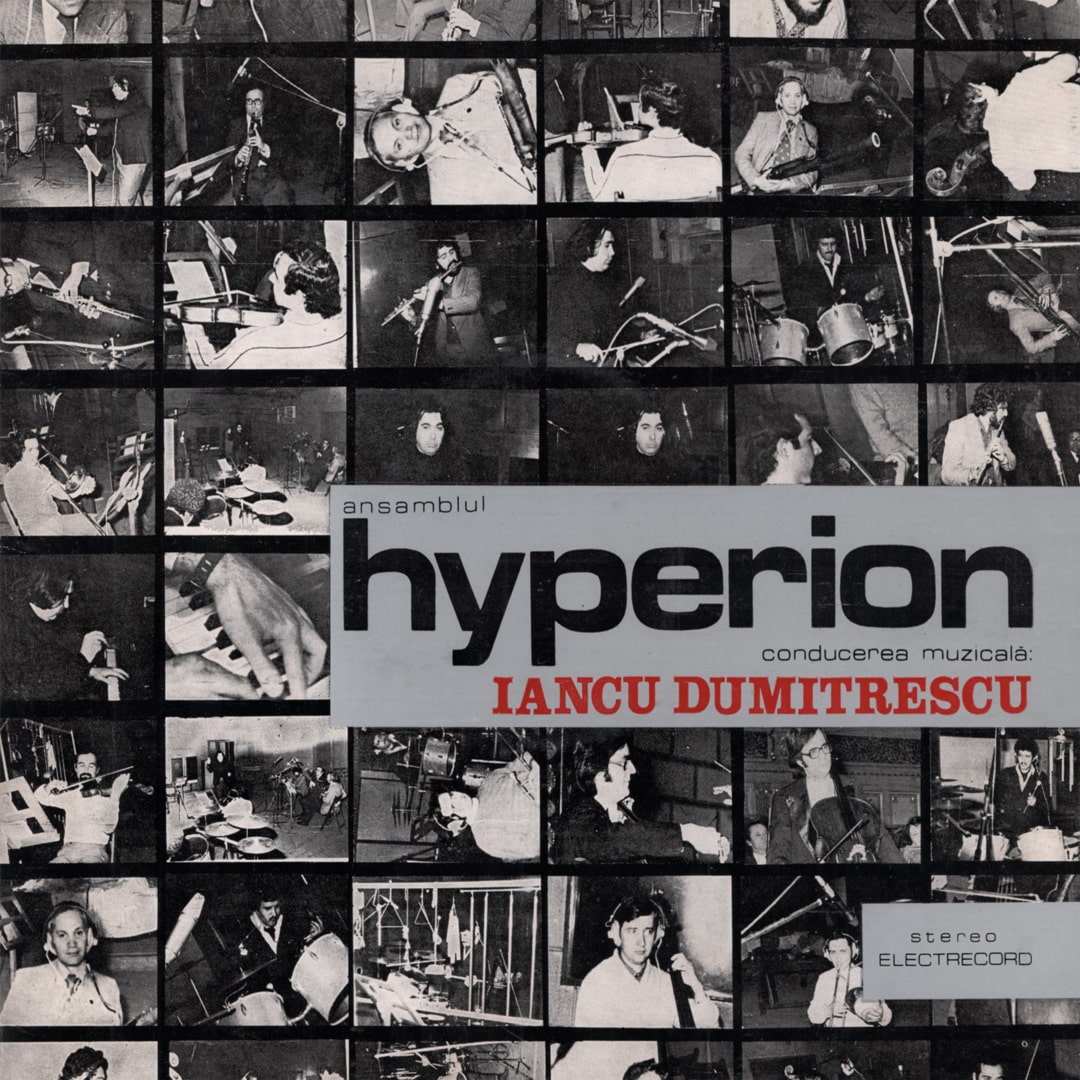
“Their latest, the first ever reissue of “Ansamblul Hyperion”, the 1981 debut by the Romanian composer, Iancu Dumitrescu, takes us deep into an entirely other realm.”
Launching into 2025 with a bang, the venerable Corbett vs Dempsey returns and forges off the beaten path with the first ever reissue of “Ansamblul Hyperion”, the legendary debut of the avant-garde Romanian composer, Iancu Dumitrescu, and his experimental ensemble Hyperion Ensemble. Comprising a series of radical acoustic and electroacoustic works by Dumitrescu and three of his peers - Octavian Nemescu, Stefan Niculescu, and Corneliu Cezar - recorded against great odds behind the iron curtain and originally released in 1981, beyond being an absolutely engrossing listen, this scarce document of Romanian experimental music during this period casts light into the shadows of an unheralded corner of history that produced some of the most thrilling music we can call to mind.
Over the last decade and a half, the Chicago based imprint, Corbett vs Dempsey - run by one of our favourite writers, John Corbett, and Jim Dempsey, as an extension of their remarkable contemporary art gallery of the same name - has carved out a singular place in the landscape of avant-garde and experimental music, issuing a stellar range of contemporary gestures as well as stunning reissues and archival releases. For the most part, Corbett vs Dempsey has dedicated its energies to the broad global context of free improvisation, dropping releases by luminaries like Joe McPhee, Cecil Taylor, Okkyung Lee, Peter Brötzmann, Sun Ra, ICP Tentet, Wadada Leo Smith, Tomeka Reid, Mats Gustafsson, Milford Graves, Ken Vandermark, Alexander von Schlippenbach, Hamid Drake, and numerous others into our midst. Their latest, the first ever reissue of “Ansamblul Hyperion”, the 1981 debut by the Romanian composer, Iancu Dumitrescu, takes us deep into an entirely other realm.
Born in 1944, Iancu Dumitrescu was among the most radical composers to emerge in Romanian music during the late 1960s and early 1970s. A student of Alfred Mendelsohn and Sergiu Celibidache, the latter of whom led him to engage with the philosophy of Edmund Husserl and apply the principles of phenomenology to music, over the course of his long career Dumitrescu has composed a remarkable body of avant-garde and experimental works, for acoustic instruments, combinations of acoustic and electronic sounds, and musique concrete and computer music. In addition to some absolutely amazing works composed for the Italian bassist, Fernando Grillo - perhaps most well remembered for his singular solo LP, “Fluvine”, issued by Cramps in 1976 - and noteworthy releases on Edition RZ, Edition Modern, ReR Megacorp, Planam, and Ideologic Organ, he founded the Hyperion Ensemble, "a multimedia group dedicated to experimental music”, during the mid-1970s, and via remarkable compositions that centre around long tones that undergo transformations in timbre, Dumitrescu has generally been associated with the spectralist musical movement, alongside distinguished composers like Giacinto Scelsi and Horațiu Rădulescu.
It is impossible to set the stage for Dumitrescu’s music without acknowledging the context within which it was initially created. Between 1945 and 1989, Romania was ruled by an authoritarian Communist government and fell behind the iron curtain. As such, his early work did not belong to the same thread of utopianism or arc of cultural imperialism as most of his peers working in the United States or Europe. It was a music made against the odds, which makes the creation of the composer’s debut LP, “Ansamblul Hyperion” - issued in 1981 - that much more remarkable, and even more so given that it was released by Electrecord, the sole Romanian state record company.
“Ansamblul Hyperion” is remarkable not just for the sounds it contains (and that would, in this case, be more than enough, given the album’s incredible quality), but also for the spirit it embodies: comprising not only Dumitrescu’s music, but also pieces by his fellow Romanian composers: Octavian Nemescu, Stefan Niculescu, and Corneliu Cezar. Recorded in a radio studio in Bucharest by the aforementioned Hyperion Ensemble, which delivers one piece by each of the four participating composers, the album begins with “Movemur Et Sumus (II + V Pentru Fernando Grillo)”, translated from the Latin as "move and exist”, composed in 1978 for cello and percussion, and regarded as one of Dumitrescu's most important works. Drawing deeply on the composer’s studies in phenomenology and belonging to his larger framework of compositional strategy that focuses intensely on sonorous objects, penetrating it until it is entirely blown open, “Movemur Et Sumus” is a swirling network of timbral qualities and microtones, drawing the listener into a profoundly emotive space marked by remarkable detail and attention to total form. This is then followed by Nemescu's electroacoustic work "Combinatii In Cercuri" (1965), a broodingly intense work of abrupt structural punctuations that pits the acoustic interventions of Hyperion Ensemble against the forbidding tones and textures of a synth. From here we move into Niculescu's "Sincronie” (1979), which features Dumitrescu on piano, a piece written for an indeterminate number of performers between two and twelve (here featuring nine) that utilizes fixed elements in the score alongside improvised elements, expanding from a core vibraphone part to encompass an almost ecstatic meditation on stasis and motion, amounting to a playful, off kilter flirtation with the resemblances of Minimalism. Fittingly wrapping up the collection is Cezar's work "Rota" (1976), which combines Romanian, Balkan, and other Eastern melodic resonances with electronics and preparations on various instruments, amounting to a striking expanse of sonic abstraction rooted in a singular sense of cultural heritage.
An incredible and rare immersion into Romanian avant-garde music unfurling against the odds behind the iron curtain, as well as the debut of one of that country’s (not to mention the world’s) most radical artists of the post-war generation, Corbett vs Dempsey’s first ever reissue of Iancu Dumitrescu’s debut LP, “Ansamblul Hyperion”, embarks upon a profound creative journey and unlocks a little known history lingering within the shadows of the European avant-garde.
Originally published by Soundohm.