
“Beyond both its creative brilliance and historical significance, on the simplest terms it’s hard to think of a record of experimental electronic music offering a more enjoyable listen than this.”
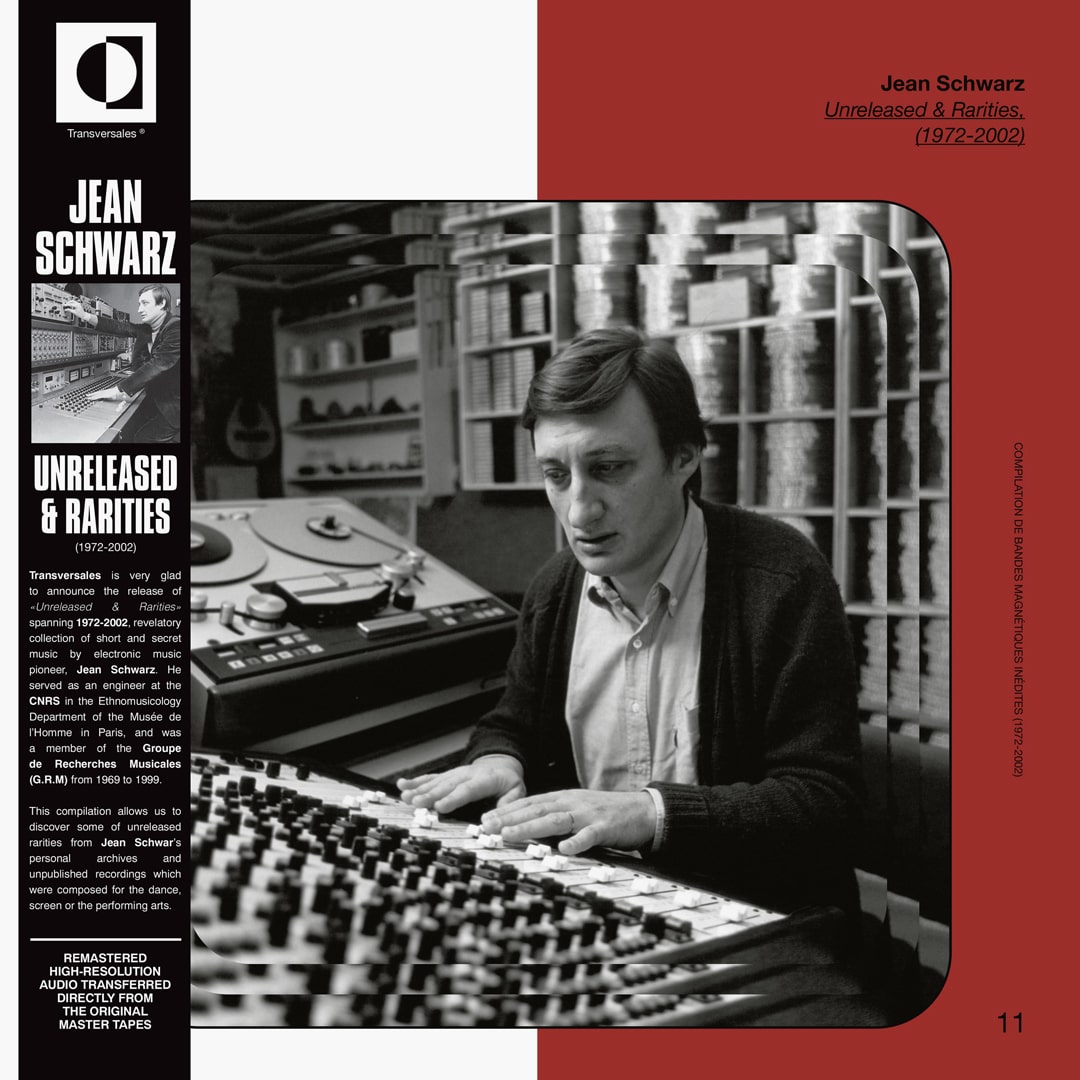
Returning their attention to two of the most singular creative voices in French electroacoustic and experimental music, the venerable Transversales Disques digs deep and delivers Jean Schwarz’s ‘Unreleased & Rarities (1972-2002)’ - the first ever extensive survey dedicated to the composer’s output - and the label’s third installment of their series dedicated to Bernard Parmegiani, ‘Mémoire Magnétique, Vol. 3’. Each respectively comprising never before issued bodies of recordings culled from the composers’ archives - largely created for the context of television and film - that entirely reconfigure our understandings of their work, few releases can be counted as historically important and truly intoxicating on creative terms as these.
Since its launch in 2017, the Paris based imprint, Transversales Disques - founded by Jonathan Fitoussi and Sébastien Rosat - has emerged as one of the most important and exciting platforms for archival sounds working today, uncovering and releasing an unparalleled body of recordings that spans numerous discrete disciplines and practices, including previously unreleased works by Luc Ferrari, Ennio Morricone, François Bayle, Philip Glass, Igor Wakhevitch, Ariel Kalma, Pharoah Sanders, Archie Shepp, Thelonious Monk, and numerous others. Two of the artists who have benefited heavily from Transversales Disques’ work are the electroacoustic pioneers Bernard Parmegiani and Jean Schwarz, in both cases issuing works that take great steps toward illuminating previously inaccessible dimensions of these Groupe de Recherches Musicales associated composers: Parmegiani’s ‘Rock’, ‘Mémoire Magnétique, Vol.1’ and ‘Mémoire Magnétique Vol.2’, and Schwarz’s astounding collaboration with Don Cherry, ‘Roundtrip’.
While certainly not as well known as some of his elders and immediate peers at Groupe de Recherches Musicales, Jean Schwarz has, for the majority of his long career, remained one of the most distinct and fascinating composers working in France. Born in 1939 in Lille, Schwarz was trained as a percussionist at Versailles Conservatory, before venturing into the world of electronic music and joining GRM in 1969, where he remained for 30 years, as well as working in parallel as an ethnomusicologist at the Laboratory of Ethnomusicology at Musée de l'Homme between 1965-1999. Creating electronic, electroacoustic, and tape works for dance, film, and musical contexts, Schwarz possesses a deeply curious and democratic mind, noted for his striking sense of rhythm and texture, whose efforts stand largely apart from those created by most other composers working at GRM during the same time, often drawing upon a diverse number of musical traditions, rooted in his own deep awareness developed through his work as an ethnomusicologist. Schwarz also gained further distinction from his peers because of his deep love of jazz. Even before he joined GRM, he worked steadily as a jazz drummer within numerous ensembles and later as a composer continuously sought to broaden his sound palette with references to jazz and through collaborations with improvising musicians from that context. One such case was his friend Don Cherry, which lies at the root of Transversales Disques’s previous release ‘Roundtrip’.
The label’s latest, ‘Unreleased & Rarities (1972-2002)’, returns our ears to the realms of creativity for which Schwarz has been most celebrated and well known. A revelatory collection spanning thirty years of “secret compositions”, comprising thirteen previously unreleased electronic and electroacoustic pieces, across the album’s two sides we are offered crucial illuminations of Schwarz’s distinct practice, drawing upon the dualities of his life as both an artist and an ethnomusicologist, which led to his development of singular techniques that merged anthropological documentation with avant-garde approaches: effectively a unique synthesis of scientific research and artistic experimentation which blends academic rigor with radical ideas and creative approaches.
Drawn from Schwarz’s own personal archive, ‘Unreleased & Rarities (1972-2002)’ is the first comprehensive survey of the composer’s work, and among the first releases by the composer, since the mid-1980s, to appear on vinyl. Like many of his peers at GRM, much of Schwarz’s work was created for specific dance performances, theatrical productions, and film scores, operating within a deeply considered framework at the studio that allowed revolutionary electronic and electroacoustic compositions to enter the popular realm and be navigated by everyday people, rather than a rarified cultural elite. This, however, in the case of Schwarz and many others, left many of those works unreleased as stand alone audio and nearly ineffaceable outside of their original context, making the issue of archival albums like this one that much more important, as they make their contexts accessible to a wide listening public for the first time and position them within the appropriate historical regard.
Perhaps more than any other body of work by Schwarz, ‘Unreleased & Rarities (1972-2002)’ illuminates the composer’s unique sensibilities and particularly the infectious and incredibly approachable character of his efforts. Much of it feels remarkably contemporary and strays well beyond the expected confines of experimental electronic and electroacoustic music. Beginning with the brilliant piece, ‘Etude Longue’, Schwarz weaves stunning textures into pulsing and modulating tones, sculpting a stunning sense of immersive space, before integrating gentle percussion toward its end that hints toward the central spine of practice that moves through the album’s length, and fully realizes itself with the absolutely intoxicating rhythms of ‘Prologue, Maison Rouge’ - a piece that almost feels like a lost, minimalist outtake by Klaus Weiss’ Niagara - before entering more complex polyrhythmic states with ‘Kodo’, a piece that seems to have been created entirely on a drum kit, with little further intervention.
While a clear sense of the rhythmical unquestionably centers heavily within Schwarz’s output and practice, ‘Unreleased & Rarities (1972-2002)’ digs deeper and offers a multidimensional perspective on his work with pieces like ‘Histoire d’A’ - a bristling effort of synthesis, across which pulses and tones dance and overlap to startling effect, and ‘Koening Song’, what seems to be a tape work utilizing vocal recordings placed within gentle states of manipulation and intervention, alluding to some of the ethnographic recordings that occupied such a significant place in Schwarz’s life, as well as a number of European folk and classical traditions.
As a sum total, Jean Schwarz’s ‘Unreleased & Rarities (1972-2002)’ stands as one of the most striking and captivating bodies of archival recordings we’ve encountered in years, taking great leaps to draw us into the deeply compelling sonic universe of one of France’s most important, but sinfully under-appreciated composers, placing him in equal standing with all the greats associated with GRM, while entirely apart forging his own path. Beyond both its creative brilliance and historical significance, on the simplest terms it’s hard to think of a record of experimental electronic music offering a more enjoyable listen than this. It’s just incredible. It confounds the mind how these recordings have remained unreleased for as long as they have.
From its earliest moments, Transversales Disques has offered a special dedication to the work of the French electroacoustic pioneer Bernard Parmegiani. Back in 2017, they brought us the composer’s incredible 1982 soundtrack, “Rock”, created for Michel Treguero’s film of the same name, followed by the LP, “Mémoire Magnétique, Vol 1.” in 2018 and then “Mémoire Magnétique, Vol 2” in 2021, both culling their previously unreleased material from the composer’s personal archives of unpublished recordings. Needless to say, this focus and care is well deserved. Bernard Parmegiani’s contributions to the development of electronic and electroacoustic practice have come to be regarded as among the most important in the history of 20th Century Music, but this wasn’t always the case. For much of his career, Parmegiani lingered in the shadow of more famous peers at Groupe de Recherches Musicales like Pierre Schaeffer, Luc Ferrari, Pierre Henry, and François Bayle, etc. Some of this was a consequence of circumstance and idealism. Gifted with a deep belief in access and humour, Parmegiani pointedly embraced the profound potential of electronic and electroacoustic sound, seeking to integrate it into every day life, particularly through forms of mass distribution activated by radio, film, and television. A great deal of his output was created for these contexts, leaving it unreleased on physical formats, while he supported himself as a sound engineer and as the head of the Music/Image division of French television. It’s only been over the last two decades, and increasingly since his passing in 2013, that a steady stream of archival releases have illuminated his profound contribution and elevated the regard for his work to its rightful place.
It is for this reason, as well as the pure joy of listening to his work, that releases like Transversales Disques’ ‘Mémoire Magnétique, Vol. 3’ (in conjunction with its predecessors) are so important. They offer access to Parmegiani’s singular vision and output like nothing before. Like the first two volumes of ‘Mémoire Magnétique’, ‘Mémoire Magnétique, Vol.3’ draws its material from the composer’s personal archives of unpublished recordings, focusing specifically on his output for the screen and the performing arts. In this instance, however, the collection focusses in on a narrower moment of his production, compared to the first two volumes, limiting itself to the four years between 1967 and 1971, “a crucial juncture in his artistic development, as he refined the techniques that would define his mature style”, while doubling as a largely unacknowledged counterpoint to more famous works like ‘Violostries’, ‘Bidule En Ré’, ‘Capture Éphémère’, ‘L’Œil Écoute’, and ‘La Roue Ferris’, created during the same period covered by the collection - these works unveil a lesser known vision of Parmegiani, one that embedded himself in the subconscious landscape of the French public, with sounds that were often heard without acknowledging their genius or source.
Comprising 15 astounding pieces, ‘Mémoire Magnétique, Vol. 3’ offers a series of intimate glimpses into the working methods of one of electronic music's most visionary composers, as well as his remarkable sense of versatility, encountering him intertwining funky instrumental passages with wonky synthesizer tones, driving textures with arpeggiating pulses, pastoral meditations permeated by slow melodies, gestures of pure experimentalism, and processed efforts at the borders of psychedelic pop. Primarily rooted in the use and manipulation of magnetic tape, each piece joins with its companions to form a striking demonstration of Parmegiani’s remarkable ability to transform everyday sounds into otherworldly sonic forms, resulting in stunning, free-standing acousmatic spaces. Treating recorded material as raw material - both retaining and relinquishing the meanings carried by its origins - his highly personal vocabulary of electronic gestures, continuously results, across the album’s two sides, in efforts that not only defy what we tend to associate with the composer, but also his peers working in parallel at GRM, and thus with the venerable electroacoustic studio itself.
Perhaps most striking, not unlike Transversales Disques’ previous releases dedicated to the composer, ‘Mémoire Magnétique, Vol. 3’ illuminates Parmegiani’s radical singularity and playful sense of humor. It’s always worth remembering that he originally trained as a mime with Jacques Lecoq, before embarking upon his career as a composer. While ebbing and flowing, it is this humor, seeded by the composer’s rigor and crystalline focus, that draws the ear through the central arc of these works, each bridging the gap between his singular sense of narrative allusion and states of total abstraction. Doubling, on broad cultural and historical terms, as a thrilling glimpse into how wild film and television were in the 1960s and 70s - embracing sounds as wild and wonderful as these for their scores - as the sounds of ‘Mémoire Magnétique, Vol. 3’ rise, fall, writhe, percolate and unfurl - flowing from the composer’s unique “ability to suggest emotion and movement without recourse to traditional melodic or harmonic structures” - once again the semi-secret and largely inescapable body of work that amounted to Parmegiani’s primary output is unveiled, offering endlessly rich access to his inner and extra creative world.
Easily among the most singular and distinct bodies of work to have appeared within Transversales Disques’ series of releases dedicated to archival works by Parmegiani, ‘Mémoire Magnétique, Vol. 3’ is equally monumental on historical terms as it is a joyous and endlessly captivating listening experience.
Originally published by Soundohm.