“Noah Howard’s towering ‘The Black Ark’ is a glorious immersion into revolutionary sound that feels as urgent and groundbreaking as the day it was made.”
Leading the charge in what’s already proving to be an incredible year for the reemergence of free jazz holy grails, Superior Viaduct returns to their longstanding commitment to this most revolutionary of African American art forms with truly stunning vinyl reissues of two of the greatest records ever laid to tape from 1972: Noah Howard’s ‘The Black Ark’ and Julius Hemphill’s ‘Dogon A.D.’. Comprising soaring artistry and players whose names shine through the ages as some of the most singular of their generation - (‘The Black Ark’) Howard, Norris Jones (Sirone), Juma Sultan, Mohammed Ali, Leslie Waldron, Arthur Doyle, Earl Cross; and (‘Dogon A.D.’) Hemphill, Baikida Carroll, Hamiet Bluiett, Abdul Wadud, and Phillip Wilson - we’ve been waiting a long time to see these drop. Both have only gotten better with age and are fully worthy of their reputations as "out-jazz" holy grails.
2026 may be the year of free jazz. Even at its relative outset, we’re witnessing the reemergence of some of the most important documents from the height of the movement during the 1960s and 70s, carrying all the force and urgency with which they were made. Unsurprisingly, Superior Viaduct, a label that has increasingly left an indelible mark on the landscape of recorded music - often making formerly improbable or impossible reissues and archival releases real - are leading the charge with stunningly produced vinyl reissues of two of the most revolutionary and groundbreaking free jazz LPs of all time: Noah Howard’s ‘The Black Ark’, originally jointly issued by Freedom and Polydor in 1972, and Julius Hemphill’s ‘Dogon A.D.’ released the same year by the tiny Mbari imprint. Absolute tour-de forces of sublime artistry and fiery energy - perfectly embodying the spirit of the Black Liberation movement and the towering creative ambition that drove artists during this moment - both have topped the holy grail lists of many collectors for years, while remaining elusive to most.
While perhaps not as famous as many of his peers, for true devotees of free jazz, the saxophonist, Noah Howard, almost always ranks among the greatest that ever was: among the first to inherit the legacy of Coltrane and Ayler in the wake of their loss. Speaking of the importance of the former, he once explained to the writer Val Wilmer, "I thought it was the greatest thing I had ever heard. It made me want to play. But I didn't know what to play." Born in New Orleans and cutting his teeth playing in church bands from a young age, the “what” began to come into focus for Howard while studying under Dewey Redman, first in Los Angeles and later on in San Francisco, and further still following his move to New York in 1965, where he began to play with Sun Ra, Archie Shepp, Bill Dixon, Pharoah Sanders and Sonny Sharrock. He clearly made an impression. A year later he was offered his first chance to record as a leader by the hugely important imprint, ESP, culminating with the lastingly remarkable LPs, ‘Noah Howard Quartet’ (1966) and ‘At Judson Hall’ (1968).
In 1969, joined by the saxophonist Frank Wright, drummers Sunny Murray and Muhammad Ali, and pianist Bobby Few, Howard made the fateful decision to join the free jazz migration to Europe, which witnessed countless African American improvisers flee the racial oppression of their own country - some for brief periods, and others permanently - for the more welcoming conditions and receptive audiences of Europe. Howard was one of those who never returned. As he later told Val Wilmer, "In three days in Europe, I had gotten more publicity than I had in five years in New York." Howard was beckoned into the studio by the recording sessions that would emerge across the BYG Jazz Actuel series. While tragically not offered a release under his own name within its ranks, he delivers some fierce playing across the length of Frank Wright’s ‘One For John’, as well as Archie Shepp’s ‘Pitchin’ Can’ and ‘Black Gipsy’, and the Frank Wright Quartet’s ‘Uhuru Na Umoja’ and ‘Church Number Nine’, all of which are the stuff of legend. What few knew was that one of the greatest records of the era, ‘The Black Ark’, had been recorded for Polydor by Howard shortly before his departure for Europe at Bell Sound Studios in New York City in 1969, but the label was sitting on the tape. It would take three years for it to emerge as a fiery mass of sonority, seemingly set to scorch the entire cultural landscape clean.
Comprising four tracks across its two sides, encountering Howard backed by a fairly large form ensemble of towering luminaries - Norris Jones (Sirone) on bass, Juma Sultan on percussion, Mohammed Ali on drums, Leslie Waldron on piano, Arthur Doyle on tenor saxophone, and Earl Cross on trumpet - ‘The Black Ark’ has been described as "the missing link between Albert Ayler and Archie Shepp". While understandable, given its close alignment with the spiritual lyricism of Ayler and the forceful fire of Shepp, it should, in truth, be regarded as its own thing and not be overshadowed by any accusation. It stands on its own, or at the very least, ahead of most of the pack, within the canon of free jazz recording from the late 1960s and early 1970s.
Launching into action with a pulsing, rhythmic drive that nods toward the (then) emerging idiom of spiritual jazz, the album’s first track, ‘Domiabra’, laced with complex tonal connections, quickly ups the pace and evolves into fierce states of hard blown free improvised fire. Particularly standing out, alongside Howard’s brilliant playing, is the remarkable energy imbued by Arthur Doyle, some stunning virtuosity by Leslie Waldron behind the keys, and the dexterous abstraction delivered by Norris Jones, who only a year after this recording would begin his rise to fame under the name Sirone, as a key member of the AACM within the Revolutionary Ensemble, alongside Leroy Jenkins and Jerome Cooper. Rounding out the first side, ‘Ole Negro’, while markedly different than its predecessor - nodding toward hard bop more than spiritual jazz - deploys a similar dichotomy of lyricism, playing of astounding skill and innovation, and states of incredible energy and cathartic release.
From the outset, the second side of ‘The Black Ark’, with the listener’s ears already well primed, strips back on the hooks and launches in with straight out of the gate fire. Lacking none of the previous side’s lyricism, the band locked into tight unison, with Earl Cross' guttural trumpet lines playing foil to Howard and Doyle’s soaring saxophones and the furious drive of the rhythm section, before dialling back the pace for the album’s closer, ‘Queen Anne’, which returns and sustains the spiritual jazz allusions from the album’s opening passages - foreshadowing the more boundary pushing territories explored by Pharoah Sanders and Alice Coltrane a few years down the road - with, once again, particularly noteworthy playing by Leslie Waldron carving the track’s arc.
An absolute monster of a record, and easily one of the greatest sessions of free jazz ever laid to tape that’s remained inexplicably out of print and largely unavailable for years, Noah Howard’s towering ‘The Black Ark’ is a glorious immersion into revolutionary sound that feels as urgent and groundbreaking as the day it was made.
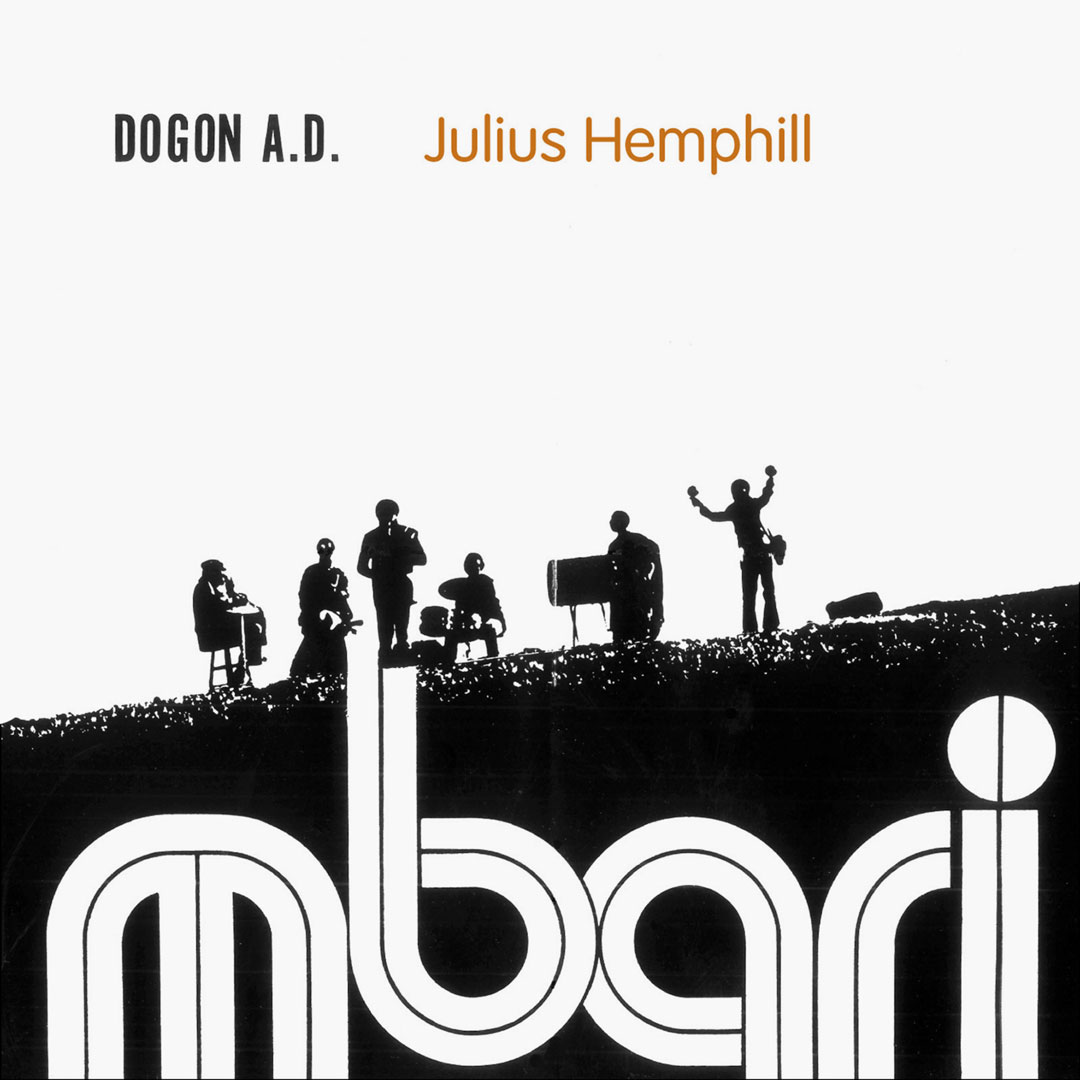
There must be something in the air around the saxophonist Julius Hemphill. Last year we caught sight of him via Moved by Sound’s release of Michael Gregory Jackson’s ‘Frequency Equilibrium Koan’ - a rare live recording from 1977 “loft era” New York - featuring Hemphill, Abdul Wadud, and Pheeroan aKLaff. Then, as if from nowhere, New World Records announced a stunning expanded CD release of his luminous debut as a leader, ‘Dogon A.D.’ from 1972, only to be shortly followed by Superior Viaduct’s release of a beautiful replica vinyl edition of the same record. Featuring the all-star line up of Baikida Carroll on trumpet, Abdul Wadud on cello; Phillip Wilson on percussion, and Hamiet Bluiett on baritone saxophone, with Hemphill leading the way on alto saxophone and flute, ‘Dogon A.D.’ was originally issued privately by the tiny Mbari imprint, and stands among the most important and creatively thrilling artifacts of St. Louis’ Black Artists Group, preceding many of its key figures relocating to New York.
Born in 1938 in Fort Worth, Texas, like a number of visionary free improvisors of his generation - Albert Ayler, Roscoe Mitchell, etc. - Julius Hemphill cut his teeth playing in the U.S. Army Band, before relocating to St. Louis, Missouri in 1968. It was there, shortly after his arrival, that Hemphill co-founded the Black Artists' Group (BAG), a loose association of young African American men and women, working collectively to contribute a “strong/fresh/inspirational creativity in the fields of Music/Writing/Dance/Drama.” Running for a handful of years until 1972, BAG emerged as an important sister collective to Chicago’s Association for the Advancement of Creative Musicians (AACM); connected by a shared dedication to the Black Arts Movement, as well as through the brothers, Lester and Joseph Bowie, the former being a founding member of the AACM and Art Ensemble of Chicago, while the latter belonged to BAG, alongside other noteworthy players like Hemphill, Oliver Lake, Floyd LeFlore, Hamiet Bluiett, Luther Thomas, Baikida Carroll, and Charles "Bobo" Shaw, to name only a few. A clear distinction, however, was BAG’s incorporation of a broader expanse of artistic practice, spanning, in addition to music, theatre, dance, poetry, and beyond. This creative ferment bubbles from within Hemphill’s debut LP as leader, ‘Dogon A.D.’, issued privately by the Mbari imprint, in 1972.
‘Dogon A.D.’ remains one of the defining documents of BAG, featuring a number of its most important musical artists: Hemphill on alto saxophone and flute, Baikida Carroll on trumpet, and Hamiet Bluiett on baritone saxophone. However, it equally doubles, through the presence of Abdul Wadud on cello and Phillip Wilson on percussion, as an important document of often overlooked connections between different geographic happenings within free jazz and Black Arts within the United States during the period during which it was made. In 1972, Wadud’s recording debut, ‘Al-Fatihah’ - made as a member of the Ohio based Black Unity Trio - was still relatively fresh, while his legendary, lone solo LP, ‘By Myself’, was still years down the road. His presence on ‘Dogon A.D.’ serves to illuminate some of his activities during the years between. At some point during the early 1970s, Wadud was introduced to Hemphill, who invited the cellist to St.Louis, where he would enter the orbit of BAG and establish a lasting collaborative relationship with the saxophonist, first appearing on ‘Dogon A.D.’, then its 1975 follow up, ‘Coon Bid'ness’, and 1978’s ‘Raw Materials And Residuals’, as well as both being members of the Human Arts Ensemble for the recording of “Çonceré Ntasiah”. Phillip Wilson, on the other hand, was an early member of the AACM and a founding member of The Art Ensemble of Chicago, who, following a brief foray as the drummer for The Butterfield Blues Band, would return to free jazz during the early 1970s, working extensively with Anthony Braxton, Roscoe Mitchell, and Lester Bowie, as well as David Murray, Hamiet Bluiett, and Frank Lowe, providing a clear illumination not only between BAG and the AACM, but also with important artists further afield.
Falling toward the end of the collective’s activities, ‘Dogon A.D.’ was recorded at Archway Studios, St. Louis, during February 1972. Both the original release on Mbari, as well as a more widely available edition, issued by Arista / Freedom in 1977, feature three pieces by the quintet, and deliver a whopping punch. The album is a breathtaking, visionary, and creatively towering piece of work, revealing its distinction at the outset, as its title track begins to unfurl. Rather than the heavy fire that marked much of free jazz of the moment, the band lays back and takes it slow, falling behind Hemphill’s soaring, shimmering lines in what might be described as a minimalist dirge or repetitive march, threaded by intermittent solos by the constrained tones of Carroll’s trumpet, and the sorrowful blues by Hamiet Bluiett, before collectively falling into the groove. While it feels so natural that it’s easy to overlook, it’s arguably Wadud’s playing - standing in where the bass normally would, pulling harmonic rhythms with his bow - that pushes the piece well beyond the expected realms.
The second track, ‘Rites’, heavily picks up the pace, being a fast paced flurry that nods toward the early innovations of Charlie Parker, Dizzy Gillespie, and Max Roach, before introducing complex polytonal and polyrhythmic collisions that feel closely aligned with roughly contemporaneous work by The Art Ensemble of Chicago, while pushing forever forward in some of the most brilliantly inspired free improvisation of its moment. Splitting a kind of distance, the album’s closer, ‘The Painter’ dials the tempo back down, while retaining its predecessor’s sense of complexity, which becomes that much more tense and revealing at this pace. The 15 minute excursion unfurls with a stunning flute solo by Hemphill, before the band falls in behind with a unity that flirts at the borders of spiritual jazz, entering further states of evolution by unleashing complex relationships in structure, timbre, and tonality between each instrument. In the simplest sense, in both its discreet moments and collectively, ‘Dogon A.D.’ amounts to a truly staggering piece of sonic art and one of the greatest gestures of free jazz of its time.
Originally published by Soundohm.