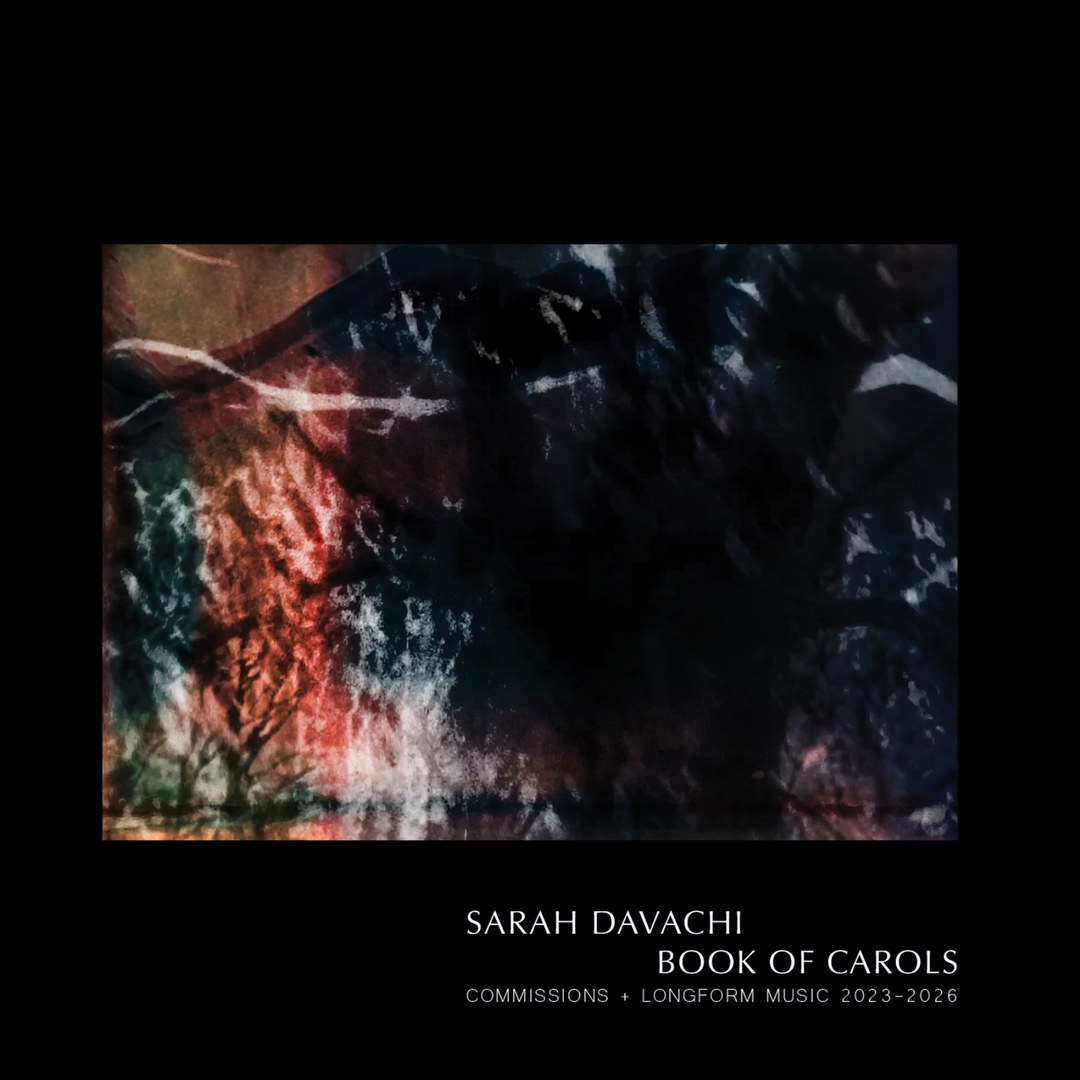
“Unfolding like a warm embrace of shifting tides, imbued with an unflinching sense of beauty, there couldn’t be a more generous place to leave the listener at the close of ‘Book of Carols’.”
Endlessly prolific and dazzlingly ambitious, building on the back of a startling run of releases over the last couple of years, Sarah Davachi returns, hot on the heels of ‘The Will of Tongues’ (among her greatest recorded achievements to date), with that album’s companion, ‘Book of Carols’, a X6CD boxset, comprising six long-form works, composed between 2023 and 2026. Dazing in its scope and immersive in its sounds and durations, comprising roughly five hours of music rendered by a brilliant cast of collaborators and the composer herself, just when you thought Davachi couldn’t outdo herself, she’s done it again, landing one of the best collections of music we’ve encountered this year.
Recorded releases always present a complex tension with regard to how we understand the nature and scope of an artist’s work. Those who receive a great deal of support by labels (usually connected to a perceived economic potential) are able to offer their audiences greater access to their work, and thus tend to be understood on more accurate terms and gain a greater position within the cultural landscape, while artists who receive less tend to be more misunderstood and overlooked. Fortunately, we live in a time during which a bit of commitment and effort, harnessing a DIY ethos, can sidestep these constraints when artists launch their own labels as platforms and means of distribution for their work. Among the most striking recent instances of this is Late Music, the imprint launched and run by the Los Angeles based, Canadian composer Sarah Davachi. Following her rapid emergence as one of contemporary experimental music’s most distinct and important voices during the second half of the 2010s, Davachi couldn’t be said to have suffered neglect on the part of the recording landscape. She has issued full-lengths on notable imprints like Cassauna, Students Of Decay, Constellation Tatsu, Important, Aventures Ltd., Ba Da Bing!, Black Sweat, Boomkat Editions, Recital, Another Timbre, and Portraits GRM, and thus can be considered to have received far more support than many of her peers. That said, it has only been through the platform of Late Music that we’ve been able to fully perceive the remarkable scope and ambition embodied across her canon of work, particularly when it comes to scale, with many of her releases on the label taking on extremely long durations. Only a handful of months ago, this materialized across the X3LP / X2CD editions of Davachi’s towering and engrossing ‘The Will of Tongues’. Now she’s back, pushing enveloping durational boundaries even further with ‘Book of Carols’, a X6CD boxset conceived as a companion to ‘The Will of Tongues’. Rippling with subtle complexity, informed by her dazzling understanding of harmonics and the long history of their relationships, ‘Book of Carols’ collectively delivers a vital and deeply human experimental music, alluding to a continuum, passing through the ages, at the very heart of expression through sound.
Born and raised in Western Canada, Sarah Davachi initially studied at the University of Calgary, before receiving her master's degree in electronic music and recording media from Mills College. With a developing career well underway and seven full-lengths already behind her on noteworthy imprints like Full Spectrum, Cassauna, Constellation Tatsu, Students Of Decay, and Aventures Ltd. (the majority of which were met with critical acclaim), in 2017 she relocated to Los Angeles to pursue a PhD in Musicology at UCLA. Davachi’s practice, as it has developed over the last decade and a half, represents a rare hybrid within contemporary experimental sound practice. Like members of previous generations of avant-garde composers (Terry Riley, La Monte Young, Lou Harrison, Harry Partch, etc.), she seeks resonance and meaning through a relationship with forms of music that do not utilize (and usually predate) the tuning system of equal temperament. Unlike the aforementioned composers, who drew inspiration from South and East Asian traditions (India, Java, China, Japan, etc.), Davachi taps European medieval and early music traditions, internalizing aspects of their resonances within her own. It is this body of work, emerging, evolving, and developing over the years since she moved to LA, that has increasingly found its ideal home on her own Late Music platform, where it doesn’t have to conform to the limits, be they temporal or monetary, faced by most labels when releasing an artist's work, and thus has steadily appeared within the cultural consciousness as a completely uncompromising body of work, collectively assembled across critically acclaimed full-lengths and collections like 'Cantus, Descant' (2020); 'Figures In Open Air' (2020); 'Antiphonals' (2021); 'Two Sisters' (2022); 'Long Gradus' (2023); 'Selected Works I & II' (2023); 'Music For A Bellowing Room' (2024); and 'The Will Of Tongues' (2026).
Sarah Davachi’s most recent full-length, ‘The Will Of Tongues’, issued this past August, stands as one of her most ambitious releases to date, comprising five new solo compositions for historical pipe organs, a suite of three choral pieces, a collection of “interludes” for various microtonal ensembles and a long-form chamber piece for string trio, organ, and tape, offering a remarkable sense of understanding and access to the scope and range of her work as a composer. ‘Book of Carols’, following quickly on its heels and conceived as a companion to ‘The Will Of Tongues’, explodes these perceptions and experiences to an even grander scale. Comprising six long-form works, each commissioned and recorded between 2023 and 2026 by various institutions and ensembles, and offered their own stand-alone CD, the box set collection covers a remarkable distance and sense of diversity over its sprawling durations, ranging from 35 to 70 minutes, and finds Davachi, within four of the pieces, incorporating electronic elements that helped define a great deal of her earlier work.
‘Book of Carols’ begins with ‘Long Dance Vale’, a 40-minute piece for electronics and two trombones, commissioned by The Broad Museum in Los Angeles, and composed across 2025 and 2026. Captured in this recording at the same venue, performed by Davachi on electronics and Mason Moy and Mattie Barbier on trombones, it's a stunning gesture of complex minimalism, which through its strong emphasis on brass and tonal duration, subtly nods toward those territories formerly explored by La Monte Young’s ‘The Second Dream Of The High-Tension Line Stepdown Transformer’, while pushing them into previously uncharted realms via microscopic and delicate interventions of electronics and increasingly challenging treatments of its drones. This is followed by the 2023 piece, ‘Diptych’, commissioned by Sonic Acts Biennial and de Bijloke, and performed by the duo, Ï Î, made up of the acclaimed aulos player, Lukas de Clerck, and the violist Victor Guaita Igual. Recorded at Kraakhuis, de Bijloke in Ghent, Belgium, ‘Diptych’ “explores the intricate nuances of duality... expressed through the interaction of the two musicians and Davachi, and in the distinct functions of [de Clerck’s] aulos’ two independent pipes, serving as both a chanter and drone”, while incorporating a “broad application of microtonality... [that] enables the two performers to dynamically navigate moments of perceived consonance and dissonance in real time.” Expressing itself as a minimalist lament of deep emotive qualities that ebb and flow across the work’s 40-minute duration, it’s an absolute stunner that renders endless surprises within its relatively constrained material means.
Diving into the third disc, we are treated to the New York based group, Ghost Ensemble’s (who brought us Catherine Lamb’s brilliant “interius/exterius” last year) rendering of ‘Basso Continuo’, which they commissioned from Davachi in 2024. Performed by Margaret Lancaster on flute, Sky Macklay on oboe, Melissa Achten on harp, Ben Richter on accordion, Cassia Streb on viola, Betsy Rettig on cello, and Lillian Young and Scott Worthington on contrabass, the piece’s title refers to a harmonic structure that was used extensively during the Baroque era, most often consisting of a bass line and a chord progression. In Davachi’s hands, the form becomes a shimmering example of deconstruction and glacial restraint, executed to sublime ends by the ensemble: each instrument’s part entering and fading in varying durations and combinations, collectively hanging in the denseness of space with a seeming slowing or suspension of time. Reaching a highpoint just over half way through the monumental expanses of ‘Book of Carols’, she delivers ‘Double Reeds’, a piece played by herself on Hammond organ and tape, premiered at CTM Festival in 2026, and created as the audio component of the film ‘Hivernale’ by her longtime collaborator Dicky Bahto. Clocking in at a full hour in length, the piece “explores a harmonic and spatial exchange between the Hammond B3 electromechanical organ and the [rotating] Leslie speaker... alongside just intoned sine tones and just intoned woodwind and brass samples.” Like many of Davachi’s works comprised by the collection, there are subtle, embedded nods across the history of music within ‘Double Reeds’, most striking to the sonic potential and qualities of the electric organ harnessed by composers like Terry Riley over his long career. However, beyond those shared elements and that both composers are held within the loose frameworks of Minimalism, the comparisons more or less end there. ‘Double Reeds’ slows down time in sharp contrast to Riley’s most common use of the organ (deploying rapid patterns and arpeggios), forcing the ear toward subtle sonic relationships and evolutions bordering on the melodic without ever fully forming as such.
Remarkably, with just over three hours of music already behind us, ‘Book of Carols’ still has two more hours of musical revelations, spanning the final two discs. The first of these comprises ‘Three Unisons for Four Voices’, commissioned by the Montréal-based ensemble, NO HAY BANDA, in 2023 and completed the following year. Clocking in at 70 minutes, it encounters the electronic contributions of Daniel Áñez’s ondes Martenot playing foil to the remaining ensemble of Adrianne Munden-Dixon on violin, Audréanne Filion on cello, Lori Freedman on bass clarinet, Kalun Leung on trombone, and Noam Bierstone on percussion, providing a dense and lush immersion into the realms of durational tonality and harmonics, before concluding the collection’s incredible journey with the 2023 MoMA commission ‘Brass Chant’, performed by the Los Angeles based microtonal ensemble Diapason (Nev Wendell, trumpet; Nicholas Ginsburg, horn; Mattie Barbier, euphonium; and Mason Moy, tuba), which notably contributed to ‘The Will Of Tongues’. Unfolding like a warm embrace of shifting tides, imbued with an unflinching sense of beauty, there couldn’t be a more generous place to leave the listener at the close of ‘Book of Carols’.
Originally published by Soundohm.