Marcel Duchamp
Marcel Duchamp (1887-1968) was a French-American artist associated with Cubism and Dada and widely regarded as a forerunner of conceptual art. He is best known for the readymade Fountain (1917), the painting Nude Descending a Staircase, No. 2 (1912) and The Large Glass. Between 1912 and 1915 he also wrote a few musical pieces built on chance procedures, decades before chance became central to the work of John Cage. Duchamp's surviving music consists of two compositions and a note for a musical happening. Erratum Musical, for three voices, was published in 1934.
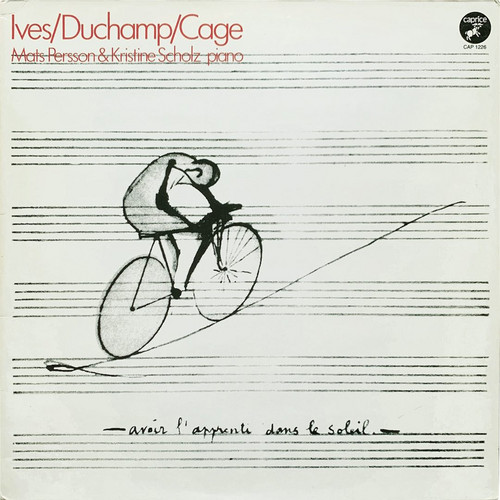
Ives/Duchamp/Cage
Historical avant-garde pieces for two pianos (prepared, quarter-tone or with tape) spanning from 1913 to 1944, performed by Kristine Schol and Mats Persson and released on Caprice in 1982 and never re-issued on either LP or CD.

Il Gesto Del Suono
2009 release ** Featuring: Marcel Duchamp, John Cage, Steve Jansen, Demetrio Stratos, Emanuele Casale, Robert Ashley, Stefano Scodanibbio, Edoardo Sanguineti, Nine Horses, Walter Prati, Robert Wyatt, Fred Frith, Massimiliano Viel, Picchio Dal Pozzo.
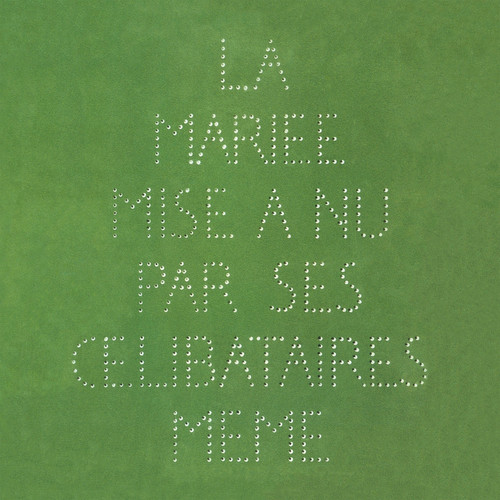
Musical Erratum + In Conversation
*2022 stock* This 74 minute album offers four spoken word extracts by Marcel Duchamp (in the English language), including The Creative Act, a fascinating lecture delivered in Houston in 1957, as well as a lengthy interview recorded in 1959.
The remai…

The Entire Musical Work Of Marcel Duchamp
Another legendary album which was issued on LP by Multhipla label, "The Entire Musical Work of " Marcel Duchamp realized by Petr Kotik and S.E.M Ensemble. Work planned and composed in 1913, based on chance operation. Recorded 7 May, 1976. B2 is a tra…
Sold Out
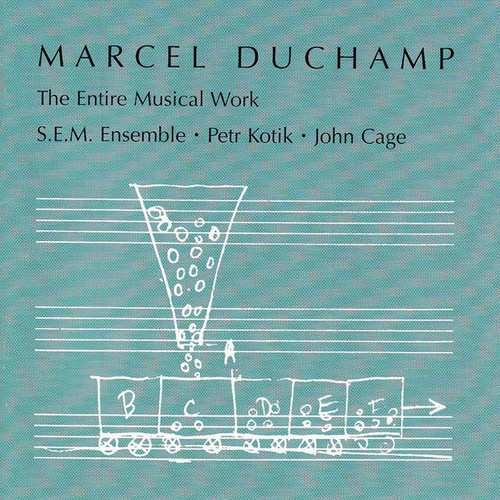
The Entire Musical Work
Originally issued in 2000, this is the first release from this 20th century composer's label, based out of the Paula Cooper Gallery in NYC; performed by Petr Kotik's S.E.M. Ensemble, with John Cage on one piece. This CD was recorded in 1987 by S.E…
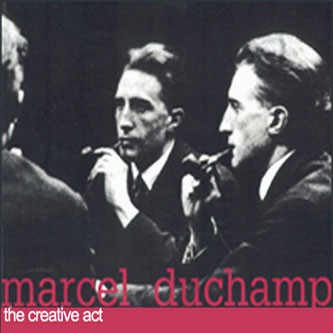
The creative act
deluxe digipack cd with booklet (english and french) : lecture in Houston, Texas - April 1957 some texts from à l'infinitif (1912-1920) ; lecture in New York, shortly before his death musical erratum (la mariée mise à nu par ses célibataires, même) ;…
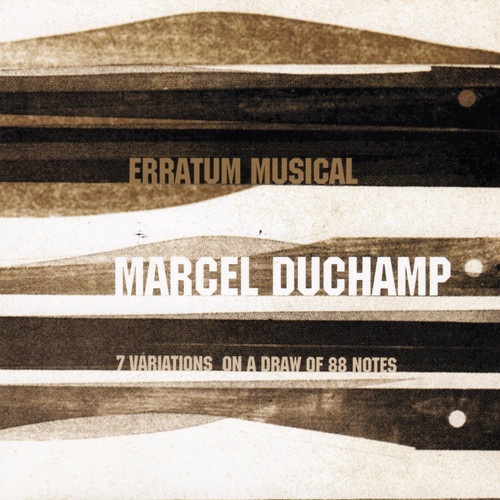
Erratum musical
the principle of musical erratum is simple: you choose a keyboard - any keyboard - you draw each note at random - no note can be struck twice, but all are struck - the resulting whole is played without any particular modulation, "a uniformity de rhyt…