
Traveller On the Road
**300 copies, clear LP** With perhaps the most impactful, harrowing take on minimalist drone since they released Kevin Drumm’s Imperial Distortion over a decade ago, Hospital Productions finally release the first proper new album from Skin Crime in years, a quietly harrowing, Japanese ghost story-inspired album of darkest ambient and industrial shadowplay inverting noise convention and exploring ideas of tense, slow-burn patience instead of aggressive intensity.Described by the label as “the mis…

It Should Be Us
**2020 small repress** Andy Stott’s first release since 2016 and first EP since 2011, It Should Be Us is a double EP of slow and raw productions for the club, recorded this year and following a series of EPs that started with Passed Me By and We Stay Together early this decade. Recorded fast and loose over the summer, these 8 tracks harness a pure and bare-boned energy, melodies subsumed by drum machines and synths; slow, rugged hedonism. It’s all about rhythmic heat and disorientation, pure dan…

Tape Anthology Vol. 1
With his new record Tape Anthology Vol. 1 Christoph Berg kicks off an album series mainly focusing on works based on tape manipulation. At the same time it marks the inaugural release of his own imprint Monochrome Editions.Christoph is a classically trained piano and violin player whose curiosity and cultural interest are by no means bound to that category, or any others for that matter. For the past few years he has also been broadening his approach to composition by researching and experimenti…
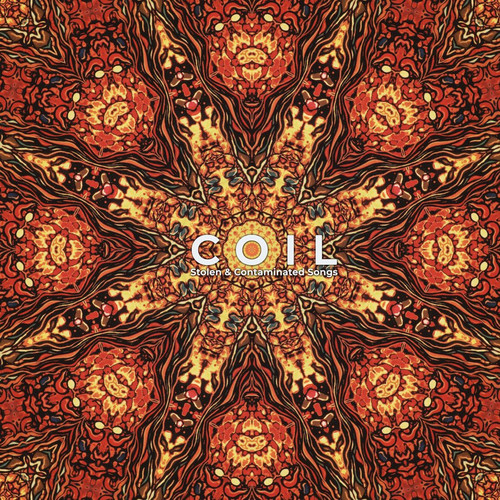
Stolen & Contaminated Songs
**CD version in 6-panel digipack** Cold Spring are proud to announce the long-awaited reissue of Coil’s 1992 album, presented on CD and, for the first time, on vinyl. Stolen & Contaminated Songs was recorded and produced in 1992. It is comprised of over 60 minutes of outtakes and unreleased songs, evolved during the recording sessions for their prior album, Love’s Secret Domain. A wealth of superb material showcasing the diversity of Coil: dark, violent, vivid and fractured, yet cohesive and bea…
Sold Out
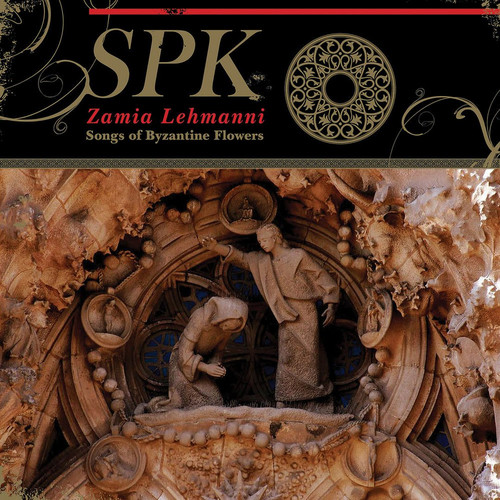
Zamia Lehmanni (Songs Of Byzantine Flowers)
**CD version in 6-panel digipack** "Originally released by Side Effects in 1986, Zamia Lehmanni was the third (and final) core SPK album and was Graeme Revell’s first truly solo project. He was in a period of transition, somewhere between the industrial noise of the early years and his later award-winning soundtrack work. On the day before this was first released, this style of music, now ubiquitous (especially in soundtracks), did not exist.After Information Overload Unit cleared a space for su…

Beehyden / Sinopia / Contagious / Bagatelle
Four remixes of four tracks taken from the latest albums on Morphine Records, by Erika, Zoë Mc Pherson, Sugai Ken and Thomas Brinkmann. Hand-crafted cover by M-L-XL.A1 Original version on doser035Lp AMA by MA.Reworked by Sugai Ken.A2 Original version on doser033LP Euganea by Upperground Orchestra.Reworked by Erika Sherman.B1 Original versions from on doser036LP Contagious by Contagious.Remixed by Zoë Mc PhersonB2 Original version on doser034LP Quellgeister3 by Stefan Fraunberger.Reworked by Tho…

New Found World
**400 copies** Reissue of this 1988 Ambient album, includes one unreleased track. Beautiful electronic soundscapes and synthesizer voyages on here! In 1916, in the middle of the First World War, a small town in Ontario changed its name from Berlin to Kitchener. Many mercurial decades later, in 1988, the town now a mid-sized city, a duo called Vernal Equinox released a record that seemed to trace its roots back to Berlin, but this time the shadowy post-war Berlin of the 70s that produced Tangerin…
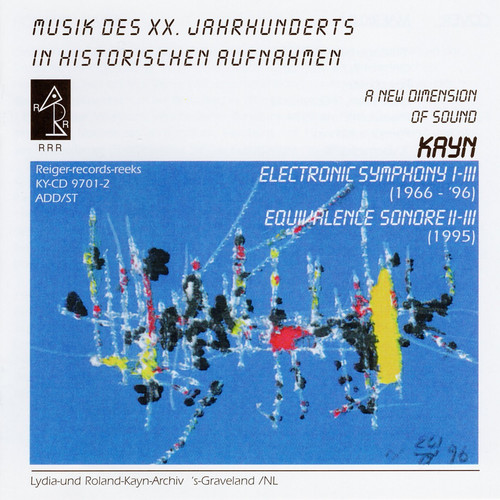
Electronic Symphony I / III
The first instalment of the ten Electronic Symphonies: Symphony I (1966-96), II (1970-96) and III (1971-97), with Equivalence Sonore II and III from 1995. Pieces concreted in real time by a complex autonomous electronic system, a process Kayn documented rather than composed.
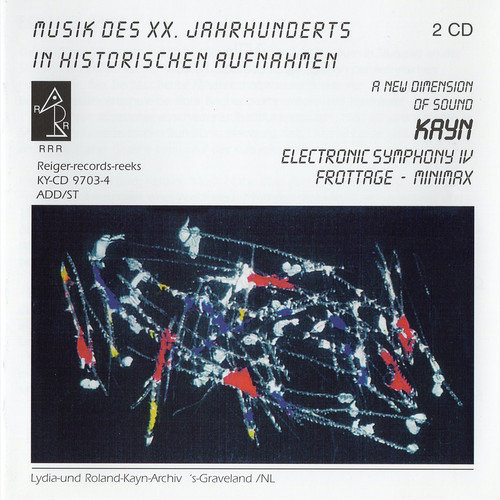
Electronic Symphony IV
Electronic Symphony IV (1988-96) unfolds over four sections across two discs, joined by Frottage and Minimax, both from 1996. Sound generated in real time by an autonomous electronic system: since the process cannot be retraced, the recording itself stands in for the score.
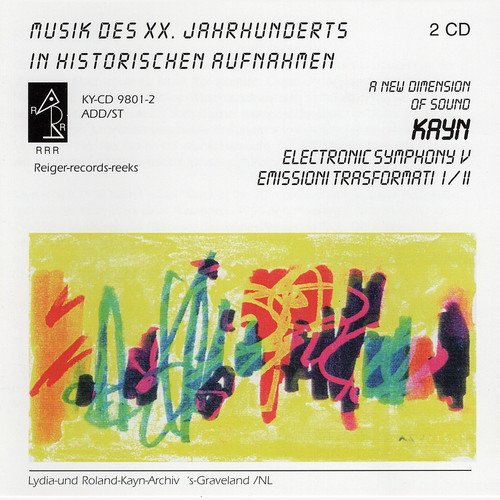
Electronic Symphony V / Emissioni Trasformati I-II
Electronic Symphony V (1977-97) in two sections, one per disc, each paired with one of the Emissioni Trasformati of 1996. Twenty years of revision folded into music that a complex autonomous electronic system concreted in real time, beyond any traceable authorship.
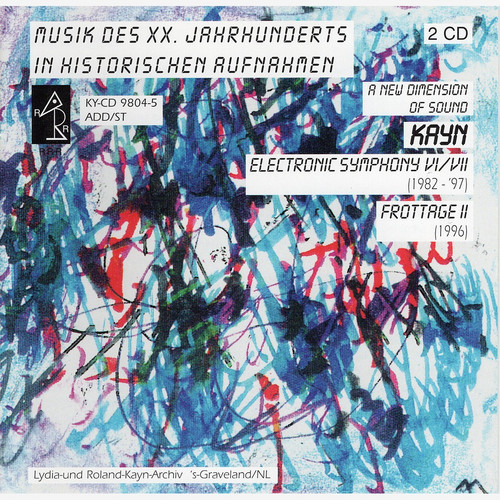
Electronic Symphony VI / VII
Electronic Symphony VI (1982-97) on the first disc, Symphony VII (1984-98) and Frottage II (1996) on the second. Two of the longest gestations in the cycle, worked over fifteen years and left to a self-regulating electronic system to concrete in real time.

Electronic Symphony VIII / X
The close of the cycle: Electronic Symphony VIII (1978-98) and the single-year Symphony IX (1999) on the first disc, Symphony X (1982-99) in two sections on the second. Thirty years of Kayn's generative studio work arriving at its last and largest statements.

Kybernetische Musik
The first volume of Kayn's cybernetic works: Ready-Made I and II (1982) on one disc, Collage and Decollage (1984) on the other. Four long pieces that arise, in the composer's words, from the interplay of merged control loops setting a process into motion.

Kybernetische Musik II
The second volume of Kayn's cybernetic works, a single CD holding two long pieces: Assemblage (1984) and Refractions (1995). Music not composed and practised but set going, arising from merged control loops and feedback in a system that can be entirely autonomous.

Kybernetische Musik III
The third volume, six pieces from 1986 to 1996 across two discs: Cybernetic Serendipity, Transfluxion and Syntropie on the first, An Artificial Acoustic Environment, Syzygy Dynamical Units and Equivalence Sonor I on the second. A decade of self-regulating systems at work.

Gärten Der Lüste / Cybernetics II / L'Innominata
Two long pieces from the turn of the millennium, Gärten Der Lüste (1999-2000) and L'Innominata (2000), each in two sections, with the early Cybernetics II (1969) set between them on the first disc. Thirty years of Kayn's electronic practice in a single pairing.

Invisible Music / Hommage a K. R. H. Sonderborg
Invisible Music (2003) spread over three parts across two discs, followed by Hommage a K. R. H. Sonderborg from the same year. Late Kayn, sound with no visible source, left to a self-regulating electronic system to unfold at its own pace.
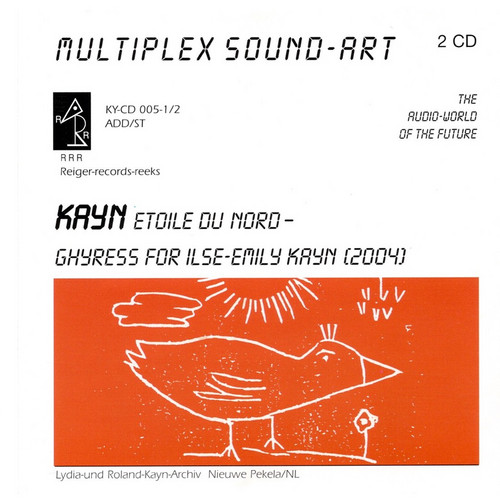
Etoile du Nord / Ghyress Für Ilse-Emily Kayn
Two long pieces from 2004: Etoile du Nord in two parts on the first disc, Ghyress für Ilse-Emily Kayn on the second, named for the daughter who would later reawaken her father's label. Among the last titles Kayn issued on Reiger Records Reeks himself.
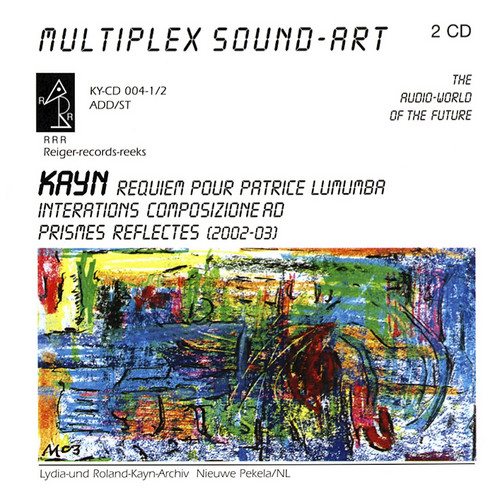
Requiem pour Patrice Lumumba, Interations, Composizione AD
Issued under Kayn's Multiplex Sound-Art heading: Requiem pour Patrice Lumumba (2002) and Interations (2003) on the first disc, the four-section Composizione AD (2002) and Prismes Reflectes (2002) on the second. Among the most recent pieces the composer completed.

Ultra / Redundancy TR / Megaphonie
Also under Kayn's Multiplex Sound-Art heading: Ultra (2001) and Redundancy TR (2003) on the first disc, the three-section Megaphonie (2001) on the second. Three of the last pieces Roland Kayn completed and released on his own label.