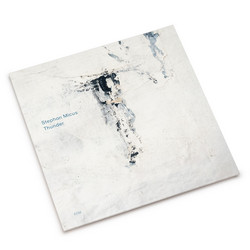
For nearly fifty years Stephan Micus has wandered the world as a one‑man ensemble, collecting instruments and techniques the way some people collect maps. A self‑taught multi‑instrumentalist, he has released close to thirty albums since the 1970s, always recorded alone, always with an ever‑expanding arsenal of wind, string and percussion instruments from across the globe. What began as curiosity about “traditional” and “exotic” tools has long since become a singular musical language: Micus studies original playing styles, then quietly bends them, placing each instrument in unconventional roles until it speaks in a voice that is his and no one else’s. The result is a body of work that turns the studio into a private sanctuary where worlds meet.
Behind Eleven Deserts is one of the most luminous early instances of that vision. Composed in 1978, the piece assembles a small, strikingly diverse group of instruments: the Balinese bamboo flute suling, with its breathy, agile tone; the Indian sarangi, whose warm timbre often evokes a human voice or cello; the Indian sitar, with its tangling overtones and sympathetic strings; and the Irish frame drum bodhrán, whose skin‑deep pulse anchors the whole. Rather than treating this instrumentation as a showcase of “world music” colour, Micus lets it function as a single, multi‑limbed creature. Lines and timbres weave so closely that it becomes difficult to tell where one tradition ends and another begins.
The soundscape that emerges feels both geographically unplaceable and emotionally precise. Suling phrases trace long arcs over low sarangi drones; sitar figures glint at the edges like heat haze; the bodhrán’s slow heartbeat keeps time in a way that feels more like walking than counting. As with much of Micus’s music, the pacing is deliberate, almost ceremonial. Themes are allowed to appear gradually, repeat with small variations, and then dissolve back into silence. Listeners are not pushed toward climax so much as invited into a meditative space where beauty resides in shade, grain and the way resonance hangs in the air.
At the heart of Behind Eleven Deserts lies a simple but powerful idea: instruments from radically different cultures can blend not just politely, but deeply, if they are approached with care and imagination. Micus’s arrangements suggest a form of listening that moves beyond token “fusion,” toward genuine coexistence. The piece gives the sense of standing at the edge of many landscapes at once – Balinese, Indian, Celtic, imagined – while feeling firmly rooted in an inner terrain of reflection and calm. In an era marked by fragmentation, this quietly articulated vision of harmony carries a subtle, enduring hope.
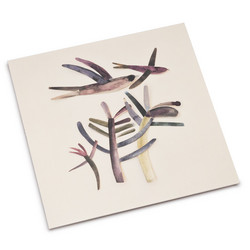
More than four decades after its creation, Behind Eleven Deserts now appears for the first time in the Intuition Master Series as a carefully remastered 180‑gram vinyl edition from Intuition Music. The new mastering reveals fine details in Micus’s playing – the attack of fingers on strings, the slight rasp of bow on sarangi, the breath inside the flute tone – without disturbing the piece’s soft glow. What sounded timeless in 1978 has lost none of its intensity or relevance; if anything, its sense of patient, border‑crossing attention feels even more necessary. This edition restores Behind Eleven Deserts not just as a historical curiosity, but as a living work that continues to open a door into Micus’s vast, contemplative world.