HeghL
Du Jeu Idéal (LP, White + 6 Artworks Box Set)
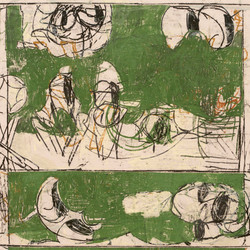
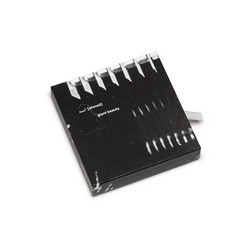
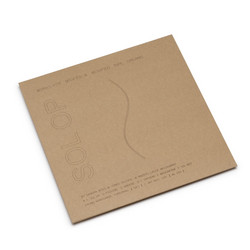
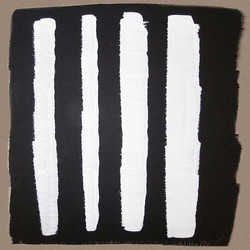
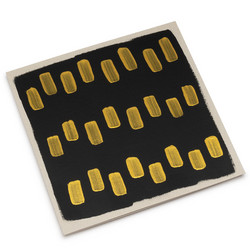
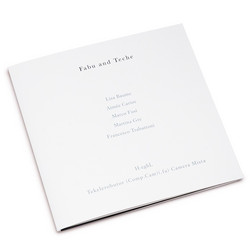
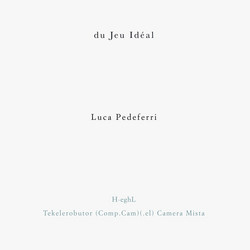
** Edition of 80 copies. LP + Artist’s Signed Drawing "Aura" and "Bagatelle", "Continuum", "Pieghe", "Matinèe" and "Note" Artworks ** Trying to give musical form to the thirty‑four series of Gilles Deleuze’s Logic of Sense sounds, at first, like a deliberate folly: a game of wishful thinking that risks collapsing into the same nonsense it invokes, like the paradoxical situations in Alice in Wonderland or Deleuze’s own examples. Du Jeu Idéal leans into that risk and uses it as a compass. Under the name Tekelerobutor (op.el), HeghL narrow their focus to “du jeu idéal”, the tenth series of Logic of Sense, and build a meeting ground between Luca Pedeferri’s piano textures and a condensed constellation of works by Lisa Baume and *Francesco Trabattoni. Each encounter between sound, text and image is treated as a transformation point where at least one fork in the road appears: one branch leads toward an archive, sealing a configuration into more or less fixed form; the other redraws and reconfigures every element involved, pushed by the new associations and forces that contact generates.
At the heart of the project is Deleuze’s notion of the game without rules. In Logic of Sense, any game utterly stripped of rules is a game that entertains no one, yet by dispersing itself across surfaces and drifts of nonsense it becomes an expression of pure thought. As a fragment of the unconscious, it slips beyond capture: unorganised or unorganisable, resistant to enactment, it opens onto a non‑place where uniqueness, whatever, and every‑time‑every‑time collapse into a single, singular expression. That expression is structurally unproductive and unrealizable; it cannot simply become a “thing among things” except through a work of art. Du Jeu Idéal takes this as both problem and method: how to stage a ruleless, useless, even “sterile and boring” event in sound, and how to let its traces appear without solidifying into doctrine.
Time is the other material. Deleuze insists that the chaotic event of the ruleless game is also temporal: an infinitely divisible time, different on every execution. In this project, the habitual figures of time – past, present and future – are treated as characters that can act or suffer, capture and contract, retain or cancel, leave or take back, engulf, contain or expel. Tekelerobutor’s “Mixed Room” tries to connect these elements: the game without rules, nonsense, chance, and the contractions and variations of time, both musical and lived. The music is built from sequences that intersect and disentangle these dimensions again and again, none definitive, each recomposing signs and layers, redrawing relationships between things and between the effects of nonsense. Power relations between forms are not described so much as tested: Pedeferri’s piano becomes a site where the “ideal game” can briefly unfold and appear, contract to the point of disappearance, and embrace – incorporeally – whatever remains of the visible.
Throughout, the piano pieces refuse narrative payoff. Instead, they explore shifts of register, density and silence that mirror the way Deleuzian series slide over one another: motifs that seem to establish rules only to evaporate, rhythmic figures that suggest a grid then allow time to fray at the edges, harmonies that hint at resolution while drifting sideways. Baume and Trabattoni’s works act less as illustrations than as parallel surfaces, other planes on which the same ideal game inscribes itself differently. In this sense, Du Jeu Idéal is not a soundtrack to Logic of Sensebut an experiment performed alongside it: a mixed room where philosophy, improvisation and composition share the same unstable floor, and where every listening becomes just one more throw of a game that, by definition, can never finally be won or lost.