Big Tip! Sukegawa's environmental music was heard by thousands of people, none of whom were listening. For more than a decade from the late 1980s he wrote music that played in the offices and research buildings of a large Japanese construction firm, composed by calculating backward from the response of the ceiling speakers it would emerge from, tested against questionnaires filled in by three thousand employees. It was never released, never performed in concert, never reviewed. It filled a space for a day and was gone.
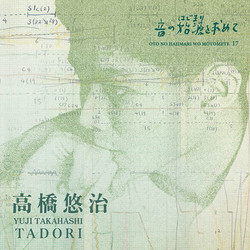
Toshiya Sukegawa (1930-2015) belonged to the first Japanese generation to work seriously with electronic sound, alongside Toshiro Mayuzumi, Joji Yuasa and Toru Takemitsu. From 1953 he sat in Minao Shibata's twelve-tone study group reading Leibowitz in the original, in a room that at various points also held Yuji Takahashi, Naozumi Yamamoto and Chumei Watanabe. He took first prize at the Japan Music Competition in 1954 while still a student. Having seen the avant-garde from inside, he drew an unusual conclusion: that the difficulty of contemporary music came from leaving timbre fixed while making structure ever more complex. Renew the timbre, he argued, and you no longer need the complexity. The wartime background matters here. At school in Sapporo he had been beaten and told that spirit would make up for American materiel, and he emerged with a lasting distrust of irrationalism and a corresponding faith in machines.
This is what separates him from the figures now most associated with Japanese environmental music. Hiroshi Yoshimura and Satoshi Ashikawa came to it from design and contemporary art. Sukegawa came from the academy, and never left it. His own definition of the form gave practical function priority while insisting that a new site of musical creation could be built inside that function. Contemporary music criticism had no vocabulary for the result, and largely ignored it.
The two discs divide along that fault line. The first collects work connected to the NHK Electronic Music Studio, where scores and documentation survive: The Eternal Morning, written for the anniversary of Hiroshima, the theme music for NHK's contemporary music programme, and Chant Du Vent (1980), his first purely electronic piece, whose melody was played by assigning pitches to individual faders and moving them by hand. The second disc is the harder material to reconstruct, drawn from what he made alone in his own studio: Bering Strait (1986), built on a Roland JUNO-60 and a four channel multitracker, alongside pieces written for break times, for evenings, for afternoons. Some were commissioned as alpha wave inducing music, or to raise productivity. Nishi has selected them by how they sound now rather than by what they were once for.
The reappraisal came from outside. In the second half of the 2010s, foreign diggers assembled Japanese environmental music of the 1980s into a category and gave it back its Japanese name, and the Light In The Attic compilation Kankyō Ongaku was nominated for a Grammy in 2020. Sukegawa's institutional work began accumulating hundreds of thousands of plays online while remaining absent from the histories written in his own country. This release is a deliberate intervention in that asymmetry, and it exists because he handed roughly fifty master DATs to Koichi Nishi before his death, with permission to do as he liked with them.
Eleven years after his death, the tapes have finally become a record. Compiled, annotated, mastered and designed by Koichi Nishi with the cooperation of the Sukegawa Archives. Noise and dropouts are inherent to the master tapes.
CD1
1. The Eternal Morning Op.68 (1983)
2. Chant Du Vent Op.62 (1980)
3-4. Theme Music For NHK Radio Program (1990)
5. The Green Chickweed Has Not Sprouted Op.78 (1989)
6. Structure Op.59 (1978)
CD2
1. Bering Strait (1986)
2. Music For 8:30 A.M. (1991)
3. Music For Break Time 1 (1989)
4. Music For Break Time 2 (1989)
5. Evening (1995, Type 2)
6. Afternoon (1995, Type 3)
7. Requiem (1997, Type 2)
8. Lacrimosa (1999)
9. Night Rain (1999, Take 1)