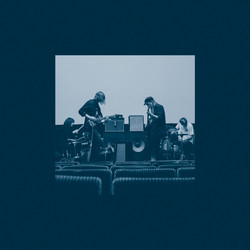
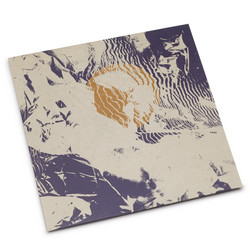
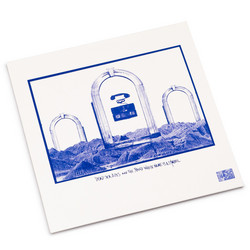
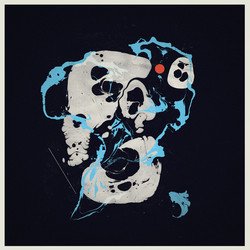
On The Run arrives as Shutaro Noguchi’s most quietly personal record to date - not because it was conceived as a grand last statement, but precisely because it wasn’t. Tracked just weeks before his return to Japan after two decades in the United States, mostly spent in Louisville, Kentucky, the album captures a musician in mid‑stride, glancing back at a life built in one place while stepping into another. Louisville had given Noguchi a musical home: from the country‑rock swagger of Ryan Davis and the Roadhouse Band to the mutant, worm‑eaten grooves of Equipment Pointed Ankh, and his own full‑band psych missive Love Super Terraneanfor Feeding Tube. Here he circles back to The Roadhouse Band one more time, using their easy rapport as a launchpad for an album that feels like a threshold - rooted in shared histories, already haunted by departure.
The tone is set from the start. Opener “Olympic 3.5” begins in bare solitude, just voice and a sense of weather rolling through: “Now the wind is blowing / It’s passing me by … I’m getting a little too used to watching this sunset.” The image is simple, the feeling anything but. As the song unfolds, the Roadhouse players slowly inhabit the space: syncopated drums, lilting synths, and subtle production sleights twist the track into a warped road‑movie odyssey that suggests an unlikely triangulation between Gong’s cosmic wanderlust and Ryuichi Sakamoto’s melodic, pop‑abstracted clarity. Noguchi slips into Wyatt‑like wordless vocalising, using timbre more than text to carry emotion, before the piece tilts into a darker, more abstract descent - as if the song itself had noticed that the sunset he’s “too used to watching” is about to be his last in that place.
Elsewhere, the record leans toward a jazz‑tinted, gently off‑centre songcraft that foregrounds Noguchi’s compositional voice. “Apocalypse/Calendar” and “River Dagger” move with a relaxed, almost conversational vocal delivery over arrangements that refuse tidy genre tags: brushed drums and loose, modal harmonies meet curious synth colours and unexpected turns in form. “Drive My Cape Cod” is the album’s most candid fragment, built from a phone voice memo captured on a long car ride and later completed in the studio. The seams are left visible by design, in a Maher Shalal Hash Baz spirit: the casual, slightly unpolished quality becomes the point, a glimpse of melodic daydreaming that reveals more than a pristine studio take might.
Some of On The Run’s most immediate pleasures lie in its groovier passages, where Noguchi and the band tap into a lineage of Japanese pop and dub‑wise experimentation without ever sounding derivative. “Melody” marries a hazy City Pop nostalgia to the Roadhouse Band’s forward‑leaning feel, letting bittersweet chords and a gently bobbing rhythm section carry a tune that feels both familiar and strangely skewed. “Time With You” floats on a bubbly, almost weightless groove; in a sly bit of role reversal, the album’s only true guitar solo is played not by guitarist‑producer Noguchi, but by Ryan Davis. The choice hints at a deeper shift. Several years ago, Keiji Haino suggested to Noguchi that he consider focusing less on guitar pyrotechnics and more on his singing, an offhand piece of advice that quietly catalysed the move away from the frantic, pedal‑driven approach of his 2018 debut toward the more song‑centred, vocally invested music heard here. Over the track’s breezy surface he sings, almost matter‑of‑factly, “It’s beginning to change / The time of the world / Eventually we’ll see it,” accepting the churn of circumstance without pretending to resolve it.
Throughout On The Run, that acceptance gives the record its emotional through‑line. These songs sit in the uneasy space between a life that’s already ending and one that hasn’t yet begun, and they refuse to tidy that ambiguity into a simple goodbye or a sunny fresh start. Instead, Noguchi and The Roadhouse Band lean into uncertainty as a shared condition: their playing is loose but attentive, their arrangements full of small, supportive gestures that leave room for hesitation and doubt. The result is an album that feels both modest and quietly expansive, the sound of friends facing an unknown horizon together. In a moment when so many are negotiating their own displacements and reroutings, On The Run resonates as more than one musician’s farewell to Louisville; it’s a reminder that there is grace, and even a kind of joy, in admitting you don’t yet know where the road is leading, only that you’re willing to walk it in good company.