György Kurtág, Kurt Widmer, Orlando Trio, Mircea Ardeleanu
Signs, Games and Messages - Friedrich Hölderlin / Samuel Beckett
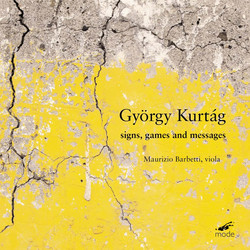
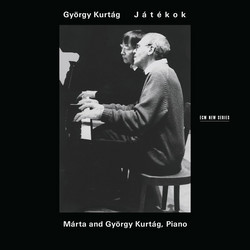
Signs, Games and Messages brings together three cycles by the Hungarian composer György Kurtág, spread over 59 tracks of which only one passes three minutes. Two cycles for baritone, the Hölderlin-Gesänge and ...pas à pas – nulle part... on texts by Samuel Beckett and Sébastien Chamfort, frame the string work in progress that gives the album its title. It was his first new ECM album in six years after Játékok, and it received the annual prize of the Preis der deutschen Schallplattenkritik.
The recording was made in February and March 2002 at Radio Studio DRS in Zürich, produced by Manfred Eicher with Markus Heiland as engineer. The baritone is Kurt Widmer. The Orlando Trio (violin, viola and cello) plays the string pieces and joins him in the Beckett cycle, with Mircea Ardeleanu on percussion. A trombone and a tuba appear in a single Hölderlin song. ECM notes that the performers worked on this music with the composer over several years.
The Hölderlin-Gesänge, op. 35a, are mostly unaccompanied, a line of incantatory phrases that Andrew Clements compared to plainchant. Only the third song, Gestalt und Geist, adds trombone and tuba as a harsh backdrop, and the cycle ends with a setting of Paul Celan's Tübingen, Jänner. The string pieces are solos, duos and trios, many of them homages, such as Hommage à J.S.B., Hommage à John Cage and Eine Blume für Dénes Zsigmondy. ...pas à pas – nulle part..., op. 36, sets Beckett's short French poems and Chamfort's maxims in 34 movements, several of them dedicated to Boulez, Ligeti, Lachenmann, Satie and others, with a vocal range that runs from whisper to cry.
Writing in The Guardian, Clements heard the Beckett cycle as an extended nocturne on darkness and death and wrote, "It is one of Kurtág's greatest achievements." He called the string pieces the counterpart to Játékok. In The Independent, Rob Cowan placed Kurtág beside Webern and Bartók and called the disc "a supreme example of his art". It was also a Le Monde de la Musique Choc du mois.
This is the CD edition of ECM New Series 1730, released in May 2003, with booklet notes by Thomas Bösche in German, English and French.