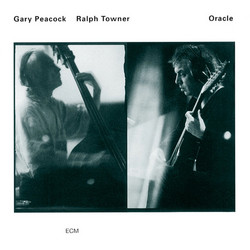
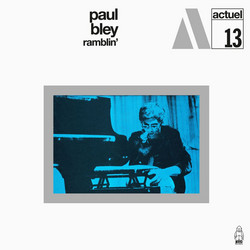
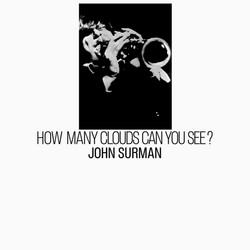
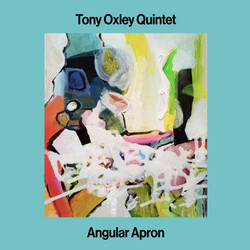
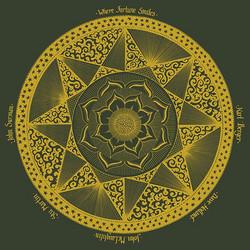
In the Evenings Out There is a free improvisation session led by the Canadian pianist Paul Bley. With him are Gary Peacock on bass, Tony Oxley on drums and John Surman on baritone saxophone and bass clarinet. Released by ECM in 1993, it is a quartet record more in name than in practice. Most of its twelve pieces are solos, duos and trios, and the four play together at length only once.
The music was recorded at Rainbow Studio in Oslo in September 1991, two years before its release, with Manfred Eicher producing and Jan Erik Kongshaug as engineer. The writing credits follow the changing line-ups. Bley signs four pieces alone, Peacock and Surman two each, and the other four are shared, one of them by the whole group. Bley and Surman had already worked together on ECM in Bley's quartet album Fragments, recorded in Oslo in 1986. The booklet carries an interview with Bley conducted by Steve Lake.
Interface, credited to all four players, is the one extended quartet performance, a little over five minutes long. Surman's Article Four, the longest track at almost eight and a half minutes, puts his bass clarinet in the foreground, while his shorter Alignment belongs to the baritone. Fair Share is a duet for Bley and Peacock, and the brief Spe-cu-lay-ting pairs Bley with Oxley. Several pieces last under four minutes, and the record ends with Bley's own Note Police, close to eight minutes long.
Critics stressed the calm of the session rather than its freedom. In his AllMusic review David R. Adler called it "a remarkable encounter between four top-notch musicians" and pointed to its "mysteriously soothing, meditative quality". The Penguin Guide to Jazz described the music as entirely collaborative, noting how few tracks use the full group. Writing on ECM Reviews in 2012, Tyran Grillo heard a record more about space than time. He judged it the most honest capture of free jazz by a quartet on the label since Fragments.
This is the CD edition, catalogue number ECM 1488, of the album first released in September 1993.