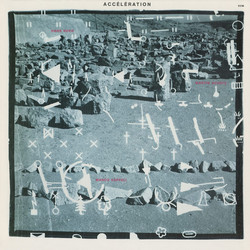
Q.E.D. is one of Terje Rypdal's records as a composer of concert music, made with the Norwegian chamber group Borealis under Christian Eggen. It joins two scores in which his electric guitar is a solo voice inside a written ensemble, the five-movement title work, Opus 52, and the Largo, Opus 55. For listeners who know Rypdal from his jazz and rock-inflected trios, it shows the other half of his output, slow-moving music that sits closer to contemporary composition than to improvisation.
The Latin title, Quod Erat Demonstrandum, is scored for electric guitar, flute, clarinet, bassoon, two French horns, piccolo trumpet, two violins, two violas, two cellos, fretless bass or double bass, and bass drum. It was recorded in August 1991 at Rainbow Studio in Oslo, and the Largo, for guitar, string ensemble and bass drum, followed there in December. Jan Erik Kongshaug engineered, Manfred Eicher produced, and Steve Lake wrote the liner notes. Eggen had already conducted on Rypdal's earlier orchestral album Undisonus, issued by ECM in 1990.
Q.E.D. lasts about 35 minutes, and its fifth movement alone takes up more than half of that. The opening movement belongs to strings and winds, and the guitar only enters in the second, singing over a swelling brass and wind texture. The piece was performed at the Molde Jazz Festival in 1991, and Lake's notes wonder how the players managed live the movement in which the guitar part is recorded backwards. The Largo, almost 17 minutes long, is a single mournful span in which the guitar sings its long lines against the string ensemble.
Reviewing it in Jazz Journal in September 1993, Graham Colombé found that "the sustained, hypnotic textures which dominate here have much more to do with this century's classical music" than with jazz. Writing on ECM Reviews, Tyran Grillo warned that it is a hard sell for jazz purists but described "an unpretentious and atmospheric work of sometimes startling beauty". He also heard the Largo as extending the deep, subterranean mood of the fourth movement of Q.E.D..
This is the CD edition, ECM 1474 (513 374-2), first released in March 1993.