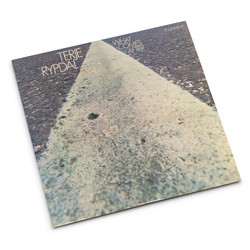
Whenever I Seem To Be Far Away is the third album Terje Rypdal made as leader for ECM, released in 1974 and often counted among his early masterpieces. Rypdal has spoken of feeling pulled between writing orchestral music and building an improvising guitar language rooted in rock rather than jazz. Here the two ambitions meet: a rock-inflected quintet on the first two pieces, a work for electric guitar and strings on the title track.
The music was recorded between January and August 1974 in Oslo and Ludwigsburg, with Jan Erik Kongshaug and Martin Wieland as engineers and Manfred Eicher producing. In Oslo Rypdal's guitar is joined by Odd Ulleberg on French horn, Pete Knutsen on mellotron and electric piano, Sveinung Hovensjø on six- and four-string bass and Jon Christensen on percussion. For the title piece he plays with members of the Südfunk Symphony Orchestra, with solo violin and viola, under the Sarajevo-born conductor and arranger Mladen Gutesha. Gutesha also worked on Keith Jarrett's In The Light, Luminessence and Arbour Zena for the label.
Silver Bird Is Heading For The Sun opens with Ulleberg's reverberant horn floating on the mellotron. As the horn fades Rypdal comes in on fuzzed guitar, the two trade long phrases, and the piece ends in a heavier, muscular passage over Hovensjø's amplified bass. The Hunt is shorter and more rhythmic, with Christensen to the fore. The title piece is subtitled Image for Electric Guitar, Strings, Oboe and Clarinet and runs close to eighteen minutes. It opens with a lone cello and grows slowly through the orchestra, holding back the guitar until the climax, where the strings take up the yearning quality of its sustained lines.
A reviewer in the Los Angeles Free Press wrote that Rypdal "pursues his own way with purity, clarity and inspirational complexity", adding: "I never heard an electric guitar sound so natural in an orchestral setting before." Tyran Grillo of ECM Reviews described the title piece as a "slow 18-minute wave of orchestral bliss".
This CD edition of ECM 1045, first released in 1974, was reissued on 9 October 2020 in a digisleeve in the Touchstones series, which ECM started in 2008 to bring key catalogue albums back.