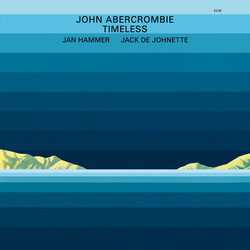
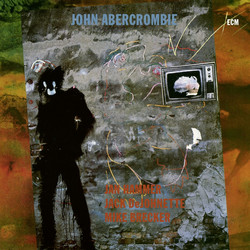
CD version. Timeless is the first album under his own name by the American guitarist John Abercrombie, and his first for ECM, released in 1975. Recorded in New York with Jan Hammer on keyboards and Jack DeJohnette on drums, it is an organ trio with no bassist. The six pieces swing between high-speed fusion and quiet duets for guitar and piano, and the record began a long relationship between Abercrombie and the label.
Abercrombie had moved to New York in 1970 and worked as a sideman, notably with Chico Hamilton. He then joined the fusion group Dreams and played on several albums by its drummer Billy Cobham. He had known Hammer since their student years at Berklee in Boston. Hammer plays organ, piano and synthesizer and wrote two of the pieces, the other four being Abercrombie's. The session took place on 21 and 22 June 1974 at Generation Sound Studios, with Tony May as recording engineer, Jan Erik Kongshaug mixing and Manfred Eicher producing.
Hammer's Lungs opens the record and runs past twelve minutes. A staccato organ figure, DeJohnette's hard-driven hi-hat and unusually frenetic guitar lines set it off, and a few minutes in the music suddenly changes course. Love Song and Remembering are the two duets, Abercrombie on acoustic guitar against Hammer's piano, while in Ralph's Piano Waltz the electric guitar and keyboard lines answer and imitate each other. The closing title track, also about twelve minutes long, grows slowly from a synthesizer drone with scattered guitar phrases into a broad, open space.
In the L.A. Free Press the guitarist and critic Lee Underwood found it "a major surprise in terms of its depth, scope and inventiveness". Barry McRae was more measured in Jazz Journal in April 1975, but judged that "Abercrombie is the outstanding solo voice". He praised DeJohnette's control and singled out the themes of Love Song and Red and Orange. He also gave credit to the engineers for the sound. When Abercrombie died in 2017, NPR described the album as both an exploratory organ-trio record and an example of fusion's second wave, and called it a reference point in his work.
This is the CD edition of ECM 1047, first released in 1975.