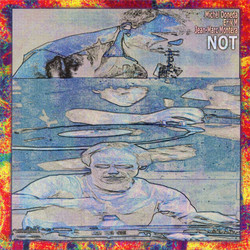
With Soufflements Cardinaux, Ensemble In(dé)fini turns the idea of the contemporary “ensemble” inside out. Instead of a fixed group of interpreters serving the score of a single author, the project brings together a circle of composer-performers to write the piece together in the most literal sense: from the first structural decisions to the last trace of feedback. At the centre stands guitarist, composer and artistic director Hervé Boghossian, whose acoustic and electric guitars act as both ground and catalyst. Around him, Owen Gardner’s microtonal electric guitar, Merve Salgar’s tanbur and Félix Chaillou-Delecourt’s hurdy-gurdy and church organ create a constellation of resonant bodies that stretch from experimental rock to medieval drone and sacred polyphony. Each musician composes, each musician performs; authorship becomes a commons, not a signature.
The name Ensemble In(dé)fini signals this fluidity. There is no canonical line-up, no definitive instrumentation; for every project the formation changes, except for Boghossian and his guitar. This refusal of fixity is not a pose but a method. It allows Soufflements Cardinaux to escape the usual categories of the scene - neither strict “new music” nor orthodox improv nor codified world-fusion - while drawing voraciously on all three. Elements from experimental and contemporary composition, free improvisation and jazz, rock energy and traditional musics from multiple regions are folded together according to the players’ own histories. The result is not a collage of styles but a single, slow-growing organism whose DNA happens to carry many dialects.
At the level of sound, the album is a cartography of breath and friction. Boghossian’s guitars move from brittle harmonics and percussive attacks to wide, distorted planes of colour; Gardner’s microtonal system slightly detunes the horizon, opening cracks between pitches where new overtones swarm. Salgar’s tanbur brings a tensile, modal line that can hover above the others like a call to prayer or sink into the ensemble as a granular drone. Chaillou-Delecourt’s hurdy-gurdy adds buzzing, archaic sustain, while his church organ injects vertical, almost liturgical weight when needed. Together they sculpt currents of sound that drift, condense and re-form, like weather fronts sliding across an invisible map of the four cardinal directions evoked by the title.
| A1 | Soufflements Cardinaux Part #1 | 15:53 | |
| B1 | Soufflements Cardinaux Part #2 | 21:29 |
- Hervé Boghossian
- Acoustic Guitar, Electric Guitar, Composed By
- Merve Salgar
- Composed By
- Owen Gardner
- Electric Guitar
- Félix Chaillou-Delecourt
- Hurdy Gurdy, Organ