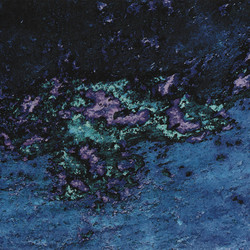
Drummer/composer Booker Stardrum delivers a new powerful solo album Close-up On The Outside (27th Feb 2026), his first for We Jazz Records. The new record sees Stardrum (also a member of SML) doubling down on the earthy tactility of human sound and communication while also exploring rich, electroacoustic landscapes. The album, released on LP and digitally, involves Stardrum's close collaborators Anna Butterss, Jeremiah Chiu, Chris Williams, Lester St. Louis, Logan Hone and Michael Coleman.
While he now lives and works near Kingston, New York, Booker Stardrum made the first notes heard on the new album at an artist residency called Denniston Hill in September 2022, "in a barn that has a very long reverb and cement floors, and really big rafter ceilings. Throughout the week I ended up recording sounds that I totally adored. I moved into my house in 2021 and had found some scraps of unused wood floorboards in the basement, so I took those (they're hard wood which sounds really good), and put them on foam and played them with mallets." The opening title track and the brief "Minturn" place Stardrum's solo music in the stillness of a late summer farm, with field recordings of insects and birds localizing the music; wooden balafon-like strokes are then looped into the foundational structure of the closing "Inside Sounds," hovering at poles that are both plaintive and direct. Dry, homemade mallet instruments and field recordings also nod in the direction of Harry Partch, the composer and inventor whose microtonal instruments were under the care of Stardrum's father, the late composer Dean Drummond (1949-2013).
There's a lot of warmth and sweat in Stardrum's music––even if it's electroacoustic, one feels that it's made by people, and there is a biologically systemic quality to the way in which digital and analog sounds are interpolated. He creates textures through midi controllers, samples, and loops, wherein acoustic sequences are altered to fit plugged-in concepts or acoustic instrumentalists are brought in to humanize what he's already mapped out electronically. Threading the unique and very present feel of other musicians into his universe with an electronic hand is a fascinating challenge. It's clear that Stardrum is a composer and while he's self-taught, that intuition allows him to draft, expand, and remove excess as pieces congeal and then breathe in a moment's time. This is certainly ensemble music, but not in the way one usually thinks of it. A case in point is "Telluric," on the latest album: "I use recorded samples of other instruments in Ableton. I was hearing upright bass and pulled in midi bass. Then I recorded drums and conga along with the midi bass part and the loop, started messing with that and edited it into a form. I was in LA and had Anna replace the midi bass, notated what I had played and gave it to them. And they played it beautifully, so I was able to remove the midi and have this wonderful, organic bass vamp."
It's important to note that Stardrum, as much as he treats each instrumental section or fragment as fodder for alteration, also respects the individuality of his collaborators––after all, Butterss can play a mean, beautiful vamp better than a midi bass can, and their personality, as much as it gets toyed with and stretched, is vital. The people he chose to work with on Close-up on the Outside are mostly artists he's worked with for years, or been connected to through mutual instigators (Lester St. Louis, for example, through the late trumpeter jaimie branch and bassist Jason Ajemian). Of Hone, Stardrum says "we've played in each other's projects over the years. Individually, we make pretty different music, but we both really understand and love each other's ideas. I can give him a prompt like 'play the saxophone like you're drunk and can barely get the notes out,' or 'just whisper into the flute,' and he'll thoughtfully and tenderly comply." This is not someone speaking of a hired gun who's allowing their notes to be manipulated and wrangled; it is a situation in which there's a lot of empathy.
Bringing it back to the earthbound carpet that he's striving for, the push-pull between humanism and machinery ties into an ecological concept that Stardrum wants to call attention to. A teetering, driving piece called "Third Nature" on the new record, as he puts it, "it gets its name from a concept in social ecology that humans are part of nature and there have been different philosophies that separate humans from nature. First nature is the natural world, second nature is human development, and social ecologists have conceived of the idea that we are of nature and how can we do a better job, exist, be of nature and affect nature in a cohabitual way?" Perhaps some sort of analogue can be found within the complex ways in which Stardrum and his creative partners shape, inhabit, and react to sound. Toggling between composer and organizer, sound designer and instrumentalist, Stardrum offers that this music "represents my pure vision because it's my music, but that vision also involves playing with other people and letting them do what they do and also hoping that they're trusting me to do what I do. But in the end, making a solo record is much more a conversation with myself than setting up an improvised dialogue with various collaborators. Everything has its own special place in my orbit."