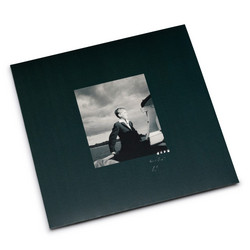
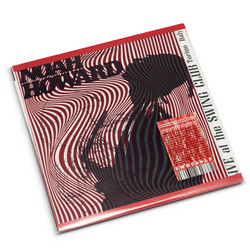
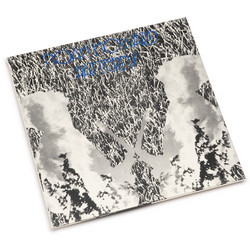
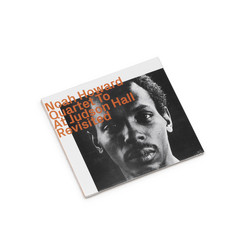
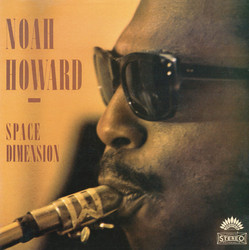
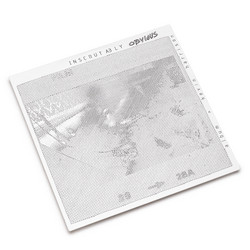
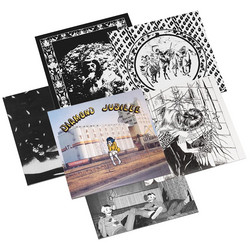
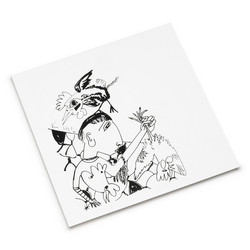
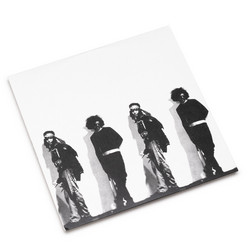
Huuuge Tip! In the pantheon of classic free jazz, Noah Howard's The Black Ark looms large. Recorded at Bell Sound Studios in New York City in 1969 - just prior to the alto saxophonist's relocation to Europe - the album was eventually released in 1972 on Alan Bates's Freedom label, and has since acquired near-mythical status among collectors and devotees of the music. Now, Superior Viaduct presents the definitive remastered edition on vinyl, restoring this landmark to the visibility it has always deserved. Born in New Orleans in 1943, Howard grew up saturated in gospel and the deep traditions of the Crescent City before making his way west to Los Angeles, where he studied with Dewey Johnson, and eventually to New York, where he fell into the orbit of Sun Ra. By the mid-1960s he had already cut two remarkable records for ESP-Disk - Noah Howard Quartet and At Judson Hall - but The Black Ark was something else entirely: a quantum leap, the moment when everything locked into place.
The Black Ark exhibits not only the power and imagination of Howard's playing, but also his breadth as a composer and bandleader. Listeners expecting unrelenting blasts of "energy music" might be surprised to find a cohesion atypical of free jazz; amidst the wild, impassioned solos, Howard weaves in Latin rhythms and fat-bottomed grooves. The first side, consisting of Domiabra and Ole Negro, sets the album's tone - both tracks sound as if they could have appeared on some of Blue Note's proto-spiritual jazz, groove-heavy releases, evoking the likes of Horace Silver or Bobby Hutcherson, before ceding the floor to the horn players' anarchic firepower. Mount Fuji, the extended centerpiece, builds from a spare, almost Japanese-inflected melody into fifteen minutes of breathtaking interplay, while Queen Anne closes the record as a ballad of devastating lyricism - proof that Howard's command of his alto was as refined in whisper as it was in fury.
The ensemble Howard assembled is nothing short of extraordinary. As John Corbett writes in the liner notes: "Two players stand out. Bassist Norris Jones - who would soon consolidate his name into a one-word reversed amalgamation/permutation of the two, Sirone - is given ample room, largely unaccompanied; his corporal approach foreshadows later work with the Revolutionary Ensemble. But the secret weapon on The Black Ark is Arthur Doyle. Straight from basement rehearsal sessions with Milford Graves, whose ensemble he had joined and who remained a favorite of the drummer for decades, Doyle is a human flamethrower." Trumpeter Earl Cross's guttural, vocal effects complement Doyle's take-no-prisoners approach, while the estimable combination of Muhammad Ali (Rashied's brother) on drums and Juma Sultan on congas adds an ever-shifting propulsion. The septet is rounded out by the enigmatic pianist Leslie Waldron, who anchors the group with imaginative accompaniment and occasional boppish flourishes.
Noah Howard would go on to record prolifically through the 1970s and 80s, founding his own AltSax label and living between Paris, Nairobi, and Brussels before his death in 2010. But The Black Ark remains the burning heart of his legacy - every bit worthy of its reputation as an "out-jazz" holy grail, a record that only sounds better with age. It remains the ideal album to convert the remaining free-jazz skeptics.
Recorded at Bell Sound Studios, New York City, 1969