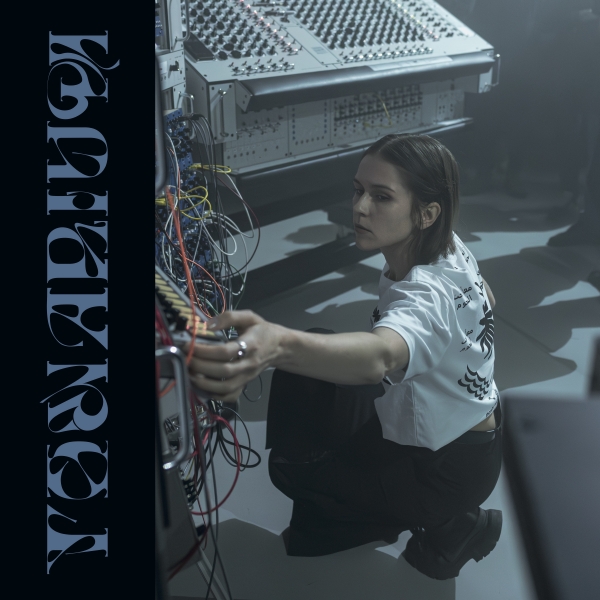
“Easily one of the most engrossing gestures of minimalist drone we’ve encountered in some time, the Polish composer, Aleksandra Słyż, returns to Superpang with Tonarium Live, a truly towering LP of glistening, synthetic forms.”
Easily one of the most engrossing gestures of minimalist drone we’ve encountered in some time, the Polish composer, Aleksandra Słyż, returns to Superpang with Tonarium Live, a truly towering LP of glistening, synthetic forms. A longform work in two parts, executed on Słyż's idiosyncratic modular "Tonarium" system, across its enveloping duration the composer unlocks complex tonal and microtonal conjunctions, and unspools microscopic details with structures of overtones, producing something that borders on the profound from the most constrained of means.
During recent years, we’ve been increasingly tipped to amazing things currently unfolding within Poland’s experimental music scene, building on the country’s longstanding contributions to electronic avant-garde, which sprang from studios like Studio Eksperymentalne Polskiego Radia (PRES) during the 1950s, deep under communist rule, fostering composers like Józef Patkowski, Krzysztof Penderecki, Elżbieta Sikora, Włodzimierz Kotoński, and Bohdan Mazurek. Among the most striking of the young artists belonging to the current Polish wellspring is Aleksandra Słyż, who piqued our interest with a couple of recent full-lengths - “A Vibrant Touch” (2022) and “Human Glory” (2020) - as well as stellar live collaborations with artists like Judith Hamann and Gerard Lebik. Now the longstanding Italian imprint, Superpang, returns with “Tonarium Live”, what might just be Słyż’s most striking and engrossing release to date. A tense and markedly dense remaining of electronic Minimalism, it’s an astounding immersion in complex intersections of sonority that has left us continuously coming back for more, and anxiously waiting for what she comes up with next.
An electroacoustic composer of ambitious scope, Aleksandra Słyż studied at the University of A. Mickiewicz in Poznań, the Poznań Academy of Music, and the Royal College of Music in Stockholm. For the better part of the last decade, she has performed widely across Europe, issued a handful of striking recorded releases, and collaborated extensively within the context of dance and movement, engaging, for many of those years, in experiments connected to movement sonification and various types of interactions, all resting within a practice rooted in the investigation of connections between acoustic and synthetic sounds, most notably in a particularly noteworthy collaboration with the cellist, Judith Hamann, and the saxophonist, Gerard Lebik, which was later issued digitally, as well as collaborations with the National Polish Radio Symphony Orchestra, the Basel Sinfonietta, the Sinfonietta Cracovia, and the Spoldzielnia Muzyczna contemporary ensemble, among others.
As a performer as much as a composer, Słyż’s work is heavily engaged with the processes of electronic synthesis, often exploring rational tuning systems, through which she constructs rich, complex drone structures, unfurling a remarkable sense of microtonal, electroacoustic tension. This led to her development of the “Tonarium”, an idiosyncratic instrument comprising two sets of modular synthesizers, alongside a mixer, the interaction of which facilitates precise control over audio and CV signals and integrates technology with analog sound, generating a distinctive sonic palette and functionality. It is precisely this instrument that was used to create Słyż’s latest LP, “Tonarium Live”.
“Tonarium Live” was recorded during December of 2023, while Słyż was in residence at The New Media Laboratory in Katowice, Poland. The work comprises two parts, each respectively exploring the fluctuating nature of sound, collectively culminating as a sonic tapestry marked by subtle nuances, pulsations, and moments of harmony, flickering within dense, chordal long tones.
Even early in an encounter with “Tonarium Live”, it becomes fairly clear that Słyż sits slightly outside the dominant tropes of contemporary minimalism and drone, forgoing the harmonically seductive and beautiful, for the types of tense, microtonal combinations that were historically favoured by composers like James Tenney. The first side of the LP draws upon sequences of long-tone chord progressions, pierced by abrupt shifts and transitions that draw the ear into the intricate detail unveiled within the piece’s structures of overtone. Contrastingly, the piece’s second section, taking up the entirety of side two, features a recurring four-chord motif that evolves and transforms amongst pulsing bass and warm and intimate swells of tonality.
This is a record to get lost within, drift and explore inner and extra landscapes alike.
Originally published by Soundohm.