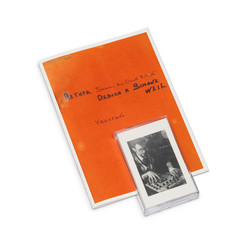
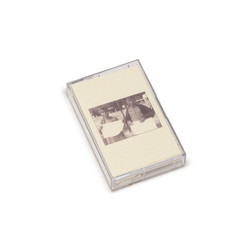
Filippo TestaFeaturing: SMET Studio Di Musica Elettronica Di Torino
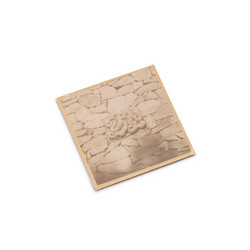
Antologica 1977 - 1990 (Tape)
Tip! Antologica 1977 - 1990 is the first real chance to hear Filippo Testa’s work as more than a rumour in footnotes about Turin’s electronic vanguard. Born in Turin on April 12, 1956, Testa studied composition and electronic music at the Giuseppe Verdi Conservatory under Enore Zaffiri, one of the key figures of Italian computer and tape music and founder of SMET (Studio di Musica Elettronica di Torino). From the late 1970s onward he was an active participant in that milieu, moving between concert halls and research environments while also devoting a major part of his life to teaching and, in parallel, to an often‑mentioned passion for animals. Antologica 1977 - 1990 gathers a decade‑plus of pieces that until now were scattered across old tapes, concert archives and private collections, revealing a composer who patiently carved out his own path at the intersection of instrumental writing, electroacoustic experiment and spiritual reflection.
The anthology’s span is suggested by the works themselves. It opens with Aethyr, Sussurro all’Eterno Ritorno. Una dedica a Simone Weil, written in 1977 and performed by Circolo Toscanini: a title that already points to Testa’s fascination with metaphysics and philosophical thought, here channelled into music that feels both fragile and rigorously structured. From there we move to Parusia (1978), for flute and two pianos (Nadia Toda Roch; Irma Corsaro and Roselda Giuliano), which uses a small ensemble to suspend time in overlapping harmonic fields. Minnedienst (1984), realised with the Alfredo Casella Chamber Orchestra at Teatro Nuovo in Turin, shows him engaging a larger group without abandoning intimacy; the title nods to medieval notions of love‑service, suggesting an undercurrent of historical and poetic research beneath the surface of his scores. Alongside these we find SER (1977), performed by Zaffiri’s electronic music class, which documents Testa’s early steps within SMET’s laboratory, and Quetzal (1984), for two clarinets (Massimo Ferraris and Diego Mascherna) and piano (Mariagrazia Parello), where wind and keyboard weave a more agile, almost narrative interplay.
A second cluster of pieces highlights Testa’s relationship with Zaffiri and with electronic and keyboard‑based media. Milice (1987) and Floating World (1990) are both performed by Enore Zaffiri at the keyboard and piano respectively, underscoring the trust between teacher and former student and hinting at aesthetic affinities without collapsing their identities. Alba De Tormes (1987), again with Zaffiri at the piano and Ellen Kappel as soprano, brings voice into the frame, drawing on the mystic aura of its title (which alludes to the town associated with Saint Teresa of Ávila) to explore a more explicitly spiritual register. From that same constellation comes Estatica, da Alba De Tormes, performed by Testa on Voyetra in 1987, translating the earlier work’s contemplative atmosphere into the realm of synthesizer sound. Across these compositions you can hear a composer equally at ease with acoustic timbre and electronic colour, using both to probe states of suspension, quiet intensity and carefully measured dissonance. The recordings themselves carry as much weight as the scores. Aethyr and Minnedienst were recorded by Alberto Ezzu, situated within the specific acoustic and social spaces that originally hosted them, while other tracks preserve performances by ensembles and soloists closely linked to Turin’s experimental circles of the time.