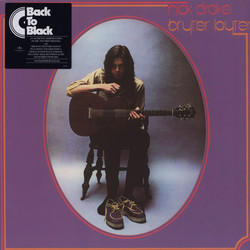
The city record. Nick Drake left Cambridge without a degree, took a room in London, and made the most outgoing album of his short life. Recorded through 1970 and released by Island in March 1971, Bryter Layter was meant to be the one that reached people. Joe Boyd and engineer John Wood went back to Sound Techniques with a larger cast and a clear plan: a rhythm section, brass, a proper band behind the songs. The title borrows the language of the radio weather forecast, respelled as if copied from an old almanac. Boyd has often said it is the one record he produced that he would not change.
Where the debut kept its distance, this one moves. Dave Pegg and Dave Mattacks of Fairport Convention supply bass and drums, and Hazey Jane II arrives with Robert Kirby’s brass and Richard Thompson’s guitar at a near gallop. At the Chime of a City Clock and Poor Boy lean into jazz, with Ray Warleigh’s alto saxophone curling around the vocal, the South African pianist Chris McGregor sitting in on the latter, and P.P. Arnold and Doris Troy answering Drake’s self-pity with a chorus that gently mocks it. Three instrumentals frame the songs like the overture, interlude and coda of a small suite, with Lyn Dobson’s flute on the title piece.
Two tracks belong to John Cale, who heard the tapes and more or less invited himself in. On Fly he plays viola and harpsichord, and the song turns brittle and courtly. On Northern Sky he plays celeste, piano and organ, and the celeste falls over Drake’s guitar like light through a window in winter. It is the nearest thing to plain happiness in his catalogue.
The album did not sell. Drake’s reaction was to strip everything away for Pink Moon, which makes Bryter Layter the only time he was heard inside a full band. This CD digipack edition returns it in a compact, durable form.