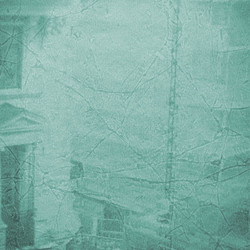
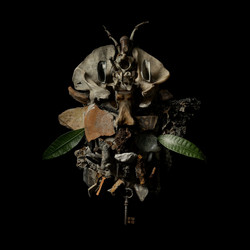
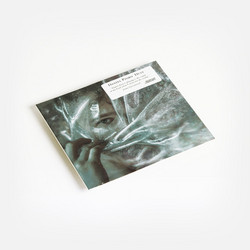
Displaces marks the most intimate and conceptually charged work yet from sound artist Francesco Fabris, a record that treats listening as a form of advanced cartography. Rooted in the notion of hyperobjects - phenomena so vast and distributed that they evade ordinary perception - the album imagines music as a map that can never quite coincide with the territory. Instead, Fabris sculpts a high‑dimensional, phased time‑space where concrete materials and digital archetypes are held in perpetual motion, constantly displaced from any stable center. Mapping here is not a neutral act but a symbolic and philosophical practice, a way of making sense of life by tracing connections between object‑oriented environments, superimposed realities and a pervasive non‑locality that touches cosmic, temporal and emotional memory alike.
Within this framework, the sonic ecosystem of Displaces unfolds as a navigational journey through an array of shifting places and scales. Fabris moves from the microcosm of quanta to the gravitational pull of dark matter, from underwater depths to overland terrains, allowing each register to bleed into the next until distinctions blur. The album encapsulates a cyclical flow between birth and death in both ecological and anthropological senses, treating each sound event as a point on a larger continuum rather than an isolated gesture. There is a sense of moving along an invisible route, where familiar landmarks keep slipping just out of view, replaced by their spectral doubles.
At the heart of this exploration is the extensive processing of the langspil, Iceland’s only traditional instrument, which Fabris bends, stretches and diffuses until it becomes an uncanny hybrid of string resonance and electronic apparition. Its tones are intertwined with manipulated field recordings of biophonies and geophonies gathered across Icelandic and Venetian territories: birds, insects, wind, water, stone and infrastructure all refracted through a meticulous studio practice. These recordings do not act as simple scenery; they are reoriented and displaced, forming the living backdrop for a meditative process that relocates familiar objects into unfamiliar realms. In doing so, Fabris reflects on the transformative power of self‑observation, letting sound register the fragmentation, entanglement and recursive patterns found in both natural environments and the human psyche.