Marcel Broodthaers
Interview with a Cat (LP, One Sided)
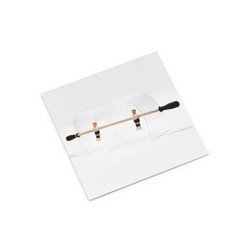
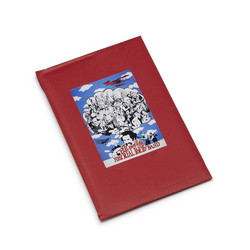
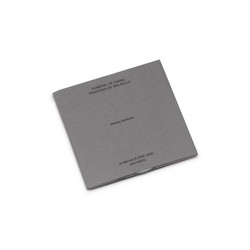
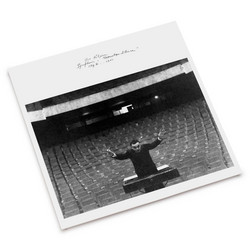
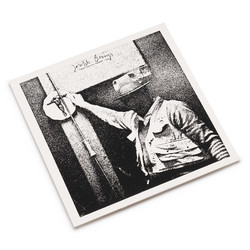
** Edition of 150 ** This limited 12" vinyl edition of Interview with a Cat restores one of the most mischievous and incisive works in Marcel Broodthaers’ oeuvre to its properly tactile form: a short audio recording cut into a disc, complete with a fold‑out insert carrying the English translation and transcript. Originally recorded in 1970 at his self‑invented Musée d’Art Moderne, Département des Aigles in Düsseldorf, the piece stages a seemingly absurd scenario. Broodthaers, in the role of earnest interviewer, poses serious questions about “new tendencies and trends in contemporary art” to a cat. The cat responds only with meows. What sounds, at first, merely hilarious quickly reveals itself as conceptually to the point: as the artist asks if a painting is “good,” whether it aligns with the latest shift from conceptual art to a “new kind of figuration,” whether it risks becoming a new academicism, the cat’s single, invariable language becomes the perfect mirror for an art world drowning in discourse and market speculation.
Formally, the work is disarmingly simple: a voice, a cat, the faint resonance of the museum environment, five minutes of call and response. Yet this minimal setup opens onto many of Broodthaers’ core preoccupations. The Musée d’Art Moderne itself was a fictional institution that he founded and installed in real spaces, a long‑running project in which eagles, labels, vitrines and bureaucratic trappings were used to probe how museums create authority, value and meaning. Placing the “interview” there doubles the satire. The artist’s questions about innovation, markets, collectors and the fate of previous artworks are exactly the questions that haunt any institutional moment of aesthetic change. The cat’s refusal to answer in human language turns every enquiry into an echo chamber of anxiety. When Broodthaers finally arrives at the deadpan injunction to “close the Museums!” and plays with the Magritte‑echoing refrain “This is a pipe / This is not a pipe,” the piece tips fully into a poetic loop where representation, language and reality chase each other in circles, while the cat keeps on meowing.
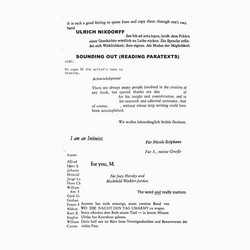
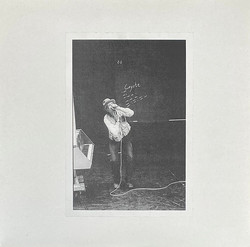
The vinyl edition underscores the work’s status as both artwork and object. To “own” Interview with a Cat is to own a record of a conversation that never resolves, a “document” that simultaneously mocks and inhabits the documentary mode. The fold‑out translation and transcript extend Broodthaers’ interest in the printed word as a material surface, where typography and layout participate in the performance of meaning and its breakdown. Listening on headphones or through speakers, one hears not only a relic of 1970s conceptualism, but a work whose humour and scepticism feel uncannily current in an era where artistic value is still framed by markets, labels and increasingly opaque discourse.
Born in 1924, Marcel Broodthaers began as a poet and remained one even after he “became an artist” at the end of 1963, following two decades of near‑poverty and marginal literary activity. Briefly associated with surrealism and the post‑war “surréalisme‑révolutionnaire” milieu, he turned to making objects by literally embedding unsold copies of his poetry book in plaster, a gesture that fused language, sculpture and self‑irony. In the twelve years that followed, until his death in 1976, he built a dense, elusive and profoundly influential body of work embracing poetry, books, film, photography, slides, drawings, painting and sculpture. Again and again he tested how words and images interact, how rhetoric shapes our understanding of art, and how institutions script what can be seen and said. Interview with a Cat condenses many of these themes into a compact, accessible form - a tiny masterpiece of conceptual deadpan in which the most eloquent critical position belongs, quite literally, to the animal who refuses to explain.