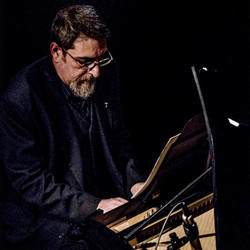
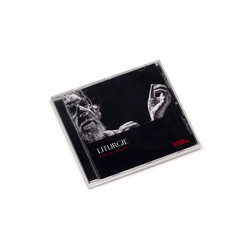
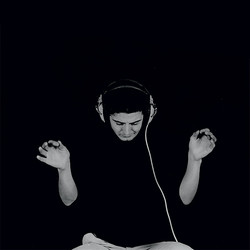
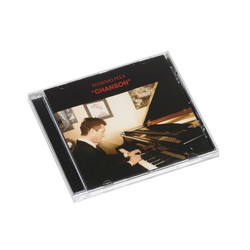
Girolamo De Simone (Naples, 1964)—composer, pianist, music historian, proponent of "new music," and publisher of "new discourses" on music (through the magazine *KonSequenz*, established in 1994)—has recently released the CD *Liturgie*. The live recording of the six tracks featured on the CD took place in April 2024 during a piano performance at the Fondazione Morra in Naples, held in conjunction with an exhibition dedicated to the French intermedial poet Henri Chopin (Paris, June 18, 1922 – London, January 3, 2008). Active since 1982, De Simone has met figures such as John Cage, Elliott Carter, and Michael Nyman, and has worked or collaborated with some of the most important contemporary composers, including Luc Ferrari, Vittorio Rieti, Pietro Grossi, Luciano Chailly, Giuseppe Chiari, Daniele Lombardi, Giancarlo Cardini, and Enrico Cocco. Along with Luciano Cilio, Giuseppe Chiari, Eugenio Fels, and Gabriele Montagano (among a select few), he is credited with introducing the performance and study of 20th-century "New Music" to Naples. In a city where the culture and centuries-old traditions of classical and operatic music were strongly established—anchored by institutions like the San Pietro a Maiella Conservatory and the Teatro di San Carlo—and where local song boasted a long history and deep roots among the populace, contemporary and avant-garde music served to expand the process of linguistic and cultural innovation that the visual arts and theater had ignited following the upheavals of 1968. Today, De Simone’s music stands at the heart of a "ritual" that liberates the audience from the ubiquitous and ambiguous abstraction of the digital realm. A theorist of "border music"—a musicality intrinsically plural in genre and boundless in its crossings—De Simone approaches composition as a circular relationship between "new music" and "music history."
De Simone writes:
"The title, *Liturgie* [Liturgies], alludes to a particular way of making music—one that, from the very moment of composition, acts almost as a ritual capable of sparking a different kind of awareness, where the perception of the 'other' is heightened and transformed into the dazzling motion of the present moment."
The CD’s six tracks range from *Sacred Bells of Tibet* to *Chorale for Lorenzo*, from *Little Bimodal Invention* to *Fantastic Piece*, and finally to *Liturgie du Souffle*. Beyond showcasing performance skill, they offer a diverse repertoire of compositions. The CD features both piano and electronic pieces. Analyzing scores by past composers—as well as reproducing archaic sounds—triggers constant returns to the contemporary realm. "Musical cells" are drawn from other sources and grafted onto different musical bodies; in this "musical biology," there is no rupture. Releasing the live performance tracks on CD is not merely a delayed playback of sound; in a humanistic sense, it preserves the record and memory of an event. The *Liturgies* remain those of the performance itself, yet they evoke the experience of listening. *Ki. Sacred Bells of Tibet* is composed using sounds derived from wind instruments, strings, glass bells, and distant silences. In contrast, *Fantastic Piece* is generated from piano motifs taken from Robert Schumann’s *Fantasiestücke* (Op. 12, 1837); these are presented—both in the electronic track and in live piano performance—using techniques that simulate the timbres of digital processing. The electronics employ "granular synthesis" and distinctive "inflections" derived from sounds with specific timbral characteristics, such as those of a piano or a human voice. The electronic process and the piano performance are integrated and fused in various ways; sound production and reproduction occur simultaneously. Other tracks on the CD serve as vehicles for 20th-century French music deconstructed into minimal cells. For instance, the esoteric vision of Erik Satie (Honfleur, May 17, 1866 – Paris, July 1, 1925) is revisited in the version of the piece *La settima Gnossienne* (from *Le Fils des étoiles*, 1891). Others still—such as *Corale per Lorenzo* and *Piccola invenzione bimodale*—open up paths to the future, exploring new harmonic techniques and embracing thematic conciseness. The piece *Liturgie du souffle* is a ritual centered on the breath, featuring piano sequences that rest upon an electronic texture. This transfiguration resonates with—and contrasts against—the vocal and electroacoustic experiments of Henri Chopin.