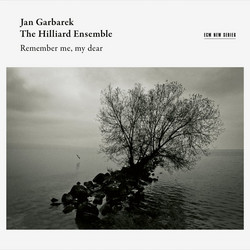
Mnemosyne is the second studio meeting of Jan Garbarek and The Hilliard Ensemble, recorded in April 1998, five years after the sessions for Officium, and issued by ECM New Series as a double album in 1999. Officium had set an improvising saxophone against sacred polyphony of the 12th to 16th centuries. Here the repertoire reaches across twenty-two centuries and several continents, and the improvised share of the music is much larger. Four singers and one saxophonist work as five voices, often building a whole piece from a few notated scraps.
The group returned to the Propstei St. Gerold, the priory in the Austrian mountains where the first album was made. The Hilliard line-up is David James (countertenor), Rogers Covey-Crump and John Potter (tenors) and Gordon Jones (baritone), with Garbarek on soprano and tenor saxophones. Manfred Eicher produced and Peter Laenger engineered. In his liner notes Potter explains that much of the newer material came as "very small amounts of material with minimal notation", some of it recovered from old book bindings or from under desert sands. The musicians agreed an outline, shared out the fragments and improvised. "We did it for each other, in the absence of an audience," he writes.
The first disc opens with Quechua Song, a Peruvian melody, and moves through Tallis's O Lord, in thee is all my trust, a Dufay Gloria, Brumel's Agnus Dei and Guillaume le Rouge's Se je fayz dueil. It closes with Hildegard von Bingen's O ignis spiritus which at almost eleven minutes is the longest track of the set. The second disc goes further back, to the ancient Greek Delphic Paean attributed to Athenaeus and the Hymn to the Sun of Mesomedes, and further afield, with a Russian psalm, William Billings's When Jesus Wept and Veljo Tormis's Estonian Lullaby, heard once on each disc. The title is the Greek word for memory and the name of a Hölderlin poem, whose first strophe is printed in the booklet.
Reviewing the first Mnemosyne concert in The New York Times in March 1999, Paul Griffiths wrote that once the surprise wears off "one feels the saxophone was always there", and heard how "the squeal of the soprano saxophone becomes, in his hands, a prayer." Writing on ECM Reviews in 2010, Tyran Grillo called the set "nothing short of remarkable" and singled out O ignis spiritus as its high point.
Double CD, ECM New Series 1700/01, first released in April 1999, with a booklet containing Potter's notes, the Hölderlin text in four languages and stills from Ingmar Bergman's The Seventh Seal.