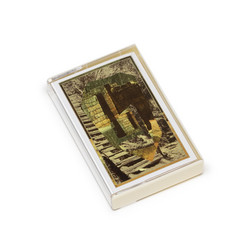
Mount Mansfield begins with a simple, disarming premise: take the highest mountain in Vermont and treat its topographical map as music. 250 miles south, in Connecticut, Sam Boston and Shawn O’Sullivan convert contour lines into a graphical score, reading ridges, gradients and valleys as cues for density, pitch, duration and exchange. The mountain’s profile stops being a representation of landscape and becomes, instead, a set of instructions - a way to think about how sound might rise, plateau and erode. What emerges is not a literal sonification but a translation: the feel of terrain rendered as sustained tone, interference pattern and slowly shifting weight.
To embody this idea, the duo build a physical feedback network between two distinct but equally tactile systems. O’Sullivan mans a cluster of analog electronics - oscillators, filters, delay lines and amplifiers wired for responsive instability. Boston works with a handmade lapsteel guitar whose frame has been bent to echo Mount Mansfield’s topology, the instrument itself warped into a faint sculptural rhyme of the score. Strings, pickups and metal meet circuits and patch cables in a looped configuration, each side feeding, colouring and perturbing the other. No element stands alone; every gesture produces secondary and tertiary ripples as the network absorbs and re‑emits energy.
The sound that flows from this setup is described as “a verdant resonance, a stochastic bloom. Motionless motion.” Those phrases capture the record’s paradoxical core. On one level, very little seems to happen: tones hover, beat against each other, thicken, thin out. On another, the micro‑activity is constant. Tiny fluctuations in pitch, overtones flickering at the edges, shifts in feedback emphasis - all accumulate into an impression of growth, of something organic unfolding in extreme slow motion. The lapsteel’s altered frame adds its own peculiarities: tensions and resonances that don’t align with standard tunings, harmonic nodes that sit in unexpected places, a physical response to touch that is subtly skewed. O’Sullivan’s electronics respond by swaying between support and disruption, sometimes smoothing the guitar into a broad band of colour, sometimes picking out its asymmetries and magnifying them into sudden blooms.
Rather than treating “landscape music” as picturesque ambient, Mount Mansfield pursues a deeper, more structural analogy. The mountain’s ridgeline informs the piece’s overall contour: long ascents of accumulating density, abrupt shelves where activity evens out, slow descents where frequencies thin and the noise floor becomes more exposed. Yet within those macro‑shapes, the duo leave room for chance and feedback behaviour to generate detail, much as weather and erosion inscribe their own patterns onto a fixed geological base. The music’s apparent stillness is thus always undercut by low‑level turbulence - a quality that makes repeated listening feel less like revisiting a track and more like returning to a particular vantage point and noticing what has changed.
For O’Sullivan, whose practice runs from hardware techno to experimental electronics, and Boston, whose bent lapsteel sits somewhere between sculpture, instrument and antenna, this collaboration marks a convergence of approaches: an interest in systems that respond to touch without being fully controlled, and in scores that set conditions instead of dictating outcomes. Mount Mansfield is the audible trace of that convergence. It proposes a way of listening to topography, feedback and metal under tension; a way of hearing how motion can be embedded in form, and how, under sustained attention, even the most “motionless” sonic landscape reveals itself as quietly, continuously in bloom.