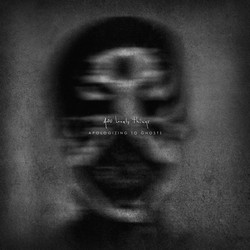
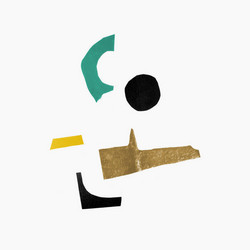
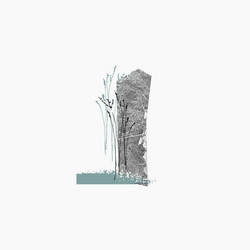
In January 2024 Marcus Fischer extended an open invitation: come and perform his graphic scores. For many musicians this would be a license to freely associate sound with image; for David Chandler and Paul Dickow, it immediately posed a more awkward question. If a graphic score refuses to dictate pitch, rhythm or form, what anchors an interpretation? Without a clear, top‑down schema from the composer, how does a performer avoid merely using the drawing as an excuse to indulge their own habits? Is it even possible to “realize” a graphic score musically while minimizing the imposition of personal subjectivity?
Chandler and Dickow Play Fischer is their attempt to live inside those questions. Rather than translating lines into melodies or shapes into beats, they treat Fischer’s score as a set of constraints around which to build an experimental apparatus. Tracing paper is laid over the original drawings, allowing them to map movement, density and direction as coordinates. Chalk becomes both a mark‑making tool and a sound source, its friction captured by contact microphones and piezo styluses that function like stethoscopes on the surface of the page. EEG brainwave readers are brought into the circuit, monitoring their own mental responses and feeding slow, unstable control voltages into the system. A modular synthesizer from the 1970s - all dials, patch cords and no presets - acts as the primary sounding body, its parameters shifted not by arbitrary knob‑twiddling but by signals derived from the interaction between eye, hand, page and brain.
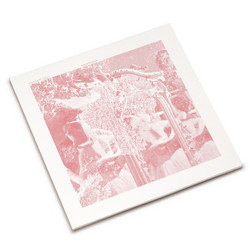
The result is a translation process that is at once radical and oddly literal. Instead of deciding in advance that a vertical line means “high pitch” or a circle means “percussion,” Chandler and Dickow allow the physical act of tracing the score, the micro‑vibrations of drawing and touching, and the involuntary rhythms of their own nervous systems to shape the music. The graphic work becomes a kind of terrain to be navigated, its contours sampled through piezo and EEG, its visual patterns converted into fluctuating voltages that the modular interprets according to its own internal logics. In this way, Fischer’s score exerts a real, material influence on the sound without needing to be “decoded” into conventional notation.
Sonically, the album reflects this layered mediation. You hear the grain of chalk across paper, transduced and amplified until it becomes a kind of dry, granular percussion. You hear slow, wavering tones whose modulations track the subtle shifts in EEG output as concentration rises, wavers, returns. You hear patches on the vintage modular synth that feel just out of human control: oscillators pushed into unstable regions, filters breathing in response to signals that are not entirely voluntary. The music moves between brittle, close‑mic intimacy and broader washes of analog tone, always carrying a faint residue of the drawing process - stops and starts, hesitations, the sense of a hand following a line.
Importantly, Chandler and Dickow Play Fischer never claims to eliminate subjectivity; it makes the attempt to limit it audible. The performers’ choices remain crucial: they decide which parts of the score to trace, how to route the EEG data, which modules to engage, when to let the system run and when to intervene. But by routing their interpretation through tracing paper, piezo styluses, brainwave sensors and a recalcitrant 1970s synth, they distribute agency across human, drawing and machine. The graphic score is not a mute image waiting to be animated, nor is it a mere prompt for improvisation; it is an active partner in a feedback loop.
In doing so, the album quietly reframes what “playing a score” can mean in experimental music. Fischer’s graphics become less a set of symbols to be decoded and more a physical object whose textures, shapes and the viewer’s own physiological responses are allowed to speak in sound. Chandler and Dickow’s interpretation is unconventional in method but rigorous in intent, using awkward tools and old hardware to test the boundary between reading and projecting, translation and invention. The result is a body of work that feels as much like a process document as a performance - a set of tracks in which the act of interpretation is not hidden but becomes the music itself.