Heins Hoffman-Richter
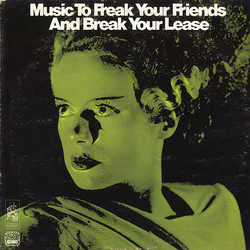
Music To Freak Your Friends And Break Your Lease (LP)
Tracked express shipping from Italy, no customs or import VAT in the EU. Shipping costs
2026 stock. It is genuinely difficult to place Rod McKuen anywhere in the twentieth century. He read alongside Kerouac and Ginsberg at the Jazz Cellar in San Francisco in the early 1950s, sang with Lionel Hampton's band, worked as a contract player at Universal, and cut the beat-poetry record Beatsville for HiFi Records in 1959. The early 1960s took him to France, where his encounter with Jacques Brel produced the English versions of Ne me quitte pas and Le Moribond that entered the language as If You Go Away and Seasons in the Sun. He wrote for film, earning two Academy Award nominations. He wrote symphonies, suites and concertos, including one for balloon and orchestra. And he sold poetry in quantities no American poet had approached before or since, which is precisely why the critical establishment of the period filed him under kitsch and largely stopped listening.
The label that carried all of this was Stanyan, founded by McKuen himself and by the early 1970s among the largest mail-order record operations in the world, second only to Columbia House. Alongside the records it sold books of poetry, calendars and, briefly, a clothing line. Nothing anywhere in that catalogue resembles Music to Freak Your Friends and Break Your Lease. The record is credited to Heins Hoffman-Richter, described on the sleeve as a "recognized raconteur, genius, composer, musicologist, conductor" and reported, in the same breath, to have died of an ear lobe tumour. The accompanying biography, written by Stanyan employee Richard Oliver, has Hoffman-Richter discovering electronic music during a thunderstorm in Cherbourg while listening to Brahms, then abandoning his flat, boarding the Orient Express and touring the electronic laboratories of Germany, Austria, England, Japan, Turkey and Tasmania. His premiere in a Soho basement empties the room. The back cover carries a circuit schematic labelled in German. It is a sustained piece of deadpan invention, and it is worth reading in full.
The music behind the gag is not a gag. Four movements, two per side - Milkshake, This Is My Beloved's Chamber, Gidget Gets in Trouble and Send Out the Clowns - built from blasts of feedback, burbling water, bleating synthesizer lines, disembodied fairground fragments, low sustained noise beds, sudden squeals and very heavy tape echo. There is no melodic material, no pulse, nothing that resolves. McKuen had clearly done the reading: Marchese's notes place the suite in the lineage of Raymond Scott's Soothing Sounds for Baby series of 1962-63 and Bent Lorentzen's The Bottomless Pit of 1972, and the record holds its own in that company far better than its packaging invites you to expect.
The parallel everyone reaches for is Lou Reed's Metal Machine Music, and the comparison is fair provided the chronology is right: McKuen got there first, by a year. Both records were issued in quadraphonic sound, both wrapped themselves in classical pretensions and mock-technical specifications, both were designed to be unlistenable to the audience that had bought the artist's previous album. The difference is that Reed put his own name on his. McKuen hid, and the record vanished accordingly, surfacing only as a Creel Pone CD-R in 2007 before Real Gone Music and Second Disc Records gave it its first vinyl reissue in 2023.
Release notes
Limited to 500 copies.
| Symphony For Tape Delay, IBM Instructional Manual, & Ohm Septet | |||
| A1 | 1st Movement: Milkshake | 8:20 | |
| A2 | 2nd Movement: This Is My Beloved's Chamber | 8:41 | |
| B1 | 3rd Movement: Gidget Gets In Trouble | 6:19 | |
| B2 | 4th Movement: Send Out The Clowns | 6:27 | |