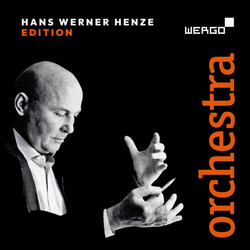
Orchestra is Dieter Schnebel's symphonic music for mobile musicians, composed between 1974 and 1977 and recorded live at the concert for the composer's 70th birthday on 14 March 2000 at the Universität der Künste Berlin. The score asks the players for an improvisation-like playing that remains sensitive to sound and imaginatively shaped, and also for resistance, withdrawal, assertion and agreement.
Schnebel, a German composer, was born in Lahr on 14 March 1930 and died in Berlin on 20 May 2018. He studied in Freiburg, where he also attended Martin Heidegger's classes, then musicology, philosophy and Protestant theology in Tübingen, and worked as a teacher and pastor in Kaiserslautern, Frankfurt and Munich. In 1976 a professorship of experimental music was created for him at the Berlin Hochschule der Künste, the school where this concert took place, and he held it until 1995. The performers are students and teachers of the Universität der Künste and of the Hochschule für Musik "Hanns Eisler", led by three conductors: Jobst Liebrecht, Harry Lyth and Dimitri Kofeinikow. Schnebel valued this recording highly, recalling a performance "very carefully rehearsed, very much in the spirit of the piece", in an impressive and poetic staging in the Hochschule's modern theatre.
The work unfolds as a sequence of short sections whose titles sketch a drama of sound and movement. It begins with Ein-Klang and Aufbrüche (departures) and passes through Zusammen (Phantasien), Rufe (calls), Opfer, a canon and a fugue subtitled Wallungen and Zuckungen. A Sternmarsch, Natur, Strahlenklang – Klangstrahlen and Technologie follow, then a Kehraus and a Trauermusik. Weitergeben (passing on), Auseinander and Trommeln lead to the final Ausklang. The numbering runs to 21, but parts 5, 8, 14 and 17 were never composed.
Orchestra was first performed in Cologne on 20 January 1978 by the Kölner Rundfunk-Sinfonie-Orchester under Ladislav Kupkovic. Its duration is open, between a quarter of an hour and an hour and a quarter; this concert lasted almost 73 minutes. It belongs to the years of Maulwerke (1974), when Schnebel's scores began to prescribe actions for producing sound rather than a fixed result.
CD, Wergo WER 6674 2, released in 2006.