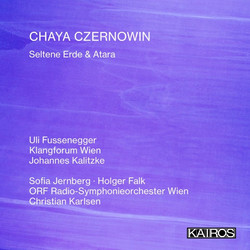
Five orchestral works by Chaya Czernowin, written between 2010 and 2013 and recorded live by five orchestras. The first three form what she calls The Crescendo Trilogy. For Czernowin these pieces mark a turning point, a shift toward a language in which space and gesture are the focus and musical movement is reached through new processes.
Czernowin is an Israeli composer, born in Haifa on 7 December 1957. She studied at the Rubin Academy in Tel Aviv, in Germany on a DAAD fellowship, and took her doctorate at the University of California, San Diego. Since 2009 she has taught at Harvard. The Quiet is played by the Symphonieorchester des Bayerischen Rundfunks under Brad Lubman (Munich, February 2011). Zohar Iver joins Ensemble Nikel and the Berner Symphonieorchester under Mario Venzago (Bern, October 2011). Esh was recorded in Cottbus in June 2012 with countertenor Kai Wessel. White Wind Waiting features guitarist Stephan Schmidt with the SWR Sinfonieorchester under François-Xavier Roth. At the Fringe of our Gaze is played by the West-Eastern Divan Orchestra under Daniel Barenboim, both recorded at Lucerne in 2013.
In each part of the trilogy a different kind of crescendo is central. The Quiet (2010), for large orchestra divided into three groups, ends on an exponential increase in volume. In Zohar Iver (Blind Radiance, 2011), for ensemble and orchestra, the crescendo is cut off by a pedal point before the end. Esh (2012), Hebrew for fire, adds a countertenor to the orchestra. At the Fringe of our Gaze (2012/13), for orchestra and concertino group, is built from highly differentiated layers of sound rising from the depths to the highest register.
At the Fringe of our Gaze was commissioned by Barenboim's West-Eastern Divan Orchestra and the Lucerne Festival. Czernowin wanted it to introduce her music to the orchestra's young players, and it focuses on the border areas of perception. The Quiet was a commission of musica viva in Munich. Across her phases, her music works closely on the character of individual sounds, with refined rhythmic and colouristic nuance, and searches deliberately for emotional extremes. Czernowin has said that she had wished for this change for ten years, and sees the earlier orchestral works as a corridor toward it.
CD, Wergo WER 7319 2, released in 2016, with a 34-page booklet and notes by Harald Hodeige.