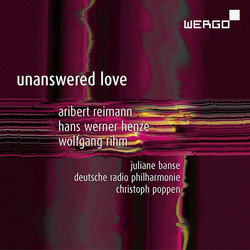
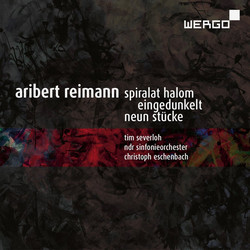
Ein Traumspiel, the first opera by Aribert Reimann, is at last available on CD, in the production of Theater Hof recorded live on 17 March 2018. The double album adds Denn Bleiben ist nirgends, his melodrama for narrator and orchestra on the first of Rainer Maria Rilke's Duino Elegies. Both works show how literature drove almost all of Reimann's writing for the voice.
Reimann was born in Berlin on 4 March 1936, studied composition with Boris Blacher and Ernst Pepping, and died in Berlin in March 2024, aged 88. He wrote nine operas, among them Lear, premiered in Munich in 1978. Ein Traumspiel was composed in 1963-64 on a commission from Theater Kiel and premiered there on 20 June 1965. In Hof Walter E. Gugerbauer conducts the Hofer Symphoniker and the opera chorus, in a staging by Lothar Krause, with Franziska Rabl as Indra's Daughter and fifteen other soloists. Reimann's own verdict on Hof is quoted by Schott: "After 54 years, I heard my 'Traumspiel' just as I had imagined it."
The libretto follows August Strindberg's play Ett drömspel in the German translation by Peter Weiss, arranged by Carla Henius. After a prelude in the clouds, Indra's Daughter passes through thirteen scenes, among them the space before a castle, a lawyer's office, a church, Fingal's Cave and the Shore of Shame. The opera's theme is Strindberg's own, compassion. At the end Reimann has the daughter carry human worries, sufferings and complaints back to the god Indra, wrapped in music of great melodic variety and intensity. The octet Ewiger, erbarme dich sounds in the second Fingal's Cave scene.
In Denn Bleiben ist nirgends Reimann takes a different path. The narrator, here Martin Engler, recites the elegy while the Deutsches Symphonie-Orchester Berlin under Manuel Nawri plays in a broad, expansive style. Reimann wrote that the poem justifies an independent piece of music and is not a pretext for background music. He described the result as "a constant exchange", in which impulses pass between language and music "until each becomes the instrument of the other". The Hof recording was coproduced with Deutschlandfunk Kultur, and the melodrama is a Deutschlandfunk Kultur recording. The set received the Supersonic Award of Pizzicato and a nomination for the quarterly list of the German Record Critics' Award (2/2026).
Double CD, Wergo WER 7381 2, released in 2026, with the libretto in German and English.