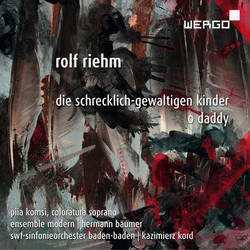
Rolf Riehm
Lenz in Moskau / Im Nachtigallental / Ton für Ton (weiße Straßen Babylons) / Au bord d’une source
This portrait of Rolf Riehm brings together four works from 2007 to 2011, two for ensemble or orchestra and two for solo instruments. The label describes his music as scenic without any stage: human relationships, deeply changed by catastrophic events, are acted out in the sound itself. The programme moves from the poet Lenz to the myth of Orpheus, from a flight over Iraq to a piano piece by Liszt blown up to orchestral size.
Riehm was born in Saarbrücken in 1937, studied musicology and oboe in Frankfurt and composition with Wolfgang Fortner in Freiburg. From 1974 to 2000 he was professor of composition and music theory at the Frankfurt music academy. He died in January 2026. The performers are Ensemble ascolta in Lenz in Moskau, the cellist Erik Borgir, Theo Nabicht on contrabass clarinet, and the recorder player Jeremias Schwarzer with the hr-Sinfonieorchester under Sian Edwards. The disc is a production of Hessischer Rundfunk in co-production with Deutschlandradio.
Lenz in Moskau (2011), for trumpet, trombone, cello, guitar, piano, two percussionists and recorded voices, tells the story of the poet Jakob Michael Reinhold Lenz twice at once, through the instruments and through the voices. The solos of trombone, guitar and above all a singing saw stand for the characters in a drama of failure, isolation and human debasement. Im Nachtigallental (In the Valley of Nightingales, 2007) for solo cello goes back to the Orpheus myth. When his singing head, nailed to his lyre, washes ashore on Lesbos, the nightingales break into song, and so poetry came into the world. The cellist changes roles constantly, playing the river, the singing head, the sea, the landscapes and their creatures.
Ton für Ton (weiße Straßen Babylons) (Note for Note, White Streets of Babylon, 2007) starts from a plane flight over Iraq: white desert roads are visible below, while a war that cannot be seen from that height rages in the land of two rivers. Riehm chose the contrabass clarinet to carry the estrangement, powerlessness and paralysis of the scene. In Au bord d'une source (2007) for tenor recorder, orchestra and electronic tape, Liszt's piano piece from the Années de pèlerinage is quoted here and there, monstrously enlarged by the full orchestra. It is not a piano concerto but a concerto for recorder.
CD, Wergo WER 7314 2, released in 2014 (69'05").