Manfred Trojahn's Second String Quartet of 1979/80 is a quartet with an unusual pair of guests: a clarinet and a mezzo-soprano, who join the strings for three poems by Georg Trakl. This is the first recording of the work, prepared in close collaboration with the composer. It captures a young composer searching for his own language in the early days of what we would now call the postmodern period.
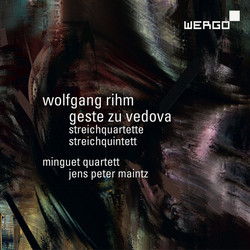
Trojahn is a German composer, flautist, conductor and writer, born in 1949 in Cremlingen in Lower Saxony and best known today for his operas. The quartet was commissioned by Radio France, and he worked on it during a stay at the Villa Massimo in Rome in 1979/80. What looked like a golden opportunity turned into a difficult period in his life, and the music carries its traces. The performers are the Minguet Quartett, mezzo-soprano Tanja Ariane Baumgartner and clarinettist Thorsten Johanns. The recording is a co-production with Deutschlandradio, made with the support of the Kunststiftung NRW.
The work lasts almost 56 minutes and is laid out in seven movements. Voice and clarinet appear only in the second, fourth and fifth (Melancholie, Der Schlaf, In Venedig), the three Trakl settings. The other four movements are for strings alone and, as the release notes point out, can also be played as a traditional string quartet. The music moves restlessly between emotional outbursts, stasis, brusqueness and moments of almost tender lyricism. The sixth movement, Bagatelle, scherzo frammento (Hommage à L.v.B.), is an ironic nod to the Classical tradition that lasts barely half a minute. The closing Abgesang (Farewell) gathers material from earlier sections: restless fluttering motifs, elegiac cantilenas and bizarre clusters.
Trojahn was never interested in atonal dogma. The tonal relationships in this score point to many sources, Romantic composers among them, and the release notes describe the piece as a key work of early postmodernism. Its scoring sits somewhere between string quartet, song cycle and chamber cantata, and the instrumental movements frame the songs like a narrative around them. For the composer it is a very personal work, which is why he followed the preparation of this recording so closely.
CD, Wergo WER 7383 2, released in 2019, first recording.