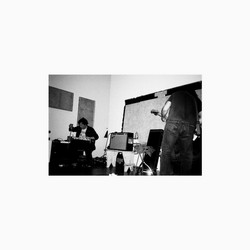
Per Samie is not a studio product in the conventional sense but the trace of a small, specific scene unfolding in real time at Studio Guerra in Pisa. Three friends - Matias Guerra on prepared guitar, Valerio Leg on electric guitar, Falco Baldaya on synth and piano - gather not around a score, but around a plant placed at the center of the stage, a living object turned into a quiet focal point. The music happens in a circle around it: sounds, vibrations, intentions radiate outward and inward, as if every gesture were addressed as much to this mute presence as to the people in the room. A few others watch in silence while Berto moves through the space taking photographs, fixing instants while the performance keeps slipping forward. The recording is simply what remained when the evening was over.
The atmosphere of Per Samie is intimate but not closed; it feels like a private ritual that happens to leave the door ajar. Guerra’s prepared guitar brings a tactile, almost percussive vocabulary to the trio, transforming strings into small machines, rustling surfaces, metallic afterimages. Leg’s electric guitar often moves in the opposite direction, drawing out sustained tones, fragile chords, and feedback halos that stretch the moment rather than punctuate it. Baldaya, alternating between synth and piano, works as both glue and disturbance, filling the air with soft harmonic fog one second and sending single notes or filtered pulses across the stereo field the next. The interplay is patient, with plenty of room for hesitation and misalignment; what holds it together is not genre but a shared willingness to listen longer than is comfortable.
The plant at the center is more than a visual curiosity. It models the kind of listening the trio seems to aspire to: receptive, non-judgmental, sensitive to the smallest shift in pressure or vibration. As the set unfolds, the music gravitates toward that mode. Volume stays mostly modest; there are no heroic solos, no obvious climaxes. Instead, meaning is built from accumulations: the way a prepared scrape finds an answering resonance in the piano’s low register, the moment when a held synth tone quietly bends to meet a guitar harmonic, the sudden decision to leave space and let the room noise breathe. Berto’s photographs, though absent from the audio, haunt the recording as an invisible framework - knowing that each instant might be frozen in an image seems to push the musicians to treat time as a sequence of frames, each with its own internal balance.