Various
Siemens-Studio Für Elektronische Musik
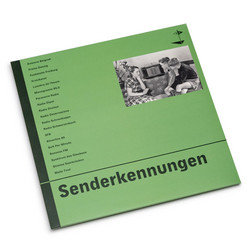
Easily among the most important documents of electronic music's early history, Siemens-Studio Für Elektronische Musik assembles 19 compositions created between the late 1950s and mid-1960s at the legendary Siemens Studio for Electronic Music in Munich - the first programmable recording studio ever built - under the artistic direction of Josef Anton Riedl. Originally issued on CD in 1998 by the Siemens Kultur Programm and compiled by Riedl himself, this remarkable collection gathers works by Herbert Brün, Mauricio Kagel, John Cage, David Tudor, Dieter Schnebel, Milko Kelemen, Ferdinand Kriwet, Paul Pörtner, and Riedl, offering an unparalleled window into one of the 20th Century's most groundbreaking creative laboratories. With a foreword by Pierre Boulez and extensive liner notes, this is an essential artefact for anyone interested in the origins of electronic and electroacoustic music.
The story of the Siemens Studio begins in 1955, when Carl Orff, commissioned by the Siemens corporation to consult on a promotional film, recommended the young composer Josef Anton Riedl to create its soundtrack. Riedl was given access to the company's electroacoustic research laboratory in Gauting, near Munich, where he not only produced a striking electronic score for the 1959 film Impuls unserer Zeit - which went on to win the Bundesfilmpreis - but, working alongside Siemens engineers Helmut Klein and Alexander Schaaf, developed an entirely new arsenal of analogue sound generators, filters, and mixing consoles. Impressed by the results, the music-loving company director Ernst von Siemens decided to establish a permanent, purpose-built studio in the basement of the Siemens headquarters at Oskar-von-Miller-Ring in Munich, officially inaugurated on April 1, 1960.
What followed was roughly a decade of extraordinary creative activity, during which Riedl, as the studio's artistic director, invited the cream of the international avant-garde to compose, experiment, and push the boundaries of what sound and music could be. Pierre Boulez, Henri Pousseur, Györgi Ligeti, Mauricio Kagel, John Cage, Karlheinz Stockhausen, David Tudor, and Ernst Krenek, among numerous others, all passed through its doors. The studio's technical configuration - featuring 20 sine wave generators, a sawtooth generator, a noise generator, a Siemens vocoder originally developed for wartime speech encryption, a Hohnerola, and a pioneering punch-tape control system that effectively made it the world's first programmable synthesizer - offered composers an unprecedented palette of sonic possibilities, rivaling the better-known studios in Cologne and Paris.
The compilation opens with Herbert Brün's Wayfaring Sounds (Klänge Unterwegs), composed in 1961, a shimmering, restless study in electronic timbres by the German-Israeli composer who would go on to become a pivotal figure at the University of Illinois. Mauricio Kagel's legendary Antithese follows - originally conceived in 1962 as a composition for electronic and public sounds, later adapted for stage performance and realized as an experimental film in 1965 - a work that stands as one of the Argentine-German composer's most radical achievements. Also present is Kagel's realization of John Cage's Imaginary Landscape No. 3, originally scored in 1942 for six percussionists and electronic sounds, here brought into the electronic domain in a production for Radio Bremen.
At the collection's core are four studies by Josef Anton Riedl himself - Studie Nr. 59, Nr. 61, Nr. 62/1, and Nr. 62/2 - which document the studio director's own evolving investigations into the medium he helped create. Further highlights include Milko Kelemen's Komposition Nr. 3 for electronic and concrete sounds and voice, co-produced with NDR; Ferdinand Kriwet's JAJA - Hörtext 2 and Paul Pörtner's Schallspielstudie 2, both exploring the electronically manipulated human voice as raw compositional material; and Riedl's haunting electroacoustic score for Salvador Dali and Luis Buñuel's silent film Un chien andalou. The program extends to Riedl's Komposition Nr. 2, the immersive Ki-No - a nocturnal serenade for projectors and listeners - pieces produced for CBS Television Network, Milko Kelemen's Judith for orchestra and electronically altered orchestral sounds, Dieter Schnebel's Leonce und Lena, and Cage and David Tudor's punch-tape controlled Experiments in Sound. A concluding lecture by Riedl with sound examples rounds out this remarkable panorama.
In 1964, the studio was transferred to the Hochschule für Gestaltung in Ulm, where it remained operational until 1967 before being stored and eventually forgotten in a basement. It was Riedl himself who, in the early 1990s, tracked down the equipment and initiated its preservation. Since 1993, the Siemens Studio has been on permanent display at the Deutsches Museum in Munich, with most of its components still in working order - a tangible monument to one of the most daring chapters in the history of electronic sound. This compilation, with its accompanying 20-page booklet featuring a foreword by Pierre Boulez and detailed documentation of the studio's history and technical capabilities, remains the definitive sonic document of that extraordinary chapter.