Huge Tip! Edition of 300, one-time pressing. A disappearing world made audible. Since the late 1970s, Christina Kubisch has dedicated her practice to the acoustic revelation of invisible forces - transforming the electromagnetic hum of surveillance systems, data centres, and power grids into a vocabulary of unexpected musicality. With Tuning, Faitiche welcomes this foundational figure of sound art into its catalogue, presenting three compositions that span two decades yet share a singular conviction: what we dismiss as non-music may be the most compelling music of all.
Kubisch belongs to a rare lineage - artists who emerged from the productive friction between visual art, classical training, and electronic experimentation during the 1970s. A flautist and painter before becoming a composer, she studied electronic music in Milan and began developing her custom electromagnetic induction system in 1978 - years before "sound art" solidified as a category. Her Electrical Walks, initiated in 2003, have since guided thousands through the hidden acoustic topographies of cities worldwide, revealing the strange polyphony that hums beneath everyday surfaces.
Gaming in Silence (2024), the album's most recent composition, was commissioned for the Sound Dome at ZKM Karlsruhe. Drawing from recordings made in the institution's server rooms and its permanent collection of historical computer games - including Atari's Asteroids (1979) and the East German Poly-Play (VEB Polytechnik, 1986) - Kubisch constructs a collage where electromagnetic waves and abstract textures interweave with her recording of a Chinese song about silence. The analogue emissions of vintage gaming hardware, with their peculiar densities and rhythmic patterns, become raw material for what Kubisch describes as "painting an abstract picture" - layering and overlapping source material until a distinctive sound space emerges. Tom Thiel's electronic sound processing and Eckehard Güther's precise engineering complete the transformation.
Two persons walking through a street in Madrid (2004) captures a remarkable experiment in electromagnetic conceptualism. Kubisch and Spanish composer Miguel Álvarez-Fernández set off from opposite ends of a major shopping street in Madrid, both wearing the custom headphones that render electromagnetic fields audible. They met briefly in the middle, then continued to opposite ends - each recording their journey through surveillance gates, ATMs, neon signs, and the invisible infrastructure of commercial space. The two recordings, layered over one another, reveal how the same electromagnetic environment yields radically different sonic experiences depending on movement and position. Here, the boundary between artist and participant dissolves entirely.
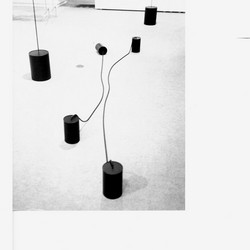
Diapason (2009 version) operates in an entirely different register. Part of a series exploring "non-instruments" or instruments that no longer exist - electrical mine bells, historical glass harmonicas, medical tuning forks - the piece works with fifteen diapasons originally used by doctors to test patients' hearing. Recorded at the Elektronisches Studio of TU Berlin, even the decay of each fork remains audible. Frequencies range from 64 to 2048 Hz, adjustable at micro-intervals using small movable weights. The sequence and duration of pauses are dictated by chance, never defined in advance. This version was created for an installation at Korskirken, the historic Holy Cross Church in Bergen, where visitors could enter and leave at will, deciding for themselves where and how long to listen as sounds emerged from small loudspeakers placed across the apse floor.
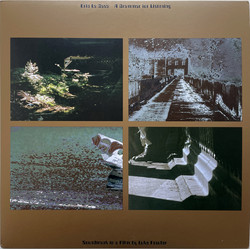
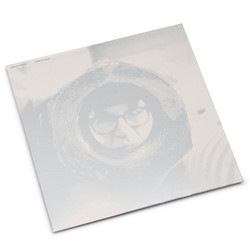
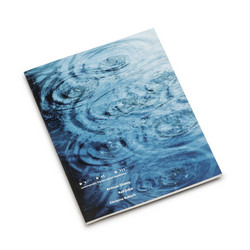
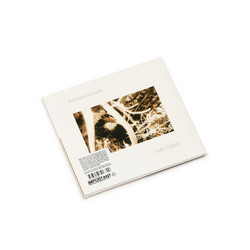
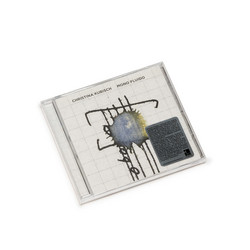
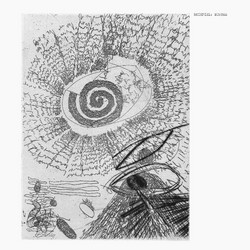
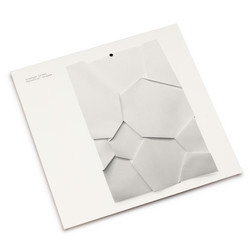
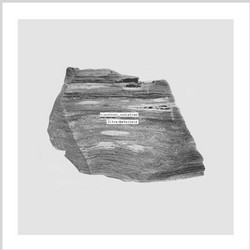
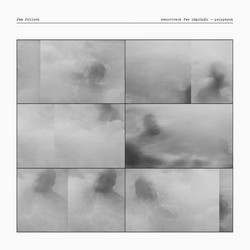
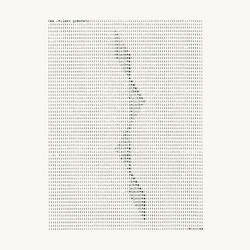
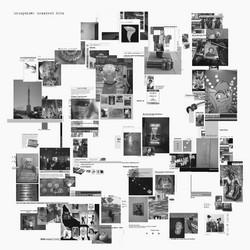
Together, these three works embody Kubisch's essential project: attending to what we've trained ourselves not to hear, finding composition where conventional listening perceives only interference, obsolescence, or silence. Giuseppe Ielasi's mastering ensures each frequency speaks with clarity; Tim Tetzner's design - featuring Kubisch's own Transitionen (2021), sonagrams of electronic waves rendered as visual form - extends the album's core premise onto its surface.
For those familiar with Faitiche's curatorial intelligence - its attentiveness to the spaces between documentation and composition - Tuning arrives as both expansion and confirmation. In Kubisch, Jan Jelinek's imprint finds a kindred sensibility: an artist for whom listening has always been a form of making, and recording a kind of revelation.


![data-cosm [n°1]](https://cdn.soundohm.com/data/products/2026-02/ikedda-data-cosm-1-jpeg.jpeg.250.jpg)