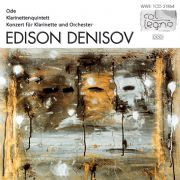
Edison Denisov
Spring Coming / Requiem (LP)
condition (records/cover): NM / VG+ (light sticker removal residue on front and light general wear)
The name is not a coincidence. Edison Denisov was born in 1929 in Tomsk, Siberia, to a father who named him after Thomas Edison out of a deep belief in invention. The son took this literally. In a Soviet musical culture policed by the Union of Composers and shaped by the dictates of Tikhon Khrennikov, Denisov became the central figure of an underground - composing in the shadow of Shostakovich's encouragement, smuggling scores westward, building clandestine connections to Pierre Boulez, Darmstadt, and the French avant-garde while never leaving the Moscow Conservatory where he taught for nearly four decades.
In 1979 he was blacklisted as one of "Khrennikov's Seven" for unauthorized participation in Western festivals. The irony of this LP's existence on Melodiya - the Soviet state label - is not lost. Spring Coming is an early orchestral work, lyrical in impulse and shot through with the rhythmic complexity and folk-derived heterophony that mark Denisov's mature voice. The Requiem (1980) is his most personal statement: scored for soprano, tenor, mixed chorus, and orchestra, it sets multilingual texts by the German writer Francisco Tanzer alongside liturgical fragments, moving through five phases - birth, childhood, love, family, death - with a tonal gravity that returns, throughout its oblique harmonics and microtonality, to D major as the symbol of Deus. Denisov drafted it in eighteen days between acts of his opera. "While composing the Requiem," he said, "I was thinking of the cross that I carry in my life." He died in Paris in 1996, following an accident.