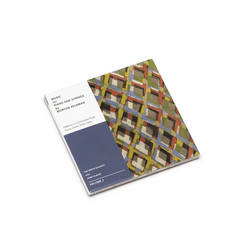
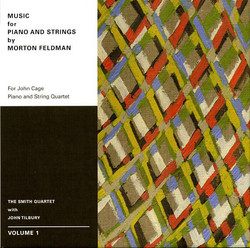
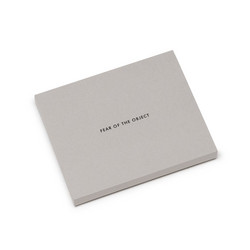
Morton Feldman, John Tilbury
Palais de Mari
*300 copies limited edition* "Feldman used to say that music is not so much an ‘art-form’ as a ‘memory-form’. Scientific research informs us that personal memories are not stored in one stable unchanging state, but that each time we retrieve a memory, it is slightly modified.
We hear the opening four-note gesture of this work, it soon passes, but the resulting resonance from the sustaining pedal remains a little longer, and then only a delicate memory trace is left. This opening gesture is heard three times. It will recur many more times in the course of the piece but it is never quite the same. It remains recognisable but is not definitively fixed. Kept malleable through numerous small changes of nuance, tessitura, timing and intervallic change. The composer referred to such changes as ‘re-spellings’. The results are curiously analogous to memory variants.
As the music continues, our absorbing consciousness registers the shades of similarity and difference. Oral cultures know well that repetition, even when re-spelled, is an unrivalled aide-mémoire, but this music is not spinning a repetitive, self-referential cocoon in which we can get lost. Here time is moving on through new elaboration and growth, while the composer’s sensitivity to touch and the inherent beauty of the piano sound, keeps us tightly glued to each passing moment.
But let us not get ahead of ourselves. Before we hear even the first few notes, there is the enigmatic title to consider - Palais de Mari - the Palace at Mari. Feldman obviously intended for us to hear his composition through this lens. The title refers to the ruins of the ancient royal palace in the city of Mari (now in Syria) which flourished around 2900 BCE, was destroyed around 2500 BCE, rebuilt and flourished again until 1759 BCE. This title therefore opens up an immense cultural/historical perspective as the context for the work, summoning deeper layers of our human cultural history than we might have expected. Even Feldman’s use of French rather than English for this title can be seen as appropriate, considering that his confrontation with the Palais de Mari was not at the Syrian archaeological site itself, but in France, viewing some of its surviving artefacts on display in the Louvre. (Most of the archaeological site was destroyed by Islamic State in 2015.)
The composer once asked “What aspects of music since Monteverdi might determine its atmosphere if heard 2000 years from now?”. That is difficult to answer, but those carefully preserved artefacts from the Palace of Mari were made by people more than twice that distance from us today. Sadly, it is all that remains, and yet, through the potency of these few objects, here we are in the 21st century pondering over that remote place before we hear a piano piece composed in 1986, a year before the composer’s death, when John Tilbury played it in Iceland in 2012.
“Music is a memory-form.”
Apart from cultural memories, we all know how potently some personal memories can be triggered by particular pieces of music. For John Tilbury himself, the preparation and performance of Palais de Mari must have brought back many memories of working closely with Feldman himself more than half a century ago, a time when Feldman’s name was scarcely known beyond a very small band of persistent but determined enthusiasts like John. This memory, allied to John’s integrity as an artist, now connects us to the music, giving this particular performance its unique authenticity.
I consider myself fortunate to have been present that day in Reykjavík." - Frank Denyer