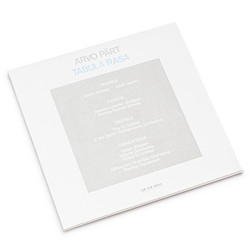
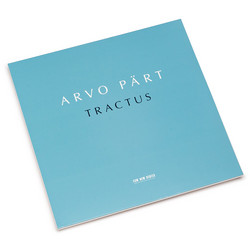
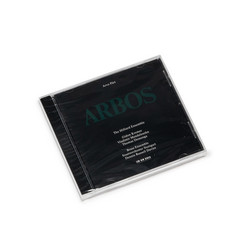
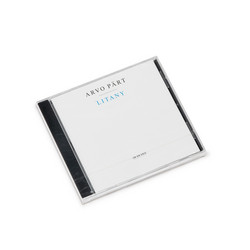
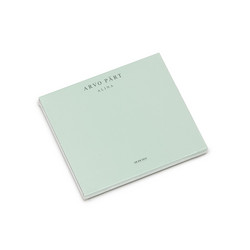
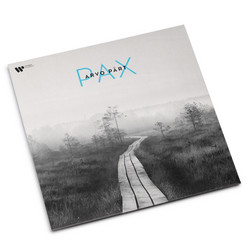
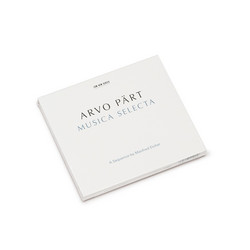
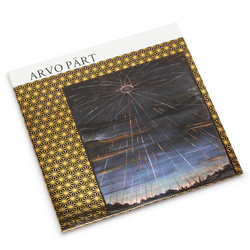
condition (record/cover): NM / EX Gatefold sleeve with booklet attached inside.
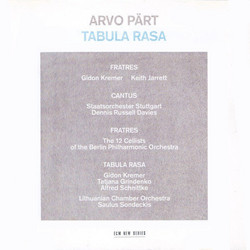
In 1976, Arvo Pärt emerged from eight years of near-total compositional silence with a method so radical in its simplicity it confounded everyone around him. He called it tintinnabuli - from the Latin for bells - and it comprised just two voices: one moving in pure triadic harmony, one in stepwise motion. From this austerity, he derived everything. Tabula Rasa, recorded in 1977 and issued by ECM in 1984, became its first and most celebrated monument.
Pärt was born in 1935 in Paide, Estonia, then under Soviet occupation. His early career moved through neoclassicism and serialism toward an increasingly confrontational relationship with Soviet cultural ideology - a 1968 performance of his Credo was effectively banned. The silence that followed was spent in intensive study of Gregorian chant, early polyphony, and Russian Orthodox music. What he found there, and what the tintinnabuli method distilled, was a form of radical reduction: music stripped to the architecture of a single harmonic decision, held long enough that the listener has no choice but to enter it.
The LP presents three works. Fratres - performed by Gidon Kremer, Keith Jarrett, and the Academy of St. Martin in the Fields - takes a single harmonic field through nine variations, each iteration altering texture while the underlying material stays constant, like light changing on a fixed surface. Cantus in Memoriam Benjamin Britten, performed by the same ensemble under Neville Marriner, is a descending scale distributed across strings and bell - eight minutes that give grief, against all expectation, its most accurate possible form.
The title work is a double concerto for two violins, string orchestra, and prepared piano - Kremer and Tatjana Grindenko as soloists, Alfred Schnittke at the prepared piano, the Lithuanian Chamber Orchestra under Eri Klas. Its two movements - Ludus and Silentium - move from an almost playful rhythmic energy into a sustained quiet so complete it seems to alter the temperature of the room.
One of the essential records of the 20th century. Original ECM pressing.