Through The Billboard Promised Land Without Ever Stopping captures Derek Jarman at a moment when his imagination was spilling equally onto page and screen. Written in 1971 and presented here in Jarman’s own voice, this recording documents his only known work of narrative fiction - a fact that immediately lends it the aura of a missing puzzle piece. What we hear is not a conventional story but a visionary sketchbook in prose: a surreal, hallucinatory fairytale whose signposts are billboards and motels, chromatic deserts and psychic weather, all pointing toward the alchemical dreamscapes that would later crystallise in films such as Blue. The promised land of the title is less a destination than a mirage, an endlessly deferred horizon shimmering over a landscape saturated with colour and symbol.
The narrative itself is deceptively simple. A young blind king, Amethyst, travels across a mythical America with his valet John, journeying without clear destination or purpose. Around this slender premise, Jarman builds a dense weave of mythic and archetypal elements: kings and servants, roads and thresholds, deserts and oceans, all flickering between folktale, queer reverie and pop‑cultural detritus. Modernity intrudes in the form of highways, billboards and neon, yet the atmosphere remains timeless, closer to dream logic than to realist travelogue. Amethyst’s blindness is crucial here, transforming the journey into a kind of inner cinema where landscapes are felt as colours, textures and desires more than as fixed locations. The result is a road story in which movement matters more than arrival, a pilgrimage through states of mind rather than across a map.
What makes the piece so compelling is the way it folds autobiography and symbol into the same current. Tantalising personal traces surface between the lines: hints of Jarman’s own youth, his sexuality, his fraught relationship with England and attraction to other, imagined geographies. These details are never foregrounded as confession; instead, they shimmer within a “panoply of chromatic landscapes and psychosexual symbols”, where colour takes on talismanic weight and desire becomes another form of navigation. Shades and hues behave like characters, echoing the later monochrome intensity of Blue, while recurring motifs of bodies, mirrors, and doubled identities sketch a queer mythology that feels both deeply personal and broadly archetypal.
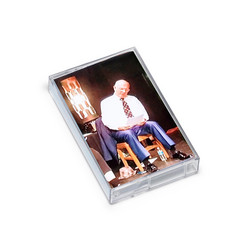
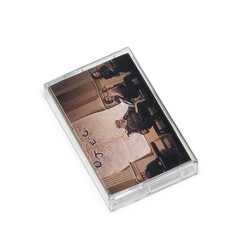
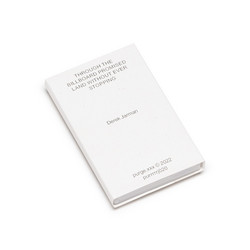
This vinyl edition restores the work to the tactile, visual context it deserves. Previously available only on a limited cassette release in 2022 (Prototype Publishing, Ltd 80), the album now arrives accompanied by facsimile images of Jarman’s handwritten drafts, drawn from his archive. The pages reveal the story as a living process - crossings‑out, marginalia, shifts in phrasing - and bring the listener closer to the moment of its making. Interleaved with these are photographs by Michael Ginsborg, a close friend of Jarman during the period of the story’s writing. His images act less as illustration than as parallel visions, expanding the book’s atmospheres of estrangement, beauty and latent menace into still frames.
Licensed from House Sparrow Press / Prototype Publishing and the Estate of Derek Jarman, Through The Billboard Promised Land Without Ever Stopping stands as both a key document and a self‑sufficient artwork: an intimate encounter with Jarman’s voice, a slipstream text that bridges his early poetic experiments and the radical film work to come, and a reminder that some journeys matter precisely because they refuse to end, or to resolve, in any conventional sense.