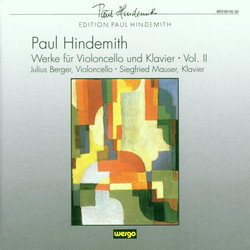
Early works tend to show where a composer starts from and where his own voice first breaks through, and Hindemith's pieces for cello and piano from 1917 and 1919-21 are a clear case. Julius Berger and Siegfried Mauser play the Three Pieces, Op. 8, and the Sonata, Op. 11 No. 3, on the first volume of their Wergo survey of this music.
Paul Hindemith (1895-1963), the German composer, was born in Hanau and began on the violin in 1906; he studied composition in Frankfurt until 1917, the year of the Op. 8 pieces. He was known first as a violist, founding the Amar Quartet in 1921, and much of his chamber music grew from that practice. Berger, cello, and Mauser, piano, went on to record the complete works for cello and piano for Wergo across two volumes; Mauser then began a complete recording of Hindemith's piano music for the label.
The Stücke für Violoncello und Klavier, Op. 8, of 1917 are a Capriccio, a long Phantasiestück and a Scherzo. The score is dated 6 March 1917, and the cellist Maurits Frank and the pianist Willy Renner played them in Frankfurt six days later. Here the starting point is audible: the piano writing and the harmony carry the clear influence of Max Reger and Richard Strauss. The Sonate für Violoncello und Klavier, Op. 11 No. 3, is a different matter, with a longer history. A first version of 1919, numbered Op. 11 No. 6 in the manuscript, was played in Frankfurt on 27 October 1919 by Frank and the pianist Emma Lübbecke-Job. Hindemith revised it in 1921, and only the middle movement of the first version survives intact, taken into the new one. The revised sonata was first heard in Munich on 5 February 1922, played by his brother Rudolf Hindemith with Franz Dorfmüller. Its first movement is marked "Mässig schnelle Viertel, viel Kraft" (moderately fast quarters, with much force), followed by a slow movement and a very lively finale that run together. In this sonata the features of Hindemith's style of the 1920s are already present, the style that made him notorious as a musical enfant terrible.
The two works together last about 46 minutes. Heard side by side, they show in a short span the change from a gifted pupil of the late-Romantic tradition to the young modernist of the Weimar years. The booklet places both works within the young composer's aesthetic development.
CD, Wergo WER 60144-50, released in 1988, in the Edition Paul Hindemith.