Various Artists
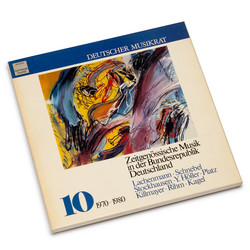
Zeitgenössische Musik In Der Bundesrepublik Deutschland 4 (1950-1960) (3LP box)
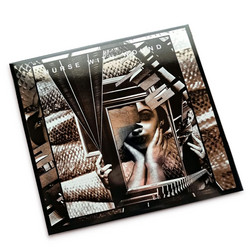
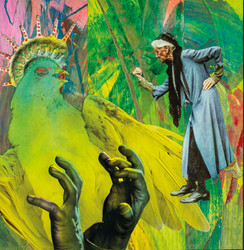
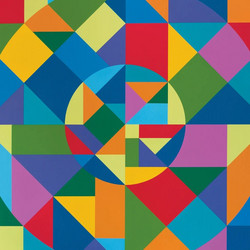
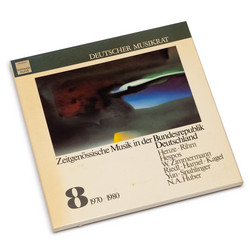
condition (records/box): NM / NM Insert included. | Volume 4 of the Deutscher Musikrat's documentation of contemporary music in the Federal Republic of Germany, and the first of the series to confront the decade in which West German composition tore itself apart and remade itself from the ground up. If Volumes 1 and 2 documented the postwar settlement - the careful reconstruction of a usable tradition - this volume is the sound of that settlement being dynamited. The cover art is Joseph Beuys's Sibirische Symphonie (1963), from the van der Grinten collection: a fitting emblem for a set in which the very question of what music could be was violently reopened.
The first two sides belong to the twin poles of the 1950s avant-garde. Hans Werner Henze's Nachtstücke und Arien (1957), after poems by Ingeborg Bachmann, fills Side A - nearly twenty-five minutes of ravishing, sensuous orchestral writing with Edda Moser as soprano soloist and the Rundfunk-Sinfonie-Orchester Köln under Christoph von Dohnányi. This was the piece that made the break between Henze and Darmstadt irreversible: lush, lyrical, unapologetically expressive at a moment when the serialists demanded austerity. Side B answers with Karlheinz Stockhausen's Gruppen für 3 Orchester (1955-57), the legendary score for three orchestras and three conductors - here Stockhausen himself with Pierre Boulez and Bruno Maderna, again with the Rundfunk-Sinfonie-Orchester Köln. Two radically incompatible visions of what the future of German music should sound like, placed back to back. The set makes no attempt to resolve the contradiction.
The third side plunges into the experimental fringe. Hans G. Helms's Daidalos (1960), the third scene from his seven-scene composition for four vocal soloists and instrumental ensemble - with Alfons and Aloys Kontarsky at the pianos, Christoph Caskel on drums, and Hans Otte conducting - belongs to the most radical wing of the Cologne school, a work in which language itself is subjected to serial procedures. Dieter Schnebel's Deuteronomium 31,6 (1956-58) for fifteen solo voices, performed by the Stuttgarter Schola Cantorum under Clytus Gottwald, extends the dissolution of text into pure vocal sound. Mauricio Kagel's Anagrama (1957/58) for four soloists, speaking chorus and chamber ensemble closes the side - Kagel conducting his own score with Cornelius Cardew on celesta and the Kontarsky brothers again at the pianos. Three works that between them map the outer limits of what the Cologne-Darmstadt axis was capable of.
Side D returns to the question of opera and dramatic music. Winfried Zillig's Die Verlobung in St. Domingo (1957), a radio opera after Heinrich von Kleist with Bernhard Minetti as narrator and the Sinfonieorchester des Norddeutschen Rundfunks under the composer's direction, represents the considerable body of work by composers who continued to operate within more traditional frameworks while absorbing selected modernist techniques. Giselher Klebe's Raskolnikows Traum (1956), a dramatic scene for soprano, solo clarinet and orchestra with Annelies Kupper and the Rundfunk-Sinfonie-Orchester Köln under Nino Sanzogno, is a compressed, expressionist scena that distills Dostoevsky into sixteen minutes of high tension.
The final two sides survey the broader landscape. Karl Höller's Serenade for wind quintet Op. 42a (1955), with Eduard Brunner on clarinet, is polished neo-classical chamber music of the highest order. Siegfried Borris's Partita für Cembalo Op. 67 Nr. 1 (1951) is a late arrival from the Hindemith orbit - sturdy, contrapuntal keyboard writing. Fritz Büchtger's Die Verklärung (1955) for baritone, women's voices and strings, conducted by the composer, is a work of quiet intensity from Munich's independent musical underground. Harald Genzmer's Konzert für Flöte und Orchester (1954), with Gustav Scheck as soloist and the Berliner Philharmoniker under Gustav König, is a major concerto from Hindemith's most gifted pupil - brilliantly written for the instrument, with a directness that must have seemed positively scandalous at Darmstadt. The set closes with Hans Ulrich Engelmann's Ezra Pound Music Op. 21 (1959), performed by the Symphonieorchester des Bayerischen Rundfunks under Witold Rowicki - a rare and fascinating score that engages with Pound's own musical experiments.
3LP box set with 44-page booklet featuring essays by Carl Dahlhaus, Rudolf Stephan, Hans Rudolf Zeller, Werner Klüppelholz, Ute Schalz-Laurenze and others. Cover design by Roberto Patelli. Released on Deutsche Harmonia Mundi / EMI Electrola, DMR 1010-12. Recordings from Westdeutscher Rundfunk, Norddeutscher Rundfunk, Bayerischer Rundfunk, Südwestfunk, Süddeutscher Rundfunk, Radio Bremen and Polydor International.