Various Artists
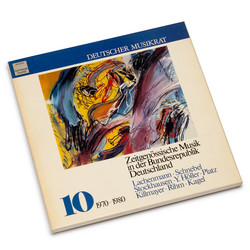
Zeitgenössische Musik In Der Bundesrepublik Deutschland 8 (1970-1980) (3LP box)
condition (records/box): NM / NMInsert included. | Volume 8 of the Deutscher Musikrat's landmark documentation of contemporary composition in the Federal Republic of Germany, covering the decade 1970-1980. Where volumes 9 and 10 in the series focused on orchestral and large-scale works, this installment casts a wider net across chamber music, vocal music, solo pieces and ensemble work, offering a fascinatingly diverse cross-section of West German compositional thought during one of its most fertile and contentious periods.
The set opens with seven movements from Hans Werner Henze's Voices (1973), the great song cycle for mezzo-soprano, tenor and instrumental groups - settings of poems by Bertolt Brecht, Erich Fried, Hans Magnus Enzensberger and others, performed by Hanna Schwarz and Paul Sperry with the London Sinfonietta under David Atherton. Henze's politically engaged lyricism makes a striking counterpoint to what follows: Wolfgang Rihm's Sub-Kontur (1974/75), a full side of dense, eruptive orchestral writing composed when Rihm was barely twenty - one of the key early scores in his neo-expressionist turn away from the Darmstadt orthodoxy, performed here by the Sinfonieorchester des Südwestfunks under Ernest Bour.
The middle discs move into more radical territory. Hans-Joachim Hespos's Čang (1976), a fierce solo for cimbalom played by Katérina Zlatníková, is paired with Walter Zimmermann's Ländler-Topographie (1978), a work that subjects the ghost patterns of Bavarian folk dance to a process of cartographic abstraction - landscape as compositional method. Josef Anton Riedl's Glas-Spiele (1974-1977), scored for self-built glass instruments and performed by an ensemble including Robyn Schulkowsky and Lorenzo Ferrero under the composer's direction, remains one of the most singular documents of the German experimental fringe. Peter Michael Hamel's Gestalt für Orchester (1980) rounds out the disc with a work rooted in his distinctive synthesis of non-Western musical thinking and European orchestral tradition.
The final disc is devoted to chamber and solo works. Mauricio Kagel's Programm (1971/72) is presented complete in four movements - Recitativarie for a singing harpsichordist (the incomparable Gerd Zacher), Die Mutation for men's choir and piano, Charakterstück for zither quartet, and Siegfriedp' for solo cello performed by Siegfried Palm - a characteristic sequence of Kagel's sly, theatrical subversions of instrumental convention. Isang Yun's Piri (1971) for solo clarinet, performed by Eduard Brunner, channels the ornamental language of Korean court music through a thoroughly modernist solo voice. Mathias Spahlinger's Vier Stücke (1975) and Nicolaus A. Huber's Dasselbe ist nicht Dasselbe (1978) for snare drum and whistling close the set - Huber's piece, in particular, a riveting exercise in stripping percussion down to its most elemental gestures.
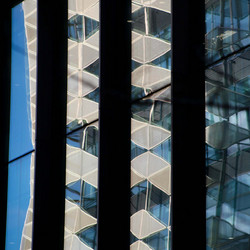
3LP box set with booklet containing essays by Carl Dahlhaus, Josef Häusler, Gerd Zacher, Gisela Gronemeyer and others. Cover art photography by Gerhard Richter. Released on Deutsche Harmonia Mundi / EMI Electrola. Recordings from Südwestfunk, Westdeutscher Rundfunk, Bayerischer Rundfunk, Saarländischer Rundfunk and Süddeutscher Rundfunk.